Brown tree snake could mean Guam will lose more than its birds
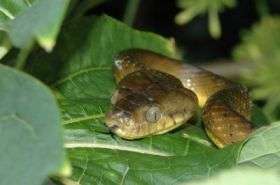
In the last 60 years, brown tree snakes have become the embodiment of the bad things that can happen when invasive species are introduced in places where they have few predators. Unchecked for many years, the snakes caused the extinction of nearly every native bird species on the Pacific island of Guam.
A variety of other damage has been directly attributed to brown tree snakes, including large population losses among other native animal species in Guam's forests, attacks on children and pets, and electrical power outages.
But new research by University of Washington biologists suggests that indirect impacts might be even farther reaching, possibly changing tree distributions and reducing native tree populations, altering already damaged ecosystems even further.
"The brown tree snake has often been used as a textbook example for the negative impacts of invasive species, but after the loss of birds no one has looked at the snake's indirect effects," said Haldre Rogers, a UW doctoral student in biology.
"It has been 25 years since the birds disappeared. It seems to me the consequences are going to keep reverberating throughout the community if birds are fundamental components of the forest," she said.
Birds typically make up a small part of the life of a forest, but they are important for pollination, spreading seeds around the forest and controlling insects that feed on plants. Guam, an island 30 miles long and 5 to 15 miles wide about 3,800 miles west of Hawaii, lost most of its native birds after the brown tree snake was introduced by accident from the Admiralty Islands following World War II. The snake has few predators on Guam, so its population density is quite high – estimated at more than 3,000 per square mile – and some individuals there grow to an unusual size of 10 feet long.
Before introduction of the brown tree snake, Guam had 12 species of native forest birds. Today 10 of those are extinct on Guam, and the other two species have fewer than 200 individuals. Though Guam has some non-native bird populations, few other birds moved in when native species died out, and none of them live in the forest. That leaves few birds to consume tree seeds and then drop them away from the trees.
That could have two possible negative impacts on the native forests, Rogers said. First, some plant species need birds to handle their seeds to ensure effective germination. In addition, seed predators and fungi that kill seeds are often found in high density directly beneath a parent tree, so the trees rely on birds to disperse seeds beyond the range of those negative effects. If native birds performed those functions on Guam, tree populations could suffer from the loss of birds. It appears 60 percent to 70 percent of tree species in the native forests are dispersed, at least in part, by birds, she said.
To test the effects of the loss of native birds on seed distribution, Rogers devised seed traps that look a bit like satellite dish receivers, with tubing bent into a circular shape and covered with fine mesh screen-door netting. She set 119 traps beneath and near Premna obtusifolia, or false elder, trees on Guam and the nearby island of Saipan, which does not have brown tree snakes. For each tree sampled, she set two traps directly beneath the tree's canopy, two about 3 feet away, three at 16 feet, three at 33 feet and seven at 65 feet.
On Saipan, Rogers and her colleagues found seeds in nearly every trap at each distance, though more seeds were found in closer traps and fewer farther away. However, on Guam the seeds appeared only in traps directly beneath the canopy. What's more, most of the farther-dispersed seeds from traps on Saipan had the seed coats removed, a factor that could speed seedling germination and the growth of new trees and something that likely could only be accomplished in the gut of a bird. None of the seeds found on Guam had seed coats removed.
In addition, the scientists randomly selected points in native forests on Guam, Saipan and two other nearby islands, Tinian and Rota, searching for seedlings of a tree called Aglaia mariannensis and each seedling's most likely parent, the closest adult of that species. On Guam all seedlings were found within 16 feet of the nearest adult tree, most within 6 feet. On the other islands the nearest adult trees were found two to three times farther away from the seedlings.
"These findings could have global implications, since forests in areas that have had a decline in bird populations instead of outright extinction might show effects similar to those in the forests of Guam," Rogers said.
She notes that recent studies show bird populations are declining worldwide, and that as many as 25 percent of U.S. species face the threat of extinction.
Rogers presents her data Friday (Aug. 8) at the Ecological Society of America meeting in Milwaukee. Co-authors are Joshua Tewksbury and Janneke Hille Ris Lambers, both UW assistant professors of biology.
Further research, Rogers believes, could turn up other indirect impacts the brown tree snake has had on Guam. For example, she notes anecdotal evidence that there is a substantially higher spider population on Guam than on other nearby islands, and she speculates that could largely be because the native bird population has been decimated.
But the biggest indirect impact, she said, could be altered seed scattering that in turn might, in the near future, transform the remaining forest from a diverse mixture of tree species to clumps of trees of the same species, separated by open space. That could have serious consequences, including extinction, for plant and animal species that still live in the forests.
"It seems logical that if there are no birds then seeds are not able to get away from their parent trees, and that is exactly what our research shows," Rogers said. "The magnitude of difference between seed dispersal on Guam and Saipan is alarming because of its implications for Guam's forests, and for forests worldwide experiencing a decline or complete loss of birds."
Source: University of Washington


