Towards lower fuel use -- technologies for lighter cars
August 8th, 2008 Towards lower fuel use -- technologies for lighter cars

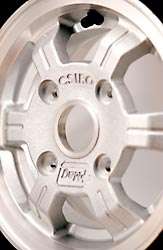
An alloy wheel produced using the T-Mag die casting technology, one of the CSIRO technologies for producing light-weight car parts. Image: CSIRO

With oil prices at an historic high and global concern about vehicle emissions, consumer demand - and the focus in car manufacturing - is shifting to lightweight, low-fuel consumption cars.

CSIRO’s Light Metals Flagship recently showcased technologies which offer high-performance, light-weight car components at three US automotive industry conferences.

“Our technologies use magnesium and aluminium alloys to create strong, lightweight car parts which are cost-competitive with structural components made of steel, and perform equally well,” said Mr Barrie Finnin, until recently General Manager for Alloy Technologies with CSIRO Materials Science & Engineering.

“We aim to get the best performance out of lighter metals with efficient manufacturing techniques and minimum wastage of materials.”

Lightweight vehicle design - replacing existing automotive structural parts with light metal alternatives - is one of several complementary approaches to achieving lower fuel consumption.

Lighter cars use less fuel because they need less energy to start and stop than heavier cars.

Internationally, the automotive industry sees use of light metals and light alloys for car and truck components as a key means of creating of more fuel-efficient cars, through specific initiatives including the US FreedomCAR project and the NADIA European project.

Mr Finnin was invited to speak about technologies for cost reduction of light alloy components at the second Annual Advanced Lightweight Materials for Automotive conference, organised by the International Quality and Productivity Center, and held in June in Detroit.

The CSIRO technologies were also presented at CastExpo 2008 in Atlanta, Georgia, in May, and displayed at the Team Australia Automotive stand at the Society of Automotive Engineers World Congress in Detroit in April.

“Promotion of these technologies globally is essential to ensure their uptake within Australia,” Mr Finnin said.

“The large manufacturers specify the parts produced by local component makers for both export and domestic sales, so we need to promote them internationally.”

Australian exports of motor vehicles and automotive components were worth a total of $4.85 billion in 2006, according to the Federal Chamber of Automotive Industries.

The automotive sector is Australia’s largest manufacturing export earner, accounting for higher export earnings than traditional products including wine, wheat and wool.

Close to 70,000 people work in the sector, many of them for smaller companies producing components.

Evaluation of the technologies by major manufacturers is also critical to their uptake.

“Both our heat treatment and ATM technologies have been evaluated or trialled by major car component manufacturers, with positive results,” said Sam Tartaglia, business development manager, who was part of the Team Australia Automotive exhibit.

Both technologies enable production of high pressure die cast (HPDC) aluminium alloy parts which have increased strength, using reduced amounts of material.

“HPDC is an established technology already used in manufacturing vehicle components, so improvements are relatively easy for manufacturers to implement,” Mr Tartaglia said.

High volumes of structural and engine parts made by HPDC are used in the car industry, which makes them an attractive means of making lighter cars.

Provided by CSIRO


print this article email this article download pdf blog this article bookmark this article     Digg this Stumble it share on Facebook share on Reddit add to delicious save to Yahoo! bookmarks
3.7/5 after 11 votes


August 8th, 2008 all stories
Technology / Engineering

Comments: 0
Rank: 3.7/5 after 11 votes

  • Stumble this up

  • Digg this

  • Share it:
  • share on Facebook
  • share on MySpace
  • share on Slashdot
  • rss-newsfeed
  • share on Google
  • share on Reddit
  • add to delicious
  • save to Yahoo! bookmarks
  • share on Windows Live
  • Add to Mixx!
Rating: 3.7/5 after 11 votes

  • Related Stories

  • Technology to 'watch over' vulnerable road users
    created May 18, 2009 | popularity not rated yet | comments 0
  • Lightweight electric motor on track
    created May 11, 2009 | popularity not rated yet | comments 0
  • UCSD Engineering Students Drive Into the Future With Electric Racecar
    created Apr 29, 2009 | popularity not rated yet | comments 0
  • A Hummer That Gets 100 MPG?
    created Apr 23, 2009 | popularity not rated yet | comments 0
  • Scientists develop world's smallest diamond transistor
    created Apr 14, 2009 | popularity not rated yet | comments 0


  • Transform a ball into a rock -- or make it invisible -- using transformation optics
    Transform a ball into a rock -- or make it invisible -- using transformation optics
    Physics / General Physics
    created 6 hours ago | popularity 3 / 5 (2) | comments 0
  • Could a quantum motor do work?
    Physics / General Physics
    created Jul 07, 2009 | popularity 4 / 5 (12) | comments 0
  • Physicists Demonstrate Quantum Memory with Matter Qubits
    Physicists Demonstrate Quantum Memory with Matter Qubits
    Physics / General Physics
    created Jul 03, 2009 | popularity 4.5 / 5 (20) | comments 1
  • 'Holey' Nanosheets for Wastewater Dye Removal
    Nanotechnology / Nanomaterials
    created Jul 01, 2009 | popularity 5 / 5 (5) | comments 1
  • Jellyfish Robot Swims Like its Biological Counterpart
    Jellyfish Robot Swims Like its Biological Counterpart
    Electronics / Robotics
    created Jun 26, 2009 | popularity 4.4 / 5 (9) | comments 1
  • Other News

    synthetic tree

    Synthetic Tree Captures Carbon 1,000 Faster Than Real Trees

    Technology / Engineering

    created 20 minutes ago | popularity 5 / 5 (1) | comments 0

    (PhysOrg.com) -- Scientists have designed a synthetic tree that traps carbon dioxide from the air in an attempt to combat growing emissions. The device looks less like a tree and more like a small building, ...


    Electric Raptor

    Raptor: An Electric Car Nearly Anyone Would Want to Drive

    Technology / Energy

    created 1hour ago | popularity 5 / 5 (1) | comments 1

    I love my Prius, it's true. But sometimes, I look at the Dodge Charger (I'm watching Burn Notice this summer) and think, "What a cool car." And when we think of cool cars, it's hard to keep the image of a ...


    Apple's iLife takes home photo albums to a new level

    Technology / Software

    created 50 minutes ago | popularity not rated yet | comments 0

    It's the amateur photographer's management tool for digital pictures. But Apple's iLife multimedia software suite has some A-list users as well.


    Massive earthquake simulation could lead to stronger, safer wooden buildings

    Massive earthquake simulation could lead to stronger, safer wooden buildings

    Technology / Engineering

    created 17 minutes ago | popularity not rated yet | comments 0

    A destructive earthquake will strike a lone, wooden condominium in Japan next week, and Rensselaer Polytechnic Institute Professor Michael Symans will be on site to watch it happen.


    IBM Researchers Develop Shield to Mask Sensitive On-Screen Information

    Technology / Software

    created 20 minutes ago | popularity not rated yet | comments 0

    IBM Research - Haifa has developed software that more efficiently and effectively hides sensitive or personal information that might otherwise appear on the computer screens of unauthorized personnel. It could prove particularly ...