From 3-D to 6-D: Researchers developing super-realistic image system
August 8, 2008
From 3-D to 6-D

Enlarge

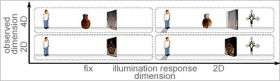
Traditional flat screen displays (bottom left) present 2D images. 3D and 4D displays have been proposed making use of lenslet arrays to shape a fixed outgoing light field for horizontal or bidirectional parallax (top left). Image / Martin Fuchs; Ramesh Raskar; Hans-Peter Seidel; and Hendrik P. A. Lensch

(PhysOrg.com) -- By producing "6-D" images, an MIT professor and colleagues are creating unusually realistic pictures that not only have a full three-dimensional appearance, but also respond to their environment, producing natural shadows and highlights depending on the direction and intensity of the illumination around them.

The process can also be used to create images that change over time as the illumination changes, resulting in animated pictures that move just from changes in the sun's position, with no electronics or active control.

To create "the ultimate synthetic display," says Ramesh Raskar, an associate professor at the MIT Media Lab, "the display should respond not just to a change in viewpoint, but to changes in the surrounding light."

Raskar and his colleagues will describe the system, which is based entirely on an arrangement of lenses and screens, on Aug. 11 at the annual SIGGRAPH (Special Interest Group on Graphics and Interactive Techniques) conference of the Association for Computing Machinery held in Los Angeles.

Three-dimensional images, created using a variety of systems that make separate images for each eye, have been around for many decades. The new MIT process could bring an unprecedented degree of realism to such images.

The basic concept is similar to those inexpensive 3-D displays sometimes used on postcards and novelty items, that use an overlay of plastic that contains a series of parallel linear lenses that create a visible set of vertical lines over the image. (It is a different approach from that used to create holograms, which require laser light to create.) In addition to three-dimensional images, these are sometimes used to present a series of images that change as you view them from different angles from side to side. This can simulate simple motion, such as a car moving along a road.

By using an array of tiny square lenses instead of the linear ones, such displays can also be made to change as you change the viewing angle up or down - making a "4-D" image. This reveals different views with horizontal as well as vertical movement of the viewer. The new "lighting aware" system adds additional layers of lenses and screens to add two more dimensions of change. The image that is seen is then not only based on the position of the viewer, but also on the direction of the illumination.

In an initial test of the principle, Raskar and his team created an image of a glass wine bottle, whose caustic (a term for the collection of light rays coming from a curved surface), shadows and highlights change with the illumination.

"Even if you have the best hologram out there," explains Raskar, when the angle of the light changes "if I have a hologram of a flower, and a real flower next to it, the hologram doesn't look real. All the shadows and all the reflections on that flower are not mimicked on that hologram."

The new system, still in a relatively low-resolution laboratory proof-of-concept, could have applications including pictures used for training purposes, he said. In training someone how to carry out industrial inspections, an image of the device to be inspected would respond just like a real object when the inspector shines lights on it from different angles, for example.

Because the system is being built by hand from custom-made parts, Raskar says, the present version costs about $30 per pixel to make. Since it takes thousands of pixels to create a recognizable image, practical devices at an affordable price will require significant further development. "It will be at least 10 years before we have any realistic practical-sized displays," he estimates.

The main applications ultimately would be for advertising and for entertainment, Raskar says. A similar system could even be adapted to produce motion pictures and moving computer displays as well, he says.

The research was done in collaboration with Martin Fuchs, Hans-Peter Seidel, and Hendrik P.A. Lensch, all of MPI Informatik, The work was partly funded by Mitsubishi Electric Research Laboratories.

Provided by MIT

4.4 /5 (49 votes)  

Filter


Move the slider to adjust rank threshold, so that you can hide some of the comments.


Display comments: newest first

GBogumil
Aug 08, 2008

Rank: not rated yet
why not take it to the final level.. instead of linear, they make it a square. Instead of a square, make it a circle. That way, any direction you look you always get the best possible image. I've thought this since the first time I saw a hologram. It was never invented until now? How odd.
mattytheory
Aug 08, 2008

Rank: not rated yet
^interesting preposition. but, what about the spaces in between the circular lenses? wont those "empty spaces" distort the final image, at least to some degree?
dirk_bruere
Aug 08, 2008

Rank: not rated yet
This idea has been popping up with tedious regularity as "the next big thing in video" for the past 40 years. The other Big Thing is the "optical transistor" that "might one day" allow computers to operate 1000x faster than today's. Yawn. Scientists with no knowledge of tech history.
DoctorKnowledge
Aug 08, 2008

Rank: not rated yet
There were fantastic computer games 15 years ago, created by just a handful of people. Now, it takes dozens of people, and high powered computers to play them on. What's the difference? Game quality? Well, no, graphics quality, to be precise.

Consumers are just nuts for graphics quality, because the "difference" can be noticed by a 6 year old in 10 seconds. What? You're willing to pay $50 for a new First Person Shooter, when you can buy any of dozens of the top rated games of all time (repackaged economically) for $5?

It's the mindless fascination with the obvious that drives this market. And in this case, they're talking about something that will make a huge, huge difference in First Person Shooters. So, definitely plan on seeing it in the store. Join the 6 year old video game lemmings.
Rank 4.4 /5 (49 votes)
Tags

Relevant PhysicsForums posts
  • How to tilt a object
    created11 hours ago
  • How to calculate total compressibility in liquid porous solid system
    created17 hours ago
  • Need help reading 3-D
    createdFeb 11, 2012
  • A way to send and receive wireless data
    createdFeb 11, 2012
  • Calling function with no input argument
    createdFeb 10, 2012
  • Force free body diagram problem on gym equipment
    createdFeb 10, 2012
  • More from Physics Forums - General Engineering

More news stories

The joy of cheques

An electronic cheque which eliminates the need for costly processing by banks but preserves the simplicity and ease of a traditional cheque book has been designed by a team of academics in the UK.

Technology / Other

created 58 minutes ago | popularity not rated yet | comments 0

Research shows promise in converting camelina oil into jet fuel

(PhysOrg.com) -- Researchers at Montana State University-Northern have developed a process to convert camelina oil to jet fuel and other high-value chemicals. MSU has applied for a U.S. patent and research is ongoing.

Technology / Energy & Green Tech

created 55 minutes ago | popularity not rated yet | comments 0

Thomas Edison inspires the oscar awards you don't see

Thomas Edison's invention of the first motion picture camera in 1891 inspired scientific and technological advances that he never could have imagined.

Technology / Hi Tech & Innovation

created 9 minutes ago | popularity not rated yet | comments 0

Cutting our carbon footprint

Roofing materials that double as solar panels and can also moderate the temperature of buildings are among the next-generation building products being developed at UNSW.

Technology / Energy & Green Tech

created 44 minutes ago | popularity not rated yet | comments 0

The art of shutting down a nuclear plant

Gaëtan Girardin, researcher in nuclear engineering, gives us the key to understanding nuclear reactor safety. While the disaster at Fukushima is at the center of our conversation, the recent and minor ...

Technology / Energy & Green Tech

created 36 minutes ago | popularity not rated yet | comments 0


With climate change, today's '100-year floods' may happen every three to 20 years: research

Last August, Hurricane Irene spun through the Caribbean and parts of the eastern United States, leaving widespread wreckage in its wake. The Category 3 storm whipped up water levels, generating storm surges ...

Researchers make better heat sensor based on butterfly wings

(PhysOrg.com) -- Scientists have long known that butterfly wings produce their iridescent colors by bouncing light around and between tiny ridges in structures made of chitin. More recently they’ve discovered ...

Manipulating genes with hidden TALENs

(PhysOrg.com) -- A better understanding of gene function in model plant and animal systems could be used to develop useful traits in livestock and crop plants, and might someday lead to developments in stem ...

Couples in the same place emotionally stay together, study says

(Medical Xpress) -- Despite life’s ups and downs, couples whose feelings are in sync consistently over time are more likely to stay together, says a University of California, Davis, study.

Researchers make breakthrough in stem cell research

(Medical Xpress) -- University of Queensland scientists have developed a world-first method for producing adult stem cells that will substantially impact patients who have a range of serious diseases.

Georgia Tech develops software for the rapid analysis of foodborne pathogens

2011 brought two of the deadliest bacterial outbreaks the world has seen during the last 25 years. The two epidemics accounted for more than 4,200 cases of infectious disease and 80 deaths. Software developed at Georgia Tech ...