Molecular bridge serves as a tether for a cell's nucleus
August 8, 2008
Molecular bridge serves as a tether for a cell's nucleus

Enlarge

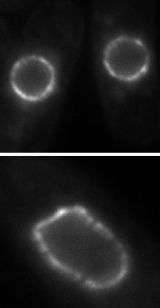
Misshapen membrane. When cells lack the protein Ima1, their nuclei appear deformed (bottom) rather than spherical.

(PhysOrg.com) -- A cell's nucleus - home of it its most precious contents — is a delicate envelope that, without support, is barely able to withstand the forces that keep it in place. Now, researchers have discovered a network of molecules in the nuclear membrane that provide the nucleus with rigidity and also facilitate a previously undiscovered form of communication between the cell’s nucleus and its cytoplasm.

In the August 8 issue of Cell, the scientists, led by Nobel Prize winner Gьnter Blobel, say that this mechanism is different from the usual traffic of molecular signals that enter and exit the nucleus through pores in the nuclear envelope.

“This is a distinct kind of physical connection between two compartments in a cell — the cytoplasm and the nucleus,” says the study’s lead investigator, Megan King, of Blobel’s Laboratory of Cell Biology. “It really opens up the possibility that there is a basic process going on that affects gene expression in ways that we had not understood before.”

King describes the network as a bridge of molecules that extends from the interior of the nucleus — specifically, the chromatin, the complex of DNA and proteins that makes up chromosomes – into the cell cytoplasm and its network of microtubules that provides structure to the cell. Though some of the proteins had been previously identified, King, Blobel and researcher Theodore Drivas discovered one in particular, called Ima1, that serves as one of the bridge’s pillars.

In fission yeast, the single-cell eukaryotes that the researchers used as a model organism, the nucleus has to stay centered within the cell before cell division is initiated. In other eukaryotes, microtubules push on the nucleus by interacting with nuclear membrane proteins from two previously discovered families: KASH domain proteins, which span the outer nuclear membrane, and SUN domain proteins, which reside in the inner nuclear membrane. However, King and the other researchers suspected that this bridge alone could not be strong enough to keep the nuclear structure stable against the forces applied by the cell’s cytoskeleton.

The researchers now say that two additional proteins are part of the yeast nuclear bridge. One is Kms2, which is part of the KASH family, and the other is Sad1, a member of the SUN family. Kms2 forms the outside pillar of the bridge and couples forces from microtubules to the protein bridge anchored on the inside by Sad1. But the scientists suspected there had to be an anchor for Sad1, or the bridge could not withstand such forces.

They then examined Ima1, which is found in many species, including humans. The protein binds to heterochromatin, which is a tightly packed form of DNA and is critically located in the inner membrane of the nucleus. Indeed, a series of experiments demonstrated that Ima1 forms the strong ground support for the side of the bridge that attaches inside the nucleus, and that other proteins, namely the Ndc80 complex, strengthen the connection, like a nut-and-bolt arrangement. Together, they proved able to absorb the forces transmitted through the centrosome on the outside of the nucleus. Whenever Ima1 or the Ndc80 complex was compromised, the bridges fell apart.

“The proteins act like players in a game of tug-of-war,” says King. “They will move side to side in an ordered line, remaining standing as long as the teams are of similar strengths. However, once one team pulls with a force that cannot be countered by the second team, both teams fall to the ground in a jumble.” When decoupled from chromatin, the nuclear envelope pays the price, becoming deformed and fragmented.

“This communication is physical, and it shows us how chromatin can support a cytoplasmic function, while, on the other hand, microtubules have the ability to affect nuclear functions,” King says.

Citatoin: Cell 134(3): 427–438 (August 8, 2008)

Provided by Rockefeller University

4.8 /5 (14 votes)  

Filter


Move the slider to adjust rank threshold, so that you can hide some of the comments.


Display comments: newest first

E_L_Earnhardt
Aug 09, 2008

Rank: not rated yet
Great work! Understand the mechanics of normal cell function and you can identify causes of malfunction. "Protein" is a mystery we have yet to understand!
Rank 4.8 /5 (14 votes)
Relevant PhysicsForums posts

More news stories

A mitosis mystery solved: How chromosomes align perfectly in a dividing cell

Although the process of mitotic cell division has been studied intensely for more than 50 years, Whitehead Institute researchers have only now solved the mystery of how cells correctly align their chromosomes during symmetric ...

Biology / Cell & Microbiology

created 3 hours ago | popularity 5 / 5 (4) | comments 0 | with audio podcast

The proteins ensuring genome protection

Researchers from the University of Geneva (UNIGE), Switzerland, have discovered the crucial role of two proteins in developing a cell 'anti-enzyme shield'. This protection system, which operates at the level of molecular ...

Biology / Cell & Microbiology

created 3 hours ago | popularity 5 / 5 (2) | comments 0 | with audio podcast

Researchers find extensive RNA editing in human transcriptome

In a new study published online in Nature Biotechnology, researchers from BGI, the world's largest genomics organization, reported the evidence of extensive RNA editing in a human cell line by analysis of RNA-seq data, demons ...

Biology / Biotechnology

created 3 hours ago | popularity 5 / 5 (3) | comments 0 | with audio podcast

Entire genome of extinct human decoded from fossil

(PhysOrg.com) -- In 2010, Svante Pääbo and his colleagues presented a draft version of the genome from a small fragment of a human finger bone discovered in Denisova Cave in southern Siberia. The ...

Biology / Biotechnology

created Feb 07, 2012 | popularity 4.7 / 5 (59) | comments 48 | with audio podcast

Why are there so few fish in the Earth's oceans?

(PhysOrg.com) -- A Stony Brook University researcher has found that, contrary to popular belief, there are not plenty of fish in the sea.

Biology / Plants & Animals

created Feb 08, 2012 | popularity 4.3 / 5 (17) | comments 27 | with audio podcast


Google might launch Drive for cloud storage soon

(PhysOrg.com) -- Google's next big move, according to the Wall Street Journal, is a cloud storage service called Drive. Hardly first to the plate, Google is simply catching up to introducing its cloud reposi ...

Scientists discover molecular secrets of 2,000-year-old Chinese herbal remedy

For roughly two thousand years, Chinese herbalists have treated Malaria using a root extract, commonly known as Chang Shan, from a type of hydrangea that grows in Tibet and Nepal. More recent studies suggest that halofuginone, ...

New method to examine batteries -- MRI from the inside

There is an ever-increasing need for advanced batteries for portable electronics, such as phones, cameras, and music players, but also to power electric vehicles and to facilitate the distribution and storage of energy derived ...

Lab study raises questions over nano-particle impact

Tests involving chickens have raised questions about the impact on health from engineered nano-particles, the ultra-fine grains commonly used in drugs and processed foods, scientists said on Sunday.

Injured boomers beware: Know when to see doctor

(AP) -- It happened to nurse Jane Byron years after an in-line skating fall, business owner Haralee Weintraub while doing "men's" push-ups, and avid cyclist Gene Wilberg while lifting a heavy box.

Starve a virus, feed a cure? Findings show how some cells protect themselves against HIV

A protein that protects some of our immune cells from the most common and virulent form of HIV works by starving the virus of the molecular building blocks that it needs to replicate, according to research published online ...