Hubble unveils colorful star birth region on 100,000th orbit milestone
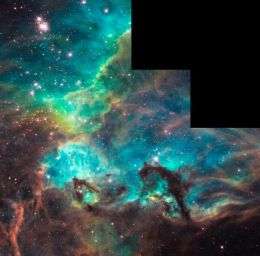
August 11th, 2008 NGC 2074 Imaged by Hubble on 100,000th Orbit Milestone

Enlarge

In commemoration of the NASA/ESA Hubble Space Telescope completing its 100,000th orbit around the Earth in its 18th year of exploration and discovery, scientists have aimed Hubble to take a snapshot of a dazzling region of celestial birth and renewal. Hubble peered into a small portion of the nebula near the star cluster NGC 2074 (upper, left). The region is a firestorm of raw stellar creation, perhaps triggered by a nearby supernova explosion. It lies about 170,000 light-years away near the Tarantula nebula, one of the most active star-forming regions in our Local Group of galaxies. This representative color image was taken on August 10, 2008, with Hubble's Wide Field Planetary Camera 2. Red shows emission from sulphur atoms, green from glowing hydrogen and blue from glowing oxygen. Credit: NASA, ESA and M. Livio (STScI)

During Hubble's 100 000th orbit around the Earth it peered into a small portion of the nebula near the star cluster NGC 2074 (upper, left). The region is a firestorm of raw stellar creation, perhaps triggered by a nearby supernova explosion. It lies about 170 000 light-years away near the Tarantula nebula, one of the most active star-forming regions in our Local Group of galaxies.

The three-dimensional-looking image reveals dramatic ridges and valleys of dust, serpent-head "pillars of creation", and gaseous filaments glowing fiercely under torrential ultraviolet radiation. The region is on the edge of a dark molecular cloud that is an incubator for the birth of new stars.

The high-energy radiation blazing out from clusters of hot young stars already born in NGC 2074 is sculpting the wall of the nebula by slowly eroding it away. Another young cluster may be hidden beneath a circle of brilliant blue gas at centre, bottom.

In this approximately 100-light-year-wide fantasy-like landscape, dark towers of dust rise above a glowing wall of gases on the surface of the molecular cloud. The seahorse-shaped pillar at lower, right is approximately 20 light-years long, roughly four times the distance between our Sun and the nearest star, Alpha Centauri.

The region is in the Large Magellanic Cloud (LMC), a satellite of our Milky Way galaxy. It is a fascinating laboratory for observing star-formation regions and their evolution. Dwarf galaxies like the LMC are considered to be the primitive building blocks of larger galaxies.

This representative colour image was taken on 10 August, 2008, with Hubble's Wide Field Planetary Camera 2. Red shows emission from sulphur atoms, green from glowing hydrogen, and blue from glowing oxygen.

Source: Hubble Information Centre


print this article email this article download pdf blog this article bookmark this article     Digg this Stumble it share on Facebook share on Reddit add to delicious save to Yahoo! bookmarks
4.1/5 after 27 votes


August 11th, 2008 all stories
Space & Earth / Astronomy

Comments: 0
Rank: 4.1/5 after 27 votes

  • Stumble this up

  • Digg this

  • Share it:
  • share on Facebook
  • share on MySpace
  • share on Slashdot
  • rss-newsfeed
  • share on Google
  • share on Reddit
  • add to delicious
  • save to Yahoo! bookmarks
  • share on Windows Live
  • Add to Mixx!
Rating: 4.1/5 after 27 votes

  • Related Stories

  • Hubble Witnesses Spectacular Flaring in Gas Jet from M87's Black Hole
    created Apr 14, 2009 | popularity not rated yet | comments 0
  • A sparkling spray of stars
    created Dec 16, 2008 | popularity not rated yet | comments 0
  • Born from the wind -- unique multi-wavelength portrait of star birth
    created Oct 08, 2008 | popularity not rated yet | comments 0
  • The little man and the cosmic cauldron
    created May 27, 2008 | popularity not rated yet | comments 0
  • Spitzer Catches Young Stars in Their Baby Blanket of Dust
    created Feb 11, 2008 | popularity not rated yet | comments 0

Tags

glowing, region

  • Physicists Demonstrate Quantum Memory with Matter Qubits
    Physicists Demonstrate Quantum Memory with Matter Qubits
    Physics / General Physics
    created Jul 03, 2009 | popularity 4.4 / 5 (16) | comments 1
  • 'Holey' Nanosheets for Wastewater Dye Removal
    Nanotechnology / Nanomaterials
    created Jul 01, 2009 | popularity 5 / 5 (5) | comments 1
  • Jellyfish Robot Swims Like its Biological Counterpart
    Jellyfish Robot Swims Like its Biological Counterpart
    Electronics / Robotics
    created Jun 26, 2009 | popularity 4.4 / 5 (8) | comments 1
  • Could Maxwell's Demon Exist in Nanoscale Systems?
    Could Maxwell's Demon Exist in Nanoscale Systems?
    Physics / General Physics
    created Jun 24, 2009 | popularity 4.4 / 5 (18) | comments 29
  • Living Safely with Robots, Beyond Asimov's Laws
    Living Safely with Robots, Beyond Asimov's Laws
    Electronics / Robotics
    created Jun 22, 2009 | popularity 4.6 / 5 (52) | comments 40
  • Other News

    Forty years ago man first walked on the moon

    Space & Earth / Space Exploration

    created 4 hours ago | popularity 5 / 5 (2) | comments 0

    Forty years ago on July 20, 1969, American astronaut Neil Armstrong realized the oldest dream of human civilizations when he became the first man to walk on the moon.


    The least sea ice in 800 years

    The least sea ice in 800 years

    Space & Earth / Earth Sciences

    created Jul 01, 2009 | popularity 4.3 / 5 (59) | comments 52

    New research, which reconstructs the extent of ice in the sea between Greenland and Svalbard from the 13th century to the present indicates that there has never been so little sea ice as there is now. The ...


    Gas around young galaxy

    Intense heat killed the Universe's would-be galaxies, researchers say

    Space & Earth / Astronomy

    created Jul 01, 2009 | popularity 3.2 / 5 (19) | comments 25

    (PhysOrg.com) -- Our Milky Way galaxy only survived because it was already immersed in a large clump of dark matter which trapped gases inside it, scientists led by Durham University's Institute for Computational ...


    Scientists' Drill Hits Magma: Only Third Time on Record

    Scientists' Drill Hits Magma: Only Third Time on Record

    Space & Earth / Earth Sciences

    created Jun 29, 2009 | popularity 4.7 / 5 (20) | comments 19

    (PhysOrg.com) -- Scientists drilling a borehole deep into Iceland’s rocky crust to explore new methods of using geothermal energy hit a major roadblock on Thursday: Their drill ran into molten rock at a depth ...


    NASA manager pitches a cheaper return-to-moon plan

    Space & Earth / Space Exploration

    created Jun 30, 2009 | popularity 4 / 5 (7) | comments 18

    (AP) -- Like a car salesman pushing a luxury vehicle that the customer no longer can afford, NASA has pulled out of its back pocket a deal for a cheaper ride to the moon.