Successful series of measurements in Arctic sea ice
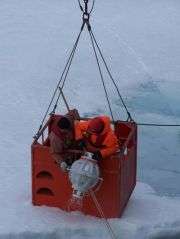
The German Research Vessel Polarstern had to prove its ice breaking capabilities in Arctic waters to gain data on two series of long-term research measurements. After working in regions up to latitude 82° N, Polarstern of the Alfred Wegener Institute for Polar and Marine Research in the Helmholtz Association will enter port in Reykjavik (Iceland) on August 10th.
"This year, we had to cope with exceptional heavy ice coverage", says chief scientist Prof. Gerhard Kattner. The sea ice covered the Arctic almost down to latitude 72° in southern direction. Perpetual winds from the Northwest have moved the ice into the central area of the Fram Strait since the beginning of summer. The main focus of the expedition lied in this region: the moorings along 78°50' N, and the so-called "AWI-Hausgarten". The measurements of the Polarstern expedition, which is completed by now, are part of continuous studies. Statements about long-term developments of the climate system can be made by means of these series of measurements. These research endeavours are only possible with an icebreaker like Polarstern - moorings in ice covered areas cannot be recovered with another research vessel.
These long-term measurements on the transport of bodies of water in the Fram Strait are conducted by the Alfred Wegener Institute since 1997. The Fram Strait lies between Spitsbergen and Greenland. It is the most important region for the exchange of Atlantic and Polar water masses. Here, warm and more saline Atlantic water flows north while cold and less saline Arctic water flows south. This marine region is the only deepwater link between the North Atlantic and the central Arctic Ocean and hence a region in which systematic changes are reflected in a particularly sensitive way. To observe and evaluate these changes, 17 moorings were distributed on the floor of the ocean around the area. They measure temperature, salinity and currents up to the surface. "We are happy and content that we were able to recover and exchange the equipment, considering the extreme ice conditions", says Dr Agnieszka Beszczynska-Möller, oceanographer at the Alfred Wegener Institute. The temperature of the Atlantic water has again slightly decreased compared to the elevated temperatures of the year 2006. This demonstrates the annual variability. All in all, the researchers have observed that the temperature in the Fram Strait has risen about 0,1°C each year since 1997.
A premiere for the Alfred Wegener Institute was the operation of a seaglider from Polarstern. This is an autonomous vehicle which regularly submerges from the surface to a depth of 1.000 metres. It measures on its dive temperature, salinity, oxygen, opacity of the water, and pressure; then it resurfaces and sends these data via satellite to Bremerhaven. From there, it can obtain new orders, if the results or other conditions require. The seaglider will measure until mid September. Then it will report its location and will presumably be salvaged by Norwegian cooperation partners on board their research vessel KV Svalbard.
The polar water near Greenland, which flows south along the Greenland coast into the Atlantic, consists of water masses of various origins. A part of it originates in the Pacific, which covers the long distance from the Bering Strait through the Arctic Ocean. "We have been documenting this water mass for years near Greenland", says Prof. Gerhard Kattner. "It was almost impossible to provide evidence of it since 2004." This points at a considerable change of the Arctic ocean current system. Current examinations again show a small part of Pacific water. Measurements in the next years will show if this trend is to continue.
The AWI is operating, since 1999, the worldwide unique ecologically orientated deep sea long-term observatory in the Polar latitudes. It examines how the deep sea changes under the influence of constant climate change. The AWI-Hausgarten covers an area of about 8.000 square kilometres near the Western coast of Spitsbergen. In this area, water depths between 1.000 and 5.500 metres are investigated to understand the function and structure of life at the bottom of the Arctic deep sea.
This monitoring of the environment includes examinations concerning the changes of the physical environment and the entry of nutrients into the seafloor. "For these purposes, we had to relocate the equipment anchored at the seafloor last year further to the North to follow the receding ice, and to ascertain that they stood at least temporarily in the sphere of influence of the ice edge," reports Ingo Schewe, biologist at the Alfred Wegener Institute. The results of the last years already showed that the changes of the ice cover have caused a decrease of some groups of animals living at the bottom of the deep sea. The ice edge is a biologically very active zone, in which algae increasingly grow, die , sink to the ground and serve as nutrients. If the ice edge shifts, it leads to changes in the availability of nutrients in the AWI-Hausgarten. What this year's thick ice cover brings about and whether the small and bigger animals of the deep sea are affected will be shown by the upcoming analyses in Bremerhaven as well as expeditions during the next years.
Polarstern will leave Reykjavik with the destination East Siberian Sea on August 12th. If the ice conditions allow, Polarstern will drive via the Northwest Passage into the work area. There, geoscientific measurements lie at the centre of attention of the expedition members. They want to collect seismic data to better understand the tectonic development of the interface between the Mendeleev Ridge and the East Siberian shelf. At the same time, US-American and Canadian researchers with similar series of measurements will be in the Northern Polar Sea. The researchers from the Alfred Wegener Institute will exchange positions of the exact operating areas of the respective ships with them.
Source: Helmholtz Association of German Research Centres


