Epson Develops New High-Resolution 3D LCD Display
August 11, 2008 Epson Develops New High-Resolution 3D LCD Display

Enlarge

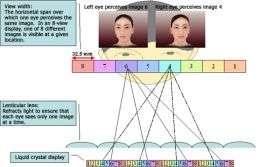
The observer's left eye sees image 6, while his right eye sees image 4. The two images are merged in the brain so that the observer perceives a 3D image. When the observer moves his head or changes position relative to the screen, the images that enter the eyes changes, so the observer sees a different 3D image. (For example, the 3D image perceived when the observer is looking at image 7 with his left eye and image 5 with his right eye differs from the 3D image perceived when the observer sees images 6 and 4.)

(PhysOrg.com) -- Seiko Epson Corporation has developed a high-resolution (equivalent to QVGA) autostereoscopic 3D liquid-crystal display that affords extra freedom of viewing position compared to conventional 3D displays, without the need for special glasses.

Demand is on the rise in the movie and gaming industries for 3D images that provide a different level of excitement from that offered by two-dimensional images. Conventional 3D displays are not up to the task due to their limited viewing zone and low resolution.

Epson's newly developed 3D display addresses these problems with a lenticular lens optimally designed for a view width of 31 to 32.5 mm. (Lenticular lens: A columnar array of cylindrical lenses that determine the view width by refraction). The development prototype presents sharp, vivid 3D images over a wider viewing zone than was previously possible. While 3D displays have often traded off resolution for enhanced 3D effects, Epson has successfully improved the perceived image quality by using "step 3D pixel array" technology.

To further popularize 3D displays and 3D content, Epson will promote the optimized 31-32.5 mm view width as an industry standard. Epson sees 3D displays that render scenes in sharp, vivid color as the next-generation of highly realistic displays and is working on proposals for delivering compelling entertainment to customers.

Technology features

[Optimized view width]

(1) Smooth 3D images

Epson's 3D display is a multiview system. Multiview systems are generally acknowledged to provide superior 3D image reproduction because the image that is visible changes along with the observer's vantage point relative to the screen. To heighten the illusion of depth in stereoscopic 3D images, design engineers can increase the number of views so that the image can be viewed from various head positions. The problem, however, is that increasing the number of views has led to a loss of resolution per view, since only so many pixels can be placed on a liquid crystal display.

Conventional multiview displays commonly employ lenticular lenses designed for a view width of 62 to 65 mm, a distance equal to the separation between the eyes of an average person. Epson, bucking the conventional industry wisdom that held the best view width to be the distance between the eyes, designed its system based on a view width of 31-32.5 mm. With a view width half that of conventional designs, combined with optimizations to prevent loss of resolution and add 3D information, Epson has succeeded in developing a display that offers smooth, high-quality 3D images.

(2) Wide viewing zone

Images on ordinary 3D displays designed with a view width of 62 to 65 mm can appear incorrect and be uncomfortable unless viewed head-on from a certain distance, since the eyes can detect a 2D image in portions of the display. The optimized view width on Epson's display reduces the appearance of visible 2D images and enables natural-looking 3D images to be viewed from a wider viewing zone.

[Step 3D pixel array technology]

To address the problem of resolution loss on multiview displays, Epson uses an image processing technology called "step 3D pixel array" that takes into account the sensitivity of the human eye to resolution loss in the horizontal direction. By minimizing pixel horizontal resolution degradation, Epson has improved perceived image quality to provide viewers with sharper, more vivid 3D images.

Provided by Epson


print this article email this article download pdf blog this article bookmark this article     Stumble it Digg this share on Facebook retweet share on Reddit add to delicious
Rate this story - 4.3 /5 (30 votes)

Rank Filter

Move the slider to adjust rank threshold, so that you can hide some of the comments.


Display comments: newest first

  • thales - Aug 11, 2008
    • Rank: 3 / 5 (2)
    All I can say is it's about time.
  • SLam_to - Aug 11, 2008
    • Rank: not rated yet
    This article is just a big ad for Epson, in fact it's "Provided by Epson"!
  • raron - Aug 11, 2008
    • Rank: not rated yet
    "Step 3D pixel array technology"

    That said so little with so many words. IE a commercial. I would be more interested in HOW they did this, not the fancy name they created.

    And yes, agreed, it's about time for 3D displays:)

    Next step, lenticular droplets for "truer" 3D experience that does not necessitate vertical head viewing? :-)
  • StevenL - Aug 14, 2008
    • Rank: not rated yet
    SLam_to it's called a press release.

August 11, 2008 all stories

Comments: 4

4.3 /5 (30 votes)
  • Stumble this up

  • Digg this

  • share this

  • hide
  • Related Stories

  • Epson Develops A6-Size Electronic Paper with World's Highest Resolution Using Plastic Substrate
    created Jun 12, 2006 | popularity not rated yet | comments 0
  • Sanyo Epson Develops High-Resolution LCDs
    created Oct 17, 2005 | popularity not rated yet | comments 0
  • Research and Markets: LCD Processing: Challenges, Directions, Markets: Japan Dominating the LCD market
    created Aug 25, 2004 | popularity not rated yet | comments 0
  • Meteor showers in Asia disappoint
    created Nov 18, 2009 | popularity not rated yet | comments 0
  • The upside of feeling down
    created Nov 09, 2009 | popularity not rated yet | comments 0


  • hide
  • Relevant PhysicsForums posts

  • Aspiring Engineering major looking for general answers
    created Nov 19, 2009
  • Calculating max load of square tube (steel)
    created Nov 19, 2009
  • Passive Chemical Heating
    created Nov 19, 2009
  • Shortening Boat Trailer
    created Nov 18, 2009
  • More from Physics Forums - General Engineering

Other News

Qualcomm's next e-book to use a mirasol display

Qualcomm's next e-book to use a mirasol display

Electronics / Consumer & Gadgets

created 23 hours ago | popularity 4.7 / 5 (9) | comments 2

(PhysOrg.com) -- Qualcomm subsidiary Mirasol is developing a new e-book reader with a color display that uses ambient light. The reader will be capable of displaying video smoothly, but the new features will ...


B&N Nook sells out, too late for holiday orders

Electronics / Consumer & Gadgets

created 13 hours ago | popularity not rated yet | comments 0

(AP) -- Consumers who haven't yet ordered Barnes & Noble's electronic book reader, the Nook, won't see one before Christmas.


More than powerful: German research computer QPACE is the most energy efficient in the world

Electronics / Hardware

created 16 hours ago | popularity not rated yet | comments 1

At the 2009 Supercomputing Conference in Portland, Oregon, the high-performance computer QPACE (QCD Parallel Computing on the Cell) was recognized today as the most energy-efficient supercomputer in the world.


'Rationalizer' bracelet tells traders when they're stressed

'Rationalizer' bracelet tells traders when they're stressed

Electronics / Consumer & Gadgets

created Nov 17, 2009 | popularity 4.3 / 5 (6) | comments 4

(PhysOrg.com) -- Philips Electronics and the Dutch bank ABN AMRO have joined forces to develop a "Rationalizer" bracelet system that detects stress levels and displays a warning to help day-traders avoid making ...


Oak Ridge 'Jaguar' supercomputer is World's fastest

Oak Ridge 'Jaguar' supercomputer is World's fastest

Electronics / Hardware

created Nov 16, 2009 | popularity 4.5 / 5 (13) | comments 2

An upgrade to a Cray XT5 high-performance computing system deployed by the Department of Energy has made the "Jaguar" supercomputer the world's fastest. Located at Oak Ridge National Laboratory, Jaguar is ...