Archaeological excavations uncover Roman temple in Zippori (Sepphoris)
August 11, 2008 Roman Temple in Zippori

Enlarge

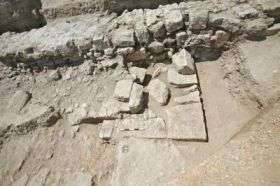
View of the remnants of the podium, the temple's façade and some steps. The long wall in the background belongs to the church whose foundations were built on the remains of the temple. Photo: Gaby Laron

Ruins of a Roman temple from the second century CE have recently been unearthed in the Zippori National Park in Israel. Above the temple are foundations of a church from the Byzantine period. The excavations, which were undertaken by the Noam Shudofsky Zippori Expedition led by of Prof. Zeev Weiss of the Institute of Archaeology at the Hebrew University of Jerusalem, shed light on the multi-cultural society of ancient Zippori.

The discovery indicated that Zippori, the Jewish capital of the Galilee during the Roman period, had a significant pagan population which built a temple in the heart of the city center. The central location of the temple which is positioned within a walled courtyard and its architectural relation to the surrounding buildings enhance our knowledge regarding the planning of Zippori in the Roman era.

The building of the church on the foundation of the temple testifies to the preservation of the sacred section of the city over time. This new finding demonstrates not only the religious life, culture and society in Roman and Byzantine Zippori, but also that this was a city in which Jews, pagans and later Christians lived together and developed their hometown with various buildings.

The newly discovered temple is located south of the decumanus - colonnaded street - which ran from east to west and was the main thoroughfare in the city during the Roman through Byzantine period. The temple, measuring approximately 24 by 12 meters, was built with a decorated façade facing the street. The temple's walls were plundered in ancient times and only its foundations remain.

No evidence has been found that reveals the nature of the temple's rituals, but some coins dating from the time of Antoninus Pius, minted in Diocaesarea (Zippori), depict a temple to the Roman gods Zeus and Tyche. The temple ceased to function at an unknown date, and a large church, the remains of which were uncovered by the Hebrew University excavation team in previous seasons, was built over it in the Byzantine period.

North of the decumanus, opposite the temple, a monumental building was partially excavated this summer. Its role is still unclear, although its nature and size indicate that it was an important building. A courtyard with a well-preserved stone pavement of smooth rectangular slabs executed in high quality was uncovered in the center of the building, upon which were found a pile of collapsed columns and capitals - probably as a result of an earthquake. The decoration on these architectural elements was executed in stucco. Beyond a row of columns, an adjacent aisle and additional rooms were discovered. Two of them were decorated with colorful, geometrical mosaics.

Source: The Hebrew University of Jerusalem


print this article email this article download pdf blog this article bookmark this article     Stumble it Digg this share on Facebook retweet share on Reddit add to delicious
Rate this story - 4.1 /5 (8 votes)


August 11, 2008 all stories

Comments: 0

4.1 /5 (8 votes)
  • Stumble this up

  • Digg this

  • share this

  • hide
  • Related Stories

  • Israel displays coins from ancient Jewish revolt
    created Nov 11, 2009 | popularity not rated yet | comments 0
  • History in 3D
    created Nov 02, 2009 | popularity not rated yet | comments 0
  • Archaeologists find early depiction of a menorah
    created Sep 11, 2009 | popularity not rated yet | comments 0
  • Largest-ever collection of coins from Bar-Kokhba revolt found
    created Sep 09, 2009 | popularity not rated yet | comments 0
  • Augmented reality: Visual time machine offers tourists a glimpse of the past
    created Aug 13, 2009 | popularity not rated yet | comments 0


  • hide
  • Relevant PhysicsForums posts

  • Breeding program
    created 12 hours ago
  • How does a concentration gradient provide energy?
    created 16 hours ago
  • Eyesight and Neural Damage from Electronics
    created Nov 19, 2009
  • Quick question about the Golgi Apparatus?
    created Nov 19, 2009
  • More from Physics Forums - Biology

Other News

Researcher says text proves Shroud of Turin real (AP)

Researcher says text proves Shroud of Turin real

Other Sciences / Archaeology & Fossils

created 13 hours ago | popularity 1.7 / 5 (15) | comments 16

(AP) -- A Vatican researcher claims a nearly invisible text on the Shroud of Turin proves the authenticity of the artifact revered as Jesus' burial cloth. The claim made in a new book by historian Barbara ...


Three of a kind

Three of a kind: Revealing language’s universal essence

Other Sciences / Social Sciences

created 17 hours ago | popularity 3.7 / 5 (7) | comments 6

(PhysOrg.com) -- On the surface, English, Japanese, and Kinande, a member of the Bantu family of languages spoken in the Democratic Republic of Congo, have little in common. It is not just that the vocabularies ...


Active hearing process in mosquitoes

Active hearing process in mosquitoes

Other Sciences / Mathematics

created 23 hours ago | popularity not rated yet | comments 0

A mathematical model has explained some of the remarkable features of mosquito hearing. In particular, the male can hear the faintest beats of the female's wings and yet is not deafened by loud noises.


Glorious Dawn: Sagan, Hawking Sing (w/ Video)

Other Sciences / Other

created Nov 12, 2009 | popularity 4.6 / 5 (17) | comments 8

Astronomer and long time science advocate Carl Sagan once said that he was "not very good at singing songs." But on Nov. 9 in Washington D.C., his voice could be heard singing about the wonders of universe -- 13 years after ...


Maya

New insights into the life of the Maya

Other Sciences / Archaeology & Fossils

created Nov 16, 2009 | popularity 4.6 / 5 (15) | comments 7

(PhysOrg.com) -- Ancient artifacts are almost always concerned with rich and powerful religious and political leaders, but new excavations of an ancient Maya site have unearthed a pyramid decorated with murals ...