OSU students build and launch a sensor into space
August 11, 2008
OSU students build and launch a sensor into space

Enlarge

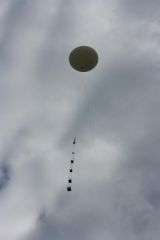
The high-altitude balloon carrying a radiation detector, high-resolution camera, sensors for temperature, pressure and humidity, and a GPS launches from OSU in Stillwater. Image: Dr. Jamey Jacob

Students from OSU's Radiation Physics Laboratory built and successfully launched a cosmic radiation detector this summer that reached the edge of outer space. Carried by a helium-filled balloon 12 inches in diameter, the detector flew for more than two hours and reached 104,000 feet in altitude. The device recorded radiation levels at the varying altitudes – information that will be used by NASA to develop instrumentation for space flight.

"This is really amazing," said Carl Johnson, a physics graduate student who designed and constructed the device. "Our detector actually flew to the edge of outer space and then back to ground, and the whole time it worked perfectly."

In addition to the radiation sensor, the balloon carried a high-resolution camera, sensors for temperature, pressure and humidity, and a GPS module to determine altitude and geographic position. The balloon and instrumentation launched from the Stillwater campus and landed about 10 miles away in Perry. OSU engineering graduate and undergraduate students Joe Conner, Xander Buck and Ryan Paul conducted the launch.

Funded through a NASA EPSCoR grant, this project was overseen by Drs. Eric Benton and Eduardo Yuihara of the OSU physics department and Dr. Andy Arena of OSU department of mechanical and aerospace engineering. Art Lucas of Lucas Newman Science and Technologies also assisted on the design and development of the radiation detector.

Benton said the purpose of the grant is two-fold.

"The purpose of the grant is not only to develop instrumentation for use in space flight but also to promote student interest in science and engineering through experiments with high-altitude balloons," he said. "The best part about the project is that the detector was built from everyday materials and launched into near space from right here in our own backyard. This proves you can accomplish really amazing things with simple materials."

The detector serves as a prototype for radiation detectors that will be included in the Near Space Standard Science Platform, a program used by science students at high schools and colleges around the country conducting research on high-altitude balloons.

Source: Oklahoma State University

3.3 /5 (4 votes)  

Filter


Move the slider to adjust rank threshold, so that you can hide some of the comments.


Display comments: newest first

nilbud
Aug 13, 2008

Rank: 1 / 5 (1)
30Km is not anywhere near the edge of outer space, perhaps the student needs to study some more and play with balloons less. This kind of project should be undertaken by primary students, it seems pathetic for university level.
jatkins
Sep 11, 2008

Rank: not rated yet
There is no strict definition for "the edge of space", but 30 km is perfectly fair. It's above 99% of the atmopshere, and just 70 km below the Karman line. The enviroment at that altitude is of extreme temperature (~-55C) and is a near vacuum; there's a reason it's termed "near space".

It's an awesome project that certainly couldn't be undertaken by primary school students (probably not even secondary). They're producing extremely useful data with a great experiment.
Rank 3.3 /5 (4 votes)
Relevant PhysicsForums posts
  • Never ending outer space.....
    createdFeb 11, 2012
  • Neutron Star fragments?
    createdFeb 11, 2012
  • stationary or not?
    createdFeb 11, 2012
  • Scale of the Universe
    createdFeb 10, 2012
  • Titan's lack of impact craters
    createdFeb 09, 2012
  • Real pictures of black hole eating a star?
    createdFeb 08, 2012
  • More from Physics Forums - General Astronomy

More news stories

With climate change, today's '100-year floods' may happen every three to 20 years: research

Last August, Hurricane Irene spun through the Caribbean and parts of the eastern United States, leaving widespread wreckage in its wake. The Category 3 storm whipped up water levels, generating storm surges ...

Space & Earth / Environment

created 4 minutes ago | popularity not rated yet | comments 0 | with audio podcast

New European rocket lifts off on maiden flight

A new lightweight rocket, Vega, lifted off from Europe's space base Monday carrying nine satellites on its inaugural flight, mission control said.

Space & Earth / Space Exploration

created 1 hour ago | popularity 5 / 5 (3) | comments 1

Climate change causes harmful algal blooms in North Atlantic: study

Warming oceans and increases in windiness could be causing of an abundance of harmful algal blooms in the North Atlantic Ocean and North Sea, according to new research.

Space & Earth / Environment

created 2 hours ago | popularity not rated yet | comments 0

Salvage workers begin pumping fuel from Italian shipwreck

Salvage workers Sunday began pumping fuel from the shipwrecked Italian cruise liner Costa Concordia, a day ahead of schedule, officials said.

Space & Earth / Environment

created 17 hours ago | popularity 5 / 5 (2) | comments 0

NASA budget will axe Mars deal with Europe: scientists

US President Barack Obama's budget proposal to be submitted next week for 2013 will cut NASA's budget by 20 percent and eliminate a major partnership with Europe on Mars exploration, scientists said Thursday.

Space & Earth / Space Exploration

created Feb 10, 2012 | popularity 5 / 5 (4) | comments 59


New molecule has potential to help treat genetic diseases and HIV

(PhysOrg.com) -- Chemists at The University of Texas at Austin have created a molecule that's so good at tangling itself inside the double helix of a DNA sequence that it can stay there for up to 16 days before ...

Social psychologist: Lust makes you smarter and evidence that seven deadly sins are good for you

(Medical Xpress) -- Good news for lovers on Valentine’s Day - the seven deadly sins, including Lust, are good for you. University of Melbourne social psychologist Dr Simon Laham uses modern research to make a compelling ...

The joy of cheques

An electronic cheque which eliminates the need for costly processing by banks but preserves the simplicity and ease of a traditional cheque book has been designed by a team of academics in the UK.

Research shows promise in converting camelina oil into jet fuel

(PhysOrg.com) -- Researchers at Montana State University-Northern have developed a process to convert camelina oil to jet fuel and other high-value chemicals. MSU has applied for a U.S. patent and research is ongoing.

Couples in the same place emotionally stay together, study says

(Medical Xpress) -- Despite life’s ups and downs, couples whose feelings are in sync consistently over time are more likely to stay together, says a University of California, Davis, study.

Researchers make breakthrough in stem cell research

(Medical Xpress) -- University of Queensland scientists have developed a world-first method for producing adult stem cells that will substantially impact patients who have a range of serious diseases.