New evidence on benefits of breast feeding
August 11, 2008 Milk

Enlarge

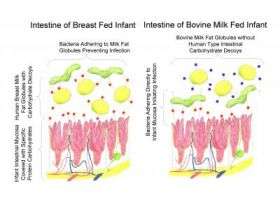
Scientists have identified sugar-based proteins in human breast-milk that could help fight disease. Credit: Credit: Niclas Karlsson

Researchers in Switzerland and Australia are reporting identification of proteins in human breast-milk — not present in cow's milk — that may fight disease by helping remove bacteria, viruses and other dangerous pathogen's from an infant's gastrointestinal tract. Their study is scheduled for the September 5 issue of ACS' Journal of Proteome Research.

Niclas Karlsson and colleagues point out that researchers have known for years that breast milk appears to provide a variety of health benefits, including lower rates of diarrhea, rashes, allergies, and other medical problems in comparison to babies fed with cow's milk. However, the biological reasons behind this association remain unclear.

To find out, the scientists collected human and cow's milk samples and analyzed their content of milk fat. They found that fat particles in human milk are coated with particular variants of two sugar-based proteins, called MUC-1 and MUC-4.

Previous studies by others have shown that these proteins can block certain receptors in the GI tract that are the main attachment sites for E. coli, Helicobacter pylori and other disease-causing microbes, thereby preventing infection. By contrast, since cow's milk lacks these protein variants, it may not offer the same disease protection, the researchers say.

Article: http://dx.doi.org/10.1021/pr700793k

Source: ACS


print this article email this article download pdf blog this article bookmark this article     Stumble it Digg this share on Facebook retweet share on Reddit add to delicious
Rate this story - 4.2 /5 (5 votes)


August 11, 2008 all stories

Comments: 0

4.2 /5 (5 votes)
  • Stumble this up

  • Digg this

  • share this

  • hide
  • Related Stories

  • The 2009 Ig Nobel prizewinners
    created Oct 05, 2009 | popularity not rated yet | comments 0
  • Ig Nobel: Researchers named the cream of the crop
    created Oct 02, 2009 | popularity not rated yet | comments 0
  • THE INFLUENCE GAME: Excuse me! Lobby wins on burps
    created Jun 20, 2009 | popularity not rated yet | comments 0
  • What makes a cow a cow? Complete bovine genome sequenced
    created Apr 23, 2009 | popularity not rated yet | comments 0
  • Skim to slim: Parents on food aid encouraged to wean kids off whole milk
    created Feb 15, 2009 | popularity not rated yet | comments 0


Other News

Study reveals why certain drug combinations backfire

Chemistry / Biochemistry

created 17 hours ago | popularity 4.5 / 5 (4) | comments 0

Combination drug therapy has become a staple for treating many infections. For instance, doctors treat extensively drug resistant forms of tuberculosis with one drug that breaks down the pathogen's protective barriers and ...


The Future in Two Words: Ionic Liquids

The Future in Two Words: Ionic Liquids

Chemistry / Materials Science

created 21 hours ago | popularity 4.3 / 5 (6) | comments 0

(PhysOrg.com) -- Ionic liquids are molecular solutions that have a wide range of potential applications, including next-generation solar cells, hydrogen fuel cells and lithium batteries.


H1N1 Virus Can Be Killed by Acidic Ozone Water

H1N1 Virus Can Be Killed by Acidic Ozone Water

Chemistry / Biochemistry

created Nov 09, 2009 | popularity 4.8 / 5 (29) | comments 12

(PhysOrg.com) -- Scientists have found that acidic ozone water can deactivate H1N1 viruses very effectively, offering a promising disinfectant for the millions of people trying to avoid the disease. Acidic ...


New evidence that dark chocolate helps ease emotional stress

New evidence that dark chocolate helps ease emotional stress

Chemistry / Biochemistry

created Nov 11, 2009 | popularity 5 / 5 (3) | comments 2

The "chocolate cure" for emotional stress is getting new support from a clinical trial published online in ACS' Journal of Proteome Research.


Energy-saving powder

Energy-saving powder: Converting methane to methanol

Chemistry / Other

created Nov 11, 2009 | popularity 3.6 / 5 (5) | comments 2

It is currently estimated that natural gas resources will be exhausted in 130 years; however, those reserves where extraction is cost-effective will only flow for another 60 years or so.