North Pole could lose summer ice
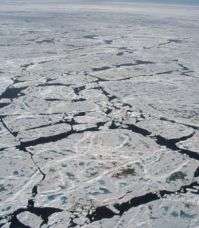
(PhysOrg.com) -- While the summer of 2007 saw record low sea-ice coverage of the Arctic Ocean, a six-year study of the Arctic's sea ice has confirmed its ongoing, massive shrinking and drastic thinning.
University of Alberta researcher Christian Haas, professor in the Department of Earth and Atmospheric Sciences and Alberta Ingenuity Scholar, has gathered a unique data set showing that the sea ice in the region of the North Pole has thinned up to 53 per cent between 2001 and 2007.
"The sea ice is becoming more vulnerable to further retreat, as ice thickness is very uniform over large regions, and ice reduction can be very fast once a certain threshold thickness is reached," he said.
The results, published online in the Geophysical Research Letters, indicate that the North Pole might soon be ice-free in the summer.
Haas and his team spent several seasons on a German icebreaker, collecting data using helicopter-borne electromagnetic (EM) instruments. Unlike ground-based measurements that can only be performed on ice which is accessible to walking, EM instruments allow for extremely accurate sampling of multiple sites throughout the North.
The instrument is operated at an altitude of 15 to 20 metres above the snow or ice surface, and its altitude is measured with a laser. Ice that was once 2.5 m thick in 1991, is now only 0.9 m.
Haas notes that the thinning is not only due to melt, but also to the replacement of older, thicker ice by relatively thin first-year ice. The regime change is due to faster ice motion, because of the thinner ice.
According to Haas, the thinning is a signal of climate change, but he notes it's still unclear what the underlying mechanisms are.
"The faster ice motion is due to changes in atmospheric circulation patterns. The independent thinning is due to increased oceanic and atmospheric heat fluxes, and it is likely those atmospheric heat fluxes, like higher air temperature and increased infrared radiation, are the major causes."
Haas' future research plans include the development of CASIMBO, the Canadian Arctic Sea Ice Mass Balance Observatory, which will establish more systematic and more frequent measurements of sea ice. While his goal includes performing summer measurements, the lack of available funding in Canada has not made this possible to date.
Scientists are monitoring the current ice situation, interested to see if it will be another record minimum ice coverage this September. New data obtained by Haas this spring does not indicate that it will be.
Provided by University of Alberta


