Evolution as Described by the Second Law of Thermodynamics
August 11th, 2008 By Lisa Zyga
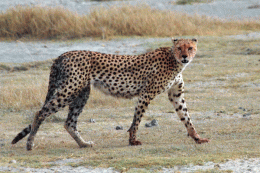
By viewing evolution as the motion of energy flows toward a stationary state (entropy), evolution can be explained by the second law of thermodynamics, a law which conventionally describes physical systems. In this view, a cheetah serves as an energy transfer mechanism, and beneficial mutations allow the animal to transfer more energy within its environment, helping even out the energy. Image credit: Rob Qld.
(PhysOrg.com) -- Often, physics and biology appear as different worlds, from a scientist’s point of view. Each discipline has its own language and concepts, and physicists and biologists tend to look at the world in different ways – not least being from inanimate and animate perspectives.
But at the core of these two sciences is the concept of motion. As a biological ecosystem evolves by the process of natural selection, it disperses energy, increases entropy, and moves toward a stationary state with respect to its surroundings. Similarly, as energy flows in various physical phenomena, they too cause biological systems to move toward stationary states with respect to their surroundings, in accordance with the second law of thermodynamics. Whether an object is animate or inanimate, science does not seem to make a distinction. In both cases, energy flows toward a stationary state, or a state of equilibrium, in the absence of a high-energy external source.
In this way, explain Ville Kaila and Arto Annila of the University of Helsinki, the second law of thermodynamics can be written as an equation of motion to describe evolution, and, in doing so, connect biology with physics. Their study, “Natural selection for least action,” is published in the Proceedings of The Royal Society A.
The second law of thermodynamics, which states that the energy of a system tends to even itself out with its surroundings (“a system’s entropy always increases”), can be expressed in many different forms. Kaila and Annila focus on two of these forms. When written as a differential equation of motion, the second law can describe evolution as an energy transfer process: natural selection tends to favor the random mutations that lead to faster entropy increases in an ecosystem. When written in integral form, the second law describes the principle of least action: motion, in general, takes the path of least energy.
Then, the scientists showed how natural selection and the principle of least action can be connected by expressing natural selection in terms of chemical thermodynamics. As the scientists explain, nature explores many possible paths to level differences in energy densities, with one kind of energy transfer mechanism being different species within the larger system of the Earth.
Mechanisms of energy transduction, especially biological species, can be intricate and complex. By randomly mutating individuals of a species, various paths are explored in the quest of increasing entropy most rapidly. These mutations sooner or later naturally converge on the most probable path. Although the energy landscape keeps changing, the most probable path is always that which is the shortest and follows the steepest energy descents. It leads toward a stationary state, such as an ecosystem evolving toward a state that will have just the right amount of plants, plant eaters, and other energy transfer mechanisms (both living and non-living) to maintain the highest rate of energy dispersal.
“In a biological context, when two rather similar species (i.e. energy transduction mechanisms) compete for the same source of energy (e.g. food), the one with even slightly more effective mechanisms (e.g. claws, teeth, feet, etc.) captures more than the other,” Annila explained to PhysOrg.com. “Gradually, the population of the more effective species will increase at the expense of the other. The overall process is pictured as flows of energy that gradually and naturally select the more effective, steeper paths. In biology, this physical consequence, which can be deduced from Lyapunov stability criterion, is known as the competitive exclusion principle.
“Let us assume that a mutation happens to improve the speed of a cheetah,” he added as an example. “Consequently, this cheetah will catch more food, i.e. more energy will channel through this individual – the path has become steeper. Likewise, a deleterious mutation will reduce the flow via the particular path that has turned less steep. In this case, the non-mutated paths are the healthy rivalries, and will enjoy correspondingly larger flows due to the diminished competition.”
The researchers note that this abstract description provides a holistic view of evolving nature, not a detailed explanation for how individual species emerge from the process. For example, plant-eating species distribute the solar energy acquired by photosynthesis, and the cheetah, as a carnivore, disperses energy further down along the gradients of the food chain, which eventually terminates into cold space. And since these energy flows themselves yield and affect energy transfer mechanisms that, in turn, alter the flows, it’s virtually impossible to predict evolution’s next move.
“A system evolves to reach a stationary state with respect to its surroundings,” Annila explained. “That is to say, when the surrounding environment is high in energy, then the system will evolve to a high-energy stationary state. Matter on Earth has evolved over eons in increasing its energy content to match that of the solar radiation density. During this process, mechanisms of energy transduction have improved, but presumably there are still ways to catch more of the sunlight to power activities that are presently fueled by non-renewables.”
The idea of using the second law of thermodynamics to describe evolution is not new. As far back as 1899, physicist Ludwig Boltzmann, a great admirer of Darwin, was contemplating about connection. Also, Alfred J. Lotka, in his main work published in 1925, expressed full confidence that biotic systems follow the same universal imperative. Many scientists today have recognized the principle of increasing entropy as a way to understand life. The connection between increasing entropy and decreasing free energy, provided by Kaila and Annila via the principle of least action, has further strengthened the unified description of natural motions.
More information: Kaila, Ville R. I. and Annila, Arto. “Natural selection for least action.” Proceedings of The Royal Society A. doi:10.1098/rspa.2008.0178.
Copyright 2008 PhysOrg.com.
All rights reserved. This material may not be published, broadcast, rewritten or redistributed in whole or part without the express written permission of PhysOrg.com.


1) The 2nd Law applies to closed systems. Living systems are not closed systems.
2) The 2nd Law describes an increase in entropy (disorder). Living systems represent an decrease in entropy.
EDIT: Many of the comments made this point already. I apologize for my flagrant redundancy.
Living systems disperse energy. Part of the energy is used to do work (this is the part referred to in the comment above as "order"), part is lost in disordered heating. Every energy conversion increases entropy.
Cool article.
Is the use of the term "evolution" misleading here? Shouldn't it merely be "survival of the fittest"? That word should be used with great care as it is over scrutinized due to politics.
JerryPark's first criticism is not well-founded in that it stems from not taking a large enough view. Evolution doesn't describe a single animal's development. It describes the development of all life on earth, as a system. So any thermodynamic theory of evolution would likewise be concerned not with individual creatures, but with the biosphere as a whole.
Granted, this is not a perfect closed system either. But it is close enough to work with. All the energy in the biosphere has effectively come from two sources, and they are generally VERY stable and consistent sources of energy: radiation from the sun, and geothermal energy from beneath the crust.
Since we can fairly reliably account for the amount of energy that is coming into the biosphere in a given unit of time, that means we can account for it in any equations concerning the change in entropy of the biosphere over time.
And if it still really bothers you, you can further enlarge the system's scope to include the sun as well. Doing so essentially relegates all external energy sources to insignificance compared to the amount of energy already in the system. We can safely ignore their influence for the purposes of evolution and say we have a closed system then, with a GIGANTIC energy gradient between the earth and the sun.
JerryPark's second criticism actually conflicts with his first. Of course life is an increase in complexity! The increase in complexity is REQUIRED to smooth the energy gradients. What the laws of thermodynamics say, in semi-layman's terms, is that a system will tend to the MINIMUM level of complexity necessary to enforce/enable the smoothest energy gradient possible.
Energy flows from the sun to the earth's atmosphere, to the earth's plants, to the earth's animals, and from here sets up several self-reinforcing cycles, with a bit of energy leaking into space as thermal radiation. The animals and plant seeds spread energy evenly over the earth by movement and proliferation. This continues until one day, the continuous stream of energy feeding into the earth and being contained within its atmosphere leads accumulates far enough to allow the complexity of a sentient species (us!) to actually develop a way to LEAVE the planet and start spreading the energy more evenly throughout the solar system, and eventually the universe!
I love it when everything comes together!
I think the 2nd law of thermodynamics is more of a statement about energy dispersion than about order/disorder. Order and disorder can both be mechanisms by which energy is dispersed and entropy is increased. I think life as a whole creates more disorder than order, unfortunately.
A good simulation of entropy is John Conway's Game of Life. If you start with a random pattern of black and white cells, you will observe emergent complexity - "boiling". This will almost always degenerate into a nearly dead state when given enough time.
http://www.math.c...ife.html
So life should not be.
In fact, if we want to give the second law its way, the end of all life is imminent too. Life just gets in the way.
If this is bad logic, someone do jump in.
http://www.math.u...cle.html
Appendix D of his book "The Numerical Solution of Ordinary and Partial Differential Equations, Second Edition" [John Wiley & Sons, 2005] includes his equations (PDF):
http://www.math.u...dixd.pdf
I'm not sure Sewell would agree that his arguments are based on "kindergarten terms", though he does recognize that the mainstream won't like it:
"The development of life may have only violated one law of science, but that was the one Sir Arthur Eddington called the "supreme" law of Nature, and it has violated that in a most spectacular way. At least that is my opinion, but perhaps I am wrong. Perhaps it only seems extremely improbable, but really isn't, that, under the right conditions, the influx of stellar energy into a planet could cause atoms to rearrange themselves into nuclear power plants and spaceships and computers. But one would think that at least this would be considered an open question, and those who argue that it really is extremely improbable, and thus contrary to the basic principle underlying the second law, would be given a measure of respect, and taken seriously by their colleagues, but we aren't."
Couldn't we scale and compare these systems and quantify positive or negative impacts on them?
From the sun, yes. But the sun's energy doesn't just "pass over" the earth. The atmosphere, which is decidedly not alive, is sitting in the way of some of the sun's radiation. It absorbs that radiation, and stores the energy as heat. The influx of from the sun is much faster than the dissipation of infrared heat radiation into space from the earth. (If for no other reason than that the earth is cooler: Newton's Law of Cooling.) So there is an accumulation of energy and accordingly a decrease in entropy, on earth.
Secondly, life transfers energy much faster than the simple heat conduction/convection that would otherwise be the dominant mode. Every time the wind carries a seed (a condensed packet of energy), or a cheetah sprints across the desert, energy is moving faster than it could by heat dissipation alone.
Not to mention the fact that non-living natural processes lead to energy "pooling" because non-living systems VERY rarely have the mobility that living systems do, without a strong energy source to keep them going. It's very easy for energy to accumulate in local minimums, in non-living systems. Many systems have avalanche scenarios available to them to dissipate this energy. But some don't, and even so, if the energy accumulation creates too steep a gradient for the avalanche to readily dissipate, another dissipation path is desirable.
The rare avalanche very rapidly spreads out accumulated gravitational potential energy, for example. The rare earthquake very rapidly distributes the accumulated kinetic energy stored as inter-plate pressure. But the key is that they are rare, and limited in how frequently they can occur.
Nothing has the potential to transport energy around the globe as fast as life. Just look at how fast humans are emptying the potential energy pools that have built up over the millenia. It's the very reason everyone is talking about "renewable energy" these days.
Sunlight flowing directly into space is NOT the steepest path towards equilibrium! The sunlight streaming from the sun is a relatively high-quality energy source that life on earth absorbs and degrades to a lower quality source, namely infrared. So life on earth is actually creating MORE entropy then is reduced by its highly ordered state.
The problem with all this is if life is actually FAVORED by the 2nd law of thermodynamics because of its ability to degrade energy faster, then why isn't it more common?
I too wonder why life is not more common.
http://www.physor...476.html
http://superstrun...lin1.jpg
In breef, just because the Universe is so chaotic, it requires to observe a pretty large volume of Universe to see some regularity in it. And because the life is so highly ordered system, it requires a pretty large volume of compactified space for its evolution, which makes the occurance of life so sparse. From sufficently distant perspective of AWT the life formation is just a throwing of dices in sufficiently large piece of chaos.
Anyway, not really relevant to article I guess...
It took many ,many years to make the eco-system on this earth by the master geneticists that provided it for you.
When an over abundance of a certain specie was noted,a predator to that specie was engaged.
The only evolutionary process is the mixing of genetics from the interaction of the male and female of a similar genotype having offspring,and you should note that there is a finite number of the human specie genotypes ,eg,bodytypes.If you do a study of that ,you would get the clue.
There are no thermodynamics,as you call out that description of moving energy,and we do seek the ground when we jump from too high as I tend to think some of you younguns might have depleted yourselves with too many of your drugs.
What else could I assume,after seeing the garbage that gets discussed after a (To Me) story seems to have come from someone with a bi-polar disorder,puts out what someone is paying them to think about,and then someone here baits the field with the word "NOBEL" prize and that reminds me of the fact that when you split that No- bel,you get an asinine Al Gore process and most of the other things that committe has awarded for and when you have no bell,it usually means you have not finished,as most in their theories cannot,and as in the case of the "ARBY'S" restaurant,a bell means a good meal and NO-bel means indigestion.
Good point.
So by this description, the atmosphere collects a vast pool of energy (over time), and reaches an equilibrium state. Then life comes along to use up (dissipate) the stored energy.
Yeah, but it's much faster to get to a universal state of equilibrium if the energy is not first retained by the atmosphere and pooled on the earth for life's use. I don't quite see yet how life speeds equilibrium up. More like life delays it. (I mean the equilibrium of the entire universe.) But even locally, you need a surplus of energy to promote growth and allow diversity. So as we "munch up" the energy too quickly, we face a crisis. We've got to ensure surplus through intelligent action, otherwise unchecked growth may lead to extinction of species. (I don't think that 'Ha ha, too bad, I'm more fit than you, so I'll take all the energy and let you die...' is a good attitude to take.) I'm hoping solar energy kicks in relatively soon, and is decentralized on a mass scale.
Again, I don't think life degrades energy faster than the plain old direct dispersal of all of the sun's energy out into space. If no life was on earth, and we still had an atmosphere to trap the sun's energy, the eventual equilibrium that would form would create a very fast (and therefore steep) exit channel for the excess energy still blasting in from our favoured star.
I, however, am not an expert, and merely conjecture.
That's a good way to put it. I would think a natural prediction of this idea would be that global warming (i.e. the atmosphere stores more energy) would result in a greater abundance of life. Over the long term of course.
Life forms are in competition for energy usable to replicate their own patterns. However, in most cases what one life form eats is another life form. Any form must balance energy expenditure between offense (eating) and defense (not being eaten). Doing anything at all systemically increases entropy, but discovering a more efficient algorithm decreases the relative need for energy and permits survival at an energy intake rate far below the maximum available.
As the planet's available energy over the long term is limited to solar influx, a species would want to optimize for capturing as much energy as possible into local storage and using that energy as efficiently as possible. Both goals decrease entropy locally while necessarily (due to the Second Law) increasing it systemically. Evolution is not a drive towards maximizing rate of entropy increase.
In much the same way, the entropy of the earth's surface seems to me to have been higher before life reformed the surface and began to create trillions of tons of highly-ordered biomass.
These are interesting questions, but it seems to me that they're above all our pay grades.I suspect that the SLT is being extended outside the range where it has significance, like the phrase 'It's all relative' is being used to excuse ignorance of obvious facts.
As a theory, it is an interesting application of 2nd law. A couple of friends an I have been debating back and forth for a couple years using physical/biological mechanics roughly akin to the theory posed. Would like to see where this leads.