Soil Studies Continue at Site of Phoenix Mars Lander
August 11, 2008 Soil Studies Continue at Site of Phoenix Mars Lander

Enlarge

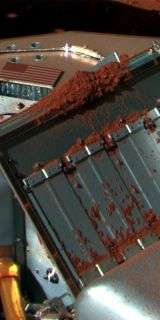
This false-color image shows a soil sample after being delivered to a gap between partially opened doors on the lander's Thermal and Evolved-Gas Analyzer. Image credit: NASA/JPL-Caltech/University of Arizona/Texas A&M University

(PhysOrg.com) -- NASA's Phoenix Mars Lander has continued studies of its landing site by widening a trench, making overnight measurements of conductivity in the Martian soil and depositing a sample of surface soil into a gap between partially opened doors to an analytical oven on the lander.

Phoenix's robotic arm delivered soil Thursday from a trench informally named "Rosy Red" through a narrow opening to a screen above the No. 5 oven on the lander's Thermal and Evolved-Gas Analyzer (TEGA). A few particles of the sample passed through the screen on Thursday, but not enough to fill the oven and allow analysis of the sample to begin. The Phoenix team sent commands for TEGA to vibrate the screen again on Friday, and more material reached the oven, though still not enough to proceed with analysis.

"There appear to be clumps blocking the opening," said Doug Ming of NASA Johnson Space Center, Houston, the Phoenix team's science lead on Friday. "However, we have seen in the past that when this soil sits for a while, it disperses. We intend to fill an oven with this material, either by additional vibration of the same screen or by opening doors to one of the other TEGA cells."

The conductivity measurements completed Wednesday ran from the afternoon of Phoenix's 70th Martian day, or sol, to the morning of Sol 71. A fork-like probe inserted into the soil checks how well heat and electricity move through the soil from one prong to another.

Friday's activities by the spacecraft included extending the width of an exploratory trench informally named "Neverland," which extends between two rocks on the surface of the ground.

Update:
Vibration of the screen above a laboratory oven on NASA's Phoenix Mars Lander on Saturday succeeded in getting enough soil into the oven to begin analysis. Commands were sent for the lander's Thermal and Evolved-Gas Analyzer to begin analysis Sunday of the soil sample from a trench called "Rosy Red."

Provided by NASA


print this article email this article download pdf blog this article bookmark this article     Stumble it Digg this share on Facebook retweet share on Reddit add to delicious
Rate this story - 3.7 /5 (3 votes)


August 11, 2008 all stories

Comments: 0

3.7 /5 (3 votes)
  • Stumble this up

  • Digg this

  • share this

  • hide
  • Related Stories

  • Phoenix Lander Digs and Analyzes Soil as Darkness Gathers
    created Oct 09, 2008 | popularity not rated yet | comments 0
  • Mid-Depth Soil Collected for Lab Test On NASA's Mars Lander
    created Aug 22, 2008 | popularity not rated yet | comments 0
  • Phoenix Lander Has An Oven Full Of Martian Soil
    created Jun 11, 2008 | popularity not rated yet | comments 0
  • Phoenix Mars Lander Will Sprinkle Martian Soil for Microscope to View
    created Jun 10, 2008 | popularity not rated yet | comments 0
  • Phoenix Vibrates Soil on Oven Door
    created Jun 09, 2008 | popularity not rated yet | comments 0


  • hide
  • Relevant PhysicsForums posts

  • The shape of our solar system's orbits.
    created Nov 07, 2009
  • Above or Below the Line of Nodes
    created Nov 07, 2009
  • Supernova vs. Nova?
    created Nov 07, 2009
  • Supernova's Gamma Rays and Comets
    created Nov 06, 2009
  • More from Physics Forums - General Astronomy

Other News

Deep creep means milder, more frequent earthquakes along Southern California's San Jacinto fault

Deep creep means milder, more frequent earthquakes along Southern California's San Jacinto fault

Space & Earth / Earth Sciences

created 15 hours ago | popularity 4.7 / 5 (3) | comments 0

With an average of four mini-earthquakes per day, Southern California's San Jacinto fault constantly adjusts to make it a less likely candidate for a major earthquake than its quiet neighbor to the east, the ...


Success in 'space elevator' competition (AP)

Success in 'space elevator' competition (Update 3)

Space & Earth / Space Exploration

created Nov 05, 2009 | popularity 4.3 / 5 (33) | comments 50

(AP) -- A robot powered by a ground-based laser beam climbed a long cable dangling from a helicopter on Wednesday to qualify for prize money in a $2 million competition to test the potential reality of the ...


In a Galaxy Far, Far Away...

In a Galaxy Far, Far Away...

Space & Earth / Astronomy

created Nov 06, 2009 | popularity 4.8 / 5 (5) | comments 17

(PhysOrg.com) -- Astronomers have published the discovery of the farthest known object in the cosmos: a star that exploded when the universe was only 630 million years old -- only 4.6% of its current age. ...


'Dropouts' pinpoint earliest galaxies

'Dropouts' pinpoint earliest galaxies

Space & Earth / Astronomy

created Nov 06, 2009 | popularity 4.2 / 5 (10) | comments 13

Astronomers, conducting the broadest survey to date of galaxies from about 800 million years after the Big Bang, have found 22 early galaxies and confirmed the age of one by its characteristic hydrogen signature ...


Space hotel taking bookings for 2012 opening

Space hotel taking bookings for 2012 opening

Space & Earth / Space Exploration

created Nov 05, 2009 | popularity 4.4 / 5 (21) | comments 11

(PhysOrg.com) -- The first orbiting space hotel is on track to open for its first customers in 2012, but hurry, as bookings are filling fast.