Southern Ocean seals dive deep for climate data
August 11, 2008 Southern Ocean seals dive deep for climate data

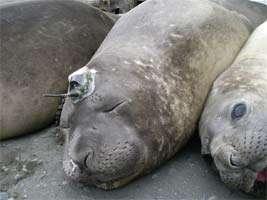
The tag on an elephant seal on South Georgia. Image credit – Dr Martin Biuw

(PhysOrg.com) -- Elephant seals are helping scientists overcome a critical blind-spot in their ability to detect change in Southern Ocean circulation and sea ice production and its influence on global climate.

According to a paper published today by a team of French, Australian, US and British scientists in the Proceedings of the National Academy of Sciences, elephant seals fitted with special oceanographic sensors are providing a 30-fold increase in data recorded in parts of the Southern Ocean rarely observed using traditional ocean monitoring techniques.

“They have made it possible for us to observe large areas of the ocean under the sea ice in winter for the first time,” says co-author Dr Steve Rintoul from the Antarctic Climate & Ecosystem Cooperative Research Centre (ACE CRC) and CSIRO’s Wealth from Oceans National Research Flagship.

"Conventional oceanographic platforms cannot provide observations under the sea ice, particularly on the Antarctic continental shelf where the most important water mass transformations take place. Until now, our ability to represent the high-latitude oceans and sea ice in oceanographic and climate models has suffered as a result.”

Co-author, University of Tasmania Professor Mark Hindell says the seal data complements traditional oceanographic sampling from ships, satellites and drifting buoys. “By providing ocean measurements under the sea ice, the seals are helping us to establish the global ocean observing system we need to detect and understand changes in the ocean,” he says.

The polar regions play an important role in the earth’s climate system and are changing more rapidly than any other part of the world. In the southern hemisphere, the limited observations available suggest that the circumpolar Southern Ocean has warmed more rapidly than the global ocean average and that the dense water formed near Antarctica and exported to lower latitudes has freshened in some locations and warmed in others. Polar changes are important because a number of feedbacks involving ocean currents, sea ice and the carbon cycle have the potential to accelerate the rate of change.

The seals typically covered a distance of 35-65 kilometres a day with a total of 16,500 profiles obtained in 2004-5. Of these, 8,200 were obtained south of 60S, nine times more than have been obtained from floats and research and supply ships. The 4,520 profiles obtained within the sea ice is a 30-fold increase over conventional data. The seals dived repeatedly to a depth of more than 500 metres on average and to a maximum depth of nearly 2000m. The Australian team included scientists from CSIRO, the ACE CRC, the University of Tasmania's School of Zoology and Centre for Marine Science and Charles Darwin University.

Provided by CSIRO


print this article email this article download pdf blog this article bookmark this article     Stumble it Digg this share on Facebook retweet share on Reddit add to delicious
Rate this story - 5 /5 (3 votes)


August 11, 2008 all stories

Comments: 0

5 /5 (3 votes)
  • Stumble this up

  • Digg this

  • share this

  • hide
  • Related Stories

  • Mysteriously warm times in Antarctica
    created Nov 18, 2009 | popularity not rated yet | comments 0
  • Freezing: a phenomenon that 'jumps'
    created Nov 16, 2009 | popularity not rated yet | comments 0
  • How much water does the ocean have?
    created Nov 12, 2009 | popularity not rated yet | comments 0
  • Australian scientists call for urgent 'global cooling' to save coral reefs
    created Nov 09, 2009 | popularity not rated yet | comments 0
  • Antarctica glacier retreat creates new carbon dioxide store
    created Nov 09, 2009 | popularity not rated yet | comments 0


  • hide
  • Relevant PhysicsForums posts

  • The IPCC and the term "most"
    created Nov 23, 2009
  • Is global warming a fact?
    created Nov 23, 2009
  • Random variability of wind patterns
    created Nov 23, 2009
  • Record precipitation in the UK
    created Nov 22, 2009
  • More from Physics Forums - Earth

Other News

Past regional cold and warm periods linked to natural climate drivers

Space & Earth / Earth Sciences

created 11 minutes ago | popularity not rated yet | comments 0

Intervals of regional warmth and cold in the past are linked to the El Niño phenomenon and the so-called "North Atlantic Oscillation" in the Northern hemisphere's jet stream, according to a team of climate scientists. These ...


Astronauts surprised by holiday turkey dinners (AP)

Astronauts surprised by holiday turkey dinners

Space & Earth / Space Exploration

created 3 hours ago | popularity not rated yet | comments 0

(AP) -- Space shuttle Atlantis' astronauts thought they were going to give thanks with pantry leftovers Thursday as their mission drew to a close, but found turkey dinners awaiting them.


Gullies and Flow Features on Crater Wall

Gullies and Flow Features on Crater Wall

Space & Earth / Space Exploration

created 3 hours ago | popularity not rated yet | comments 0

(PhysOrg.com) -- This image from the High Resolution Imaging Science Experiment (HiRISE) camera on NASA's Mars Reconnaissance Orbiter shows a sample of the variety and complexity of processes that may occur ...


Russia: no space for space tourists (AP)

Russia: no space for space tourists

Space & Earth / Space Exploration

created 7 hours ago | popularity 2.7 / 5 (3) | comments 2

(AP) -- A top Russian space official says there is no space for tourists wishing to fly to the International Space Station.


Monster Waves on the Sun are Real

Monster Waves on the Sun are Real (w/ Video)

Space & Earth / Astronomy

created 20 hours ago | popularity 4.9 / 5 (15) | comments 2

Sometimes you really can believe your eyes. That's what NASA's STEREO (Solar Terrestrial Relations Observatory) spacecraft are telling researchers about a controversial phenomenon on the sun known as the "solar ...