Research supports suggestions that global warming will do little to change hurricane activity
August 12th, 2008 A Sharper View of Hurricanes

Enlarge

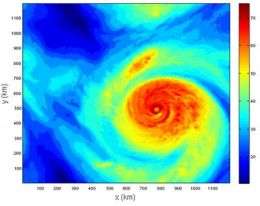
Figure shows an example of a hurricane computer simulation generated by the Rosenstiel School team. The colors indicate water vapor in a vertical column of the atmosphere, where the dark red areas would indicate extremely heavy rainfall. The small size of each pixel, 3 km x 3 km provides remarkably accurate detail in the storm. In comparison, the number of pixels in an image used to represent storms in global climate models are typically 100 km x 100 km, at best. Credit: UM/RSMAS

In a study published in the July 2008 issue of Geophysical Research Letters, Drs. David S. Nolan and Eric D. Rappin from the University of Miami's Rosenstiel School of Marine and Atmospheric Science describe a new method for evaluating the frequency of hurricane formation in present and future tropical climates. While current thinking about changes in hurricane frequency comes mostly from computer simulations of global climate, the computer models used for these studies can only represent the coarsest features of hurricanes, thus casting doubt in their predictions of hurricane activity.

The new approach by Nolan and Rappin, developed in collaboration with Dr. Kerry Emanuel of the Massachusetts Institute of Technology, uses computer models with much more accurate representation of the processes that lead to hurricane formation, much the same way a digital image with more pixels allows for a more detailed photographic image.

The models are used to simulate the rate of hurricane development in tropical atmospheres with varying values of sea surface temperature and vertical wind shear (which is the extent to which wind speed and direction changes with height in the atmosphere). These two variables – ocean temperature and wind shear -- are considered to be the two most important factors in predicting hurricane activity, both in operational forecasting and in consideration of climate change.

"We designed the computer simulations to show that as the ocean temperature increased, hurricanes would form more rapidly and easily, even in the presence of wind shear," says Nolan, associate professor of Meteorology at the Rosenstiel School. "Instead, we got exactly the opposite result. As the water temperature increased, the effectiveness of the wind shear in suppressing hurricane formation actually became greater."

The simulations show that if they do form, hurricanes become stronger in the warmer environments. Together, these results suggest that in a global warming world, there would be less hurricanes, but those that do form could become stronger. The same prediction has recently been made by other studies using global climate models, and the similarity of the two predictions enhances confidence in the results.

"The additional aspect that our method offers is a much more accurate picture of the process of tropical storm and hurricane formation, as compared to the global models," Nolan said. "Our ongoing work with this model and others should lead to a much better understanding of the relationship between climate and global hurricane activity."

Source: University of Miami Rosenstiel School of Marine & Atmospheric Science


print this article email this article download pdf blog this article bookmark this article     Digg this Stumble it share on Facebook share on Reddit add to delicious save to Yahoo! bookmarks
3.8/5 after 8 votes


August 12th, 2008 all stories
Space & Earth / Earth Sciences

Comments: 0
Rank: 3.8/5 after 8 votes

  • Stumble this up

  • Digg this

  • Share it:
  • share on Facebook
  • share on MySpace
  • share on Slashdot
  • rss-newsfeed
  • share on Google
  • share on Reddit
  • add to delicious
  • save to Yahoo! bookmarks
  • share on Windows Live
  • Add to Mixx!
Rating: 3.8/5 after 8 votes

  • Related Stories

  • QuikScat Finds Tempests Brewing In 'Ordinary' Storms
    created Jun 26, 2009 | popularity not rated yet | comments 0
  • Hurricanes not likely to disrupt ocean carbon balance
    created Mar 30, 2009 | popularity not rated yet | comments 0
  • Mass media often failing in its coverage of global warming, says climate researcher
    created Feb 13, 2009 | popularity not rated yet | comments 0
  • Satellites Capture Sea Surface Heights Around the World
    created Feb 06, 2009 | popularity not rated yet | comments 0
  • On the trail of polar lows
    created Dec 12, 2008 | popularity not rated yet | comments 0


  • Physicists Demonstrate Quantum Memory with Matter Qubits
    Physicists Demonstrate Quantum Memory with Matter Qubits
    Physics / General Physics
    created Jul 03, 2009 | popularity 4.4 / 5 (17) | comments 1
  • 'Holey' Nanosheets for Wastewater Dye Removal
    Nanotechnology / Nanomaterials
    created Jul 01, 2009 | popularity 5 / 5 (5) | comments 1
  • Jellyfish Robot Swims Like its Biological Counterpart
    Jellyfish Robot Swims Like its Biological Counterpart
    Electronics / Robotics
    created Jun 26, 2009 | popularity 4.4 / 5 (8) | comments 1
  • Could Maxwell's Demon Exist in Nanoscale Systems?
    Could Maxwell's Demon Exist in Nanoscale Systems?
    Physics / General Physics
    created Jun 24, 2009 | popularity 4.4 / 5 (18) | comments 29
  • Living Safely with Robots, Beyond Asimov's Laws
    Living Safely with Robots, Beyond Asimov's Laws
    Electronics / Robotics
    created Jun 22, 2009 | popularity 4.6 / 5 (52) | comments 40
  • Other News

    Steam billows from the cooling towers at a nuclear power generating station in Byron

    Tropical zone expanding due to climate change: study

    Space & Earth / Earth Sciences

    created 56 minutes ago | popularity 5 / 5 (2) | comments 0

    Climate change is rapidly expanding the size of the world's tropical zone, threatening to bring disease and drought to heavily populated areas, an Australian study has found.


    US ambitions to send astronauts back to the moon as a prelude to missions to Mars have been put in doubt

    Forty years ago man first walked on the moon

    Space & Earth / Space Exploration

    created 22 hours ago | popularity 4.3 / 5 (4) | comments 2

    Forty years ago on July 20, 1969, American astronaut Neil Armstrong realized the oldest dream of human civilizations when he became the first man to walk on the moon.


    The least sea ice in 800 years

    The least sea ice in 800 years

    Space & Earth / Earth Sciences

    created Jul 01, 2009 | popularity 4.1 / 5 (64) | comments 60

    New research, which reconstructs the extent of ice in the sea between Greenland and Svalbard from the 13th century to the present indicates that there has never been so little sea ice as there is now. The ...


    Gas around young galaxy

    Intense heat killed the Universe's would-be galaxies, researchers say

    Space & Earth / Astronomy

    created Jul 01, 2009 | popularity 3.4 / 5 (21) | comments 27

    (PhysOrg.com) -- Our Milky Way galaxy only survived because it was already immersed in a large clump of dark matter which trapped gases inside it, scientists led by Durham University's Institute for Computational ...


    Scientists' Drill Hits Magma: Only Third Time on Record

    Scientists' Drill Hits Magma: Only Third Time on Record

    Space & Earth / Earth Sciences

    created Jun 29, 2009 | popularity 4.7 / 5 (22) | comments 21

    (PhysOrg.com) -- Scientists drilling a borehole deep into Iceland’s rocky crust to explore new methods of using geothermal energy hit a major roadblock on Thursday: Their drill ran into molten rock at a depth ...