Researchers Discover Tiny Cellular Antennae Trigger Neural Stem Cells
August 12th, 2008 Researchers Discover Tiny Cellular Antennae Trigger Neural Stem Cells

Enlarge

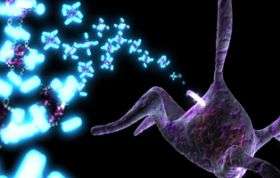
Tiny thread like cilia on brain cells act as sort of an antennae that directs signals telling stem cells to create new neurons.

(PhysOrg.com) -- Yale University scientists today reported evidence suggesting that the tiny cilia found on brain cells of mammals, thought to be vestiges of a primeval past, actually play a critical role in relaying molecular signals that spur creation of neurons in an area of the brain involved in mood, learning and memory. The findings are published online in the journal Proceedings of the National Academy of Science.

The cilia found on brain cells of mammals until recently had been viewed as a mysterious remnant of a distant evolutionary past, when the tiny hair-like structures were used by single-celled organisms to navigate a primordial world.

“Many neuroscientists are shocked to learn that cells in the brain have cilia. Thus it was even more exciting to show that cilia have a key function in regulating the birth of new neurons in the brain,” said Matthew Sarkisian, post doctoral fellow in the department of neurobiology and co-first author on the study.

In the past decade, scientists have discovered primary cilia may have important functions in many animals. For instance, in 2000, Yale University scientists discovered defects in these cilia could lead to rare type of kidney disease. Researchers have been finding new functions for primary cilia ever since.

In the present study, researchers discovered that in mice, primary cilia act like antennae to receive and coordinate signals that spur creation of new brain cells. These cilia receive signals from a key protein required in development called “sonic hedgehog.” When the Yale team deleted genes needed to form primary cilia, they discovered that mice developed significant brain abnormalities including hydrocephalus. They also found that the absence of primary cilia on neural stem cells disrupted the ability of sonic hedgehog to signal neural stem cells to initiate creation of new neurons in the brain.

Furthermore, this group also observed cilia on dividing brain tumor cells. Postdoctoral fellow and co-first author Joshua Breunig said, “Considering sonic hedgehog is also heavily implicated in brain tumor formation, our study places the primary cilium at the crossroads of both regenerative neurobiology and neuro-oncology.”

Authors include: Jon Arellano, Yury Morozov, Albert Ayoub, Sonal Sojitra, Baolin Wang, Richard Flavell, Pasko Rakic (corresponding author) and Terrence Town

The study was funded by the National Institutes of Health and the Kavli Institute.

Citation: PNAS, online publication, Aug. 11

Provided by Yale University


print this article email this article download pdf blog this article bookmark this article     Digg this Stumble it share on Facebook share on Reddit add to delicious save to Yahoo! bookmarks
4.8/5 after 18 votes

Rank Filter

Move the slider to adjust rank threshold, so that you can hide some of the comments.


Display comments: newest first

  • gmurphy - Aug 13, 2008
    • Rank: not rated yet
    hey, maybe the cila are used by the neurons to move to their intended destination?, I know that in the formation of an embryos brain, the neurons are created in the centre of the brain and then migrate outwards along special channels.

August 12th, 2008 all stories
Biology /

Comments: 1
Rank: 4.8/5 after 18 votes

  • Stumble this up

  • Digg this

  • Share it:
  • share on Facebook
  • share on MySpace
  • share on Slashdot
  • rss-newsfeed
  • share on Google
  • share on Reddit
  • add to delicious
  • save to Yahoo! bookmarks
  • share on Windows Live
  • Add to Mixx!
Rating: 4.8/5 after 18 votes

  • Related Stories

  • Scientists identify cells for spinal-cord repair
    created Jul 22, 2008 | popularity not rated yet | comments 0
  • Study identifies cells for spinal-cord repair
    created Jul 18, 2008 | popularity not rated yet | comments 0
  • St. Jude finds 'dancing' hair cells are key to humans' acute hearing
    created May 07, 2008 | popularity not rated yet | comments 0
  • Can You Feel The Heat? Your Cilia Can
    created Oct 24, 2007 | popularity not rated yet | comments 0
  • Loss of cell's 'antenna' linked to cancer's development
    created Jun 28, 2007 | popularity not rated yet | comments 0


  • Physicists Demonstrate Quantum Memory with Matter Qubits
    Physicists Demonstrate Quantum Memory with Matter Qubits
    Physics / General Physics
    created Jul 03, 2009 | popularity 4.4 / 5 (17) | comments 1
  • 'Holey' Nanosheets for Wastewater Dye Removal
    Nanotechnology / Nanomaterials
    created Jul 01, 2009 | popularity 5 / 5 (5) | comments 1
  • Jellyfish Robot Swims Like its Biological Counterpart
    Jellyfish Robot Swims Like its Biological Counterpart
    Electronics / Robotics
    created Jun 26, 2009 | popularity 4.4 / 5 (8) | comments 1
  • Could Maxwell's Demon Exist in Nanoscale Systems?
    Could Maxwell's Demon Exist in Nanoscale Systems?
    Physics / General Physics
    created Jun 24, 2009 | popularity 4.4 / 5 (18) | comments 29
  • Living Safely with Robots, Beyond Asimov's Laws
    Living Safely with Robots, Beyond Asimov's Laws
    Electronics / Robotics
    created Jun 22, 2009 | popularity 4.6 / 5 (53) | comments 40
  • Other News

    Battle of the sexes benefits offspring, says research

    Battle of the sexes benefits offspring, says research

    Biology / Plants & Animals

    created 45 minutes ago | popularity not rated yet | comments 0

    Parents compensate for a lazy partner by working harder to bring up their offspring, but not enough to completely make up for the lack of parenting, says research by bird biologists at the University of Bath.


    Researchers uncover the potential for super-sized abalone

    Biology / Microbiology

    created 4 hours ago | popularity not rated yet | comments 0

    (PhysOrg.com) -- Designer abalone could be an option in the foreseeable future, thanks to a project conducted at UQ's Heron Island Research Station and the St Lucia campus.


    Scientists 'rebuild' giant moa using ancient DNA

    Biology / Plants & Animals

    created Jul 01, 2009 | popularity 5 / 5 (10) | comments 12

    (PhysOrg.com) -- Scientists have performed the first DNA-based reconstruction of the giant extinct moa bird, using prehistoric feathers recovered from caves and rock shelters in New Zealand.


    Pacific Giant Salamander (Dicamptodon tenebrosus)

    Salamanders, regenerative wonders, heal like mammals, people

    Biology / Microbiology

    created Jul 01, 2009 | popularity 5 / 5 (20) | comments 11

    The salamander is a superhero of regeneration, able to replace lost limbs, damaged lungs, sliced spinal cord -- even bits of lopped-off brain. But it turns out that remarkable ability isn't so mysterious after ...


    California water plan aims to save Puget Sound orcas

    Biology / Ecology

    created 20 hours ago | popularity 4 / 5 (1) | comments 0

    A plan to restore salmon runs on California's Sacramento River also could help revive killer whale populations 700 miles to the north in Puget Sound, as federal scientists struggle to protect endangered species in a complex ...