'Top Secret' Technology To Help U.S. Swimmers Trim Times at Beijing Olympics
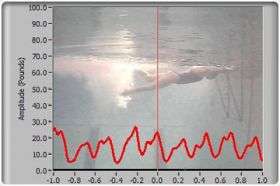
(PhysOrg.com) -- Milliseconds can mean the difference between triumph and defeat in the world of Olympic sports, leading more trainers and athletes to look toward technology as a tool to get an edge on the competition.
A fluids mechanics professor at Rensselaer Polytechnic Institute in Troy, N.Y., is using experimental flow measurement techniques to help American swimmers sharpen their strokes, shave seconds from their lap times, and race toward a gold medal in Beijing this summer.
Professor Timothy Wei, head of Rensselaer’s Department of Mechanical, Aerospace, and Nuclear Engineering and acting dean of the university’s School of Engineering, helped develop top-secret, state-of-the-art equipment and mathematical techniques that USA Swimming coaches have been using to help train Olympians.
“This is the real thing,” Wei said. “We have the physical system, we’re taking flow measurements of actual swimmers, and we’re getting more information than anyone has ever had before about swimming and how the swimmer interacts with the water. And so far, these techniques have contributed to some very significant improvements in the lap times of Olympic swimmers.”
In years past, swimming coaches have used computer modeling and simulation to hone the techniques of athletes. But Wei developed state-of-the-art water flow diagnostic technologies, modifying and combining force measurement tools developed for aerospace research with a video-based flow measurement technique known as Digital Particle Image Velocimetry (DPIV), in order to create a robust training tool that reports the performance of a swimmer in real-time.
“This project moved the swimming world beyond the observational into scientific fact,” said USA Swimming Coach Sean Hutchison. “The knowledge gained gave me the foundation for which every technical stroke change in preparation for the Beijing Olympics was based.”
You can see one of the videos, of 2008 Olympian Megan Jendrick, here: www.rpi.edu/news/video/wei/videos.html
The secret, Wei said, is in understanding how the water moves. The new system incorporates highly sophisticated mathematics with stop-motion video technology to identify key vortices, pinpoint the movement of the water, and compute how much energy the swimmer exerts.
“You have to know the flow,” Wei said. “To see how a swimmer’s motion affects the flow, you need to know how much force the swimmer is producing, and how that force impacts the water.”
“Swimming research has strived to understand water flow around a swimmer for decades because how a swimmer’s body moves the surrounding water is everything,” said USA Swimming’s Biomechanics Manager Russell Mark. “The ability to measure flow and forces in a natural and unimpeded environment hasn’t been available until recently, and Dr. Wei’s technology and methods presented USA Swimming with a unique opportunity that United States swimmers and coaches could learn a lot from.”
Wei has been working with USA Swimming for several years, but the idea and design of the new flow measurement tool really took shape in 2007. Most of the preliminary tests were conducted in October 2007, and the coaches and swimmers have spent the past several months incorporating what they have learned into their training regimes. For any swimmer, it takes time to make adjustments to their strokes and practice new techniques, Wei said.
One highlight of working on the project was when Mark arranged for Wei to attend the 2007 and 2008 U.S. Summer Nationals and be on deck with the swimmers.
“How often does a researcher get to do something like this?” said Wei, whose young son and daughter also swim competitively. “It’s been a journey into a world that someone like me would have never before gotten the privilege to see first-hand.”
Wei began his research career as an aeronautical and mechanical engineer, including hydrodynamics research for the U.S. Navy. But lately he has expanded into bio-related research, such as working with a vascular surgeon to study effects of flow over endothelial cells, and partnering with a neurosurgeon to understand the mechanisms behind hydrocephalus, or excess fluid in the brain.
As a young researcher, Wei dreamed of measuring flow around swimming whales, but the idea never progressed to fruition. Recently, however, in the midst of his work with USA Swimming, Wei worked with marine biologists Frank Fish and Terrie Williams to measure the flow around swimming bottlenose dolphins at the University of California, Santa Cruz.
Wei said he’s confident that the United States will have a strong showing in swimming at the 2008 Olympics in Beijing, and that he’s already thinking of ways to improve his technology to be even more effective when training swimmers to compete in the 2012 London Olympics.
“It’s been a wonderful, unique experience,” he said. “It’s everyone’s dream to make a difference, and I’m excited to keep helping the team for as long as they need me.”
Wei is also currently working with the U.S. Olympic skeleton team and looking at new flow measurement techniques to help shave precious milliseconds off downhill times.
Provided by Rensselaer Polytechnic Institute


