Strange molecule in the sky cleans acid rain, scientists discover
August 12, 2008 Strange molecule in the sky cleans acid rain, scientists discover

Enlarge

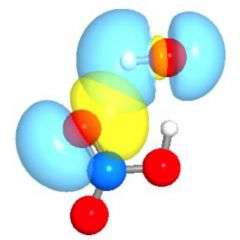
Scientists at Purdue and Pennsylvania universities have discovered an atmospheric molecule that is essential to the breakdown of pollutants in the atmosphere. The molecule, which had not been seen before, is unusual because it has two hydrogen bonds. This image shows the structure of the molecule, with the blue ball being a nitrogen atom, red representing hydrogen atoms, white representing oxygen atoms, and the yellow clouds showing the location of the double hydrogen bonds. (Purdue News Service image/Joseph Francisco)

Researchers have discovered an unusual molecule that is essential to the atmosphere's ability to break down pollutants, especially the compounds that cause acid rain. It's the unusual chemistry facilitated by this molecule, however, that will attract the most attention from scientists.

Marsha Lester, the University of Pennsylvania's Edmund J. Kahn Distinguished Professor, and Joseph Francisco, William E. Moore Distinguished Professor of Chemistry at Purdue University, found the molecule, which had puzzled and eluded scientists for more than 40 years.

A technical paper describing the molecule is published this week in a special edition of the Proceedings of the National Academy of Science.

Somewhat like a human body metabolizing food, the Earth's atmosphere has the ability to "burn," or oxidize pollutants, especially nitric oxides emitted from sources such as factories and automobiles. What doesn't get oxidized in the atmosphere falls back to Earth in the form of acid rain.

"The chemical details of how the atmosphere removes nitric acid have not been clear," Francisco says. "This gives us important insights into this process. Without that knowledge we really can't understand the conditions under which nitric acid is removed from the atmosphere."

Francisco says the discovery will allow scientists to better model how pollutants react in the atmosphere and to predict potential outcomes.

"This becomes important in emerging industrial nations such as China, India and Brazil where there are automobiles and factories that are unregulated," Francisco says. "This chemistry will give us insight into the extent that acid rain will be a future concern."

Lester says the molecule had been theorized by atmospheric chemists for 40 years and that she and Francisco had pursued it for the past several years.

"We've speculated about this unusual atmospheric species for many years, and then to actually see it and learn about its properties was very exciting," she says.

What makes the molecule so unusual is its two hydrogen bonds, which are similar to those found in water.

Chemists know that although water is one of the most common substances found on the planet, it has unusual properties. For example, the solid form - ice - is lighter than the liquid form and floats. Water also boils at a much higher temperature than would be expected from its chemical structure.

The cause of these strange behaviors are weak hydrogen bonds that hold water molecules together.

The new atmospheric molecule has two hydrogen bonds, which allows it to form a six-sided ring structure. Hydrogen bonds are usually weaker than the normal bonds between atoms in a molecule, which are known as covalent bonds. In fact, covalent bonds are 20 times stronger than hydrogen bonds. But in this case, these two hydrogen bonds are strong enough to affect atmospheric chemistry, Francisco says.

Lester says the new molecule exhibits its own unusual properties.

"The reaction involving this molecule proceeds faster as you go to lower temperatures, which is the opposite of most chemical reactions," she says. "The rate of reaction also changes depending on the atmospheric pressure, and most reactions don't depend on external pressure. The molecule also exhibits unusual quantum properties."

Lester says the unusual properties prevented scientists from being able to model the reaction for so long.

"This is not how we explain chemistry to high school students," she says.

Francisco says that this discovery will be used in areas other than atmospheric chemistry.

"Here's a situation where we were studying this purely environmental problem, but, because the findings are so fundamental, it may have broader ramifications to biological systems that depend on hydrogen bonds," he says.

The breakthrough was enabled by laser-based laboratory techniques at the University of Pennsylvania and the supercomputing resources available at Purdue, Francisco says. The computation was done on an SGI Altix supercomputer operated by the Office of Information Technology at Purdue.

"The key is knowing where to look and how to identify new chemical entities, and with the computing resources we have at Purdue we can help identify processes to within experimental uncertainty," he says. "We couldn't have done this without the supercomputing power that we have available."

Source: Purdue University


print this article email this article download pdf blog this article bookmark this article     Stumble it Digg this share on Facebook retweet share on Reddit add to delicious
Rate this story - 4.2 /5 (48 votes)

Rank Filter

Move the slider to adjust rank threshold, so that you can hide some of the comments.


Display comments: newest first

  • TJ_alberta - Aug 12, 2008
    • Rank: 3 / 5 (1)
    "The new atmospheric molecule has two hydrogen bonds, which allows it to form a six-sided ring structure." I don't have access to the original article. Can someone please explain how two hydrogen bonds make a size sided ring?
  • Arikin - Aug 12, 2008
    • Rank: 2.3 / 5 (3)
    Discovery by computation? So no actual sampling from the atmosphere?? Does it actually exist in nature or is this mathematical proof of a theory?
  • Trippy - Aug 13, 2008
    • Rank: 5 / 5 (1)
    ...red representing hydrogen atoms, white representing oxygen atoms...


    And yet nobodies commented on this obvious error...

    Hydrogen Double (covalent) bonding with /anything/?

    It should be the other way around, Red is Oxygen, white is hydrogen.
  • Trippy - Aug 13, 2008
    • Rank: not rated yet
    "The new atmospheric molecule has two hydrogen bonds, which allows it to form a six-sided ring structure." I don't have access to the original article. Can someone please explain how two hydrogen bonds make a size sided ring?


    Because the Hydrogen bonds form 2 of the 6 sides.

    On one side of the hydrigen bonds you have

    H-O

    And on the other side you have:

    O=N-O-H

    With the hydrogen bonds being between the terminal hydrogen and oxygen atoms (as drawn above).
  • superhuman - Aug 13, 2008
    • Rank: 3 / 5 (2)
    Scientists discovered new molecule yet the dumb article wont even tell us what it is!

    I can guess from the picture that its supposed to be NO3- OH- or NO3- OH*.

    Besides nitric oxide (NO3-) can't be oxidized any further, it can only be reduced, how this new molecule is supposed to do it isn't explained either.
  • nano999 - Aug 13, 2008
    • Rank: 3 / 5 (2)
    Terrible article. Is this the best writing that Perdue University can produce?
  • Velanarris - Aug 13, 2008
    • Rank: 1 / 5 (1)
    ...red representing hydrogen atoms, white representing oxygen atoms...


    And yet nobodies commented on this obvious error...

    Hydrogen Double (covalent) bonding with /anything/?

    It should be the other way around, Red is Oxygen, white is hydrogen.


    Two single hydrogen atoms both forming a single bond is a double hydrogen bond.

    Not a covalent bond, which hydrogen cannot perform.
  • Trippy - Aug 13, 2008
    • Rank: 5 / 5 (1)
    ...red representing hydrogen atoms, white representing oxygen atoms...


    And yet nobodies commented on this obvious error...

    Hydrogen Double (covalent) bonding with /anything/?

    It should be the other way around, Red is Oxygen, white is hydrogen.


    Two single hydrogen atoms both forming a single bond is a double hydrogen bond.

    Not a covalent bond, which hydrogen cannot perform.


    This may sound rude, but congratulations on missing the point.

    First off, I explicitly stated in my post that I was talking about covalent bonds.

    Secondly, I was referring to the picture included with the article that describes the red atoms as being hydrogen, and forming a covalent double bond with the blue atom (that is, after all what the sticks are supposed to represent, covalent bonds).

    Thirdly (and finally) Hydrogen does form covalent bonds, on a regular basis.
  • Trippy - Aug 17, 2008
    • Rank: not rated yet
    Nano999, Superhuman.

    Had you done a little research, you would have found the original article here:

    http://news.uns.p...one.html

    Which would have led you to the following PNAS article:

    http://www.pnas.o...f623e246

    Which essentially explains that the molecule pictured is a reaction intermediate in the oxidation of nitric acid to Nitrogen trioxide (N IV -> N V IIRC) by a hydroxyl radical (water being the other product)

August 12, 2008 all stories

Comments: 9

4.2 /5 (48 votes)
  • Stumble this up

  • Digg this

  • share this

  • hide
  • Related Stories

  • Ice Gets Bent Out of Shape
    created Sep 09, 2009 | popularity not rated yet | comments 0
  • Researchers reveal the internal dance of water
    created Aug 12, 2009 | popularity not rated yet | comments 0
  • Nanophysics: Serving up Buckyballs on a silver platter
    created Jul 27, 2009 | popularity not rated yet | comments 0
  • Researchers describe 'implausible' chemistry that produces herbicidal compound
    created Jun 10, 2009 | popularity not rated yet | comments 0
  • A New Family of Molecules for Self-Assembly: The Carboranes
    created Mar 24, 2009 | popularity not rated yet | comments 0


Other News

New hydrogen-storage method discovered

New hydrogen-storage method discovered

Chemistry / Materials Science

created 9 hours ago | popularity 4.4 / 5 (21) | comments 2

Scientists at the Carnegie Institution have found for the first time that high pressure can be used to make a unique hydrogen-storage material. The discovery paves the way for an entirely new way to approach ...


Accidental discovery produces durable new blue pigment for multiple applications

Accidental discovery produces durable new blue pigment for multiple applications

Chemistry / Biochemistry

created Nov 16, 2009 | popularity 4.5 / 5 (32) | comments 6

An accidental discovery in a laboratory at Oregon State University has apparently solved a quest that over thousands of years has absorbed the energies of ancient Egyptians, the Han dynasty in China, Mayan ...


New on-off 'switch' triggers and reverses paralysis in animals with a beam of light

New on-off 'switch' triggers and reverses paralysis in animals with a beam of light (w/ Video)

Chemistry / Biochemistry

created Nov 18, 2009 | popularity 4.8 / 5 (5) | comments 4

In an advance with overtones of Star Trek phasers and other sci-fi ray guns, scientists in Canada are reporting development of an internal on-off "switch" that paralyzes animals when exposed to a beam of ultraviolet ...


One word: bioplastics

One word: bioplastics

Chemistry / Materials Science

created Nov 17, 2009 | popularity 4.6 / 5 (13) | comments 4

(PhysOrg.com) -- Every year, more than 250 billion pounds of plastic are produced worldwide. Much of it ends up in the world's oceans, a fact that troubles MIT biology professor Anthony Sinskey.


New research provides blueprint for molecular basis of global warming

New research provides blueprint for molecular basis of global warming

Chemistry / Materials Science

created Nov 17, 2009 | popularity 4 / 5 (4) | comments 3

A new study indicates that major chemicals most often cited as leading causes of climate change, such as carbon dioxide and methane, are outclassed in their warming potential by compounds receiving less attention.