Robot with a Biological Brain: new research provides insights into how the brain works
August 13th, 2008 Robot with a Biological Brain: new research provides insights into how the brain works

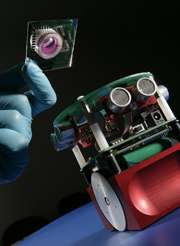
Robot with a biological brain.

(PhysOrg.com) -- A multidisciplinary team at the University of Reading has developed a robot which is controlled by a biological brain formed from cultured neurons. This cutting edge research is the first step to examine how memories manifest themselves in the brain, and how a brain stores specific pieces of data. The key aim is that eventually this will lead to a better understanding of development and of diseases and disorders which affect the brain such as Alzheimer's Disease, Parkinson's Disease, stroke and brain injury.

The robot's biological brain is made up of cultured neurons which are placed onto a multi electrode array (MEA). The MEA is a dish with approximately 60 electrodes which pick up the electrical signals generated by the cells. This is then used to drive the movement of the robot.

Every time the robot nears an object, signals are directed to stimulate the brain by means of the electrodes. In response, the brain's output is used to drive the wheels of the robot, left and right, so that it moves around in an attempt to avoid hitting objects. The robot has no additional control from a human or a computer, its sole means of control is from its own brain.

The researchers are now working towards getting the robot to learn by applying different signals as it moves into predefined positions. It is hoped that as the learning progresses, it will be possible to witness how memories manifest themselves in the brain when the robot revisits familiar territory.

Professor Kevin Warwick from the School of Systems Engineering, said: "This new research is tremendously exciting as firstly the biological brain controls its own moving robot body, and secondly it will enable us to investigate how the brain learns and memorises its experiences. This research will move our understanding forward of how brains work, and could have a profound effect on many areas of science and medicine."

Dr Ben Whalley from the School of Pharmacy, said: "One of the fundamental questions that scientists are facing today is how we link the activity of individual neurons with the complex behaviours that we see in whole organisms. This project gives us a really unique opportunity to look at something which may exhibit complex behaviours, but still remain closely tied to the activity of individual neurons. Hopefully we can use that to go some of the way to answer some of these very fundamental questions. "

Provided by University of Reading


print this article email this article download pdf blog this article bookmark this article     Digg this Stumble it share on Facebook share on Reddit add to delicious save to Yahoo! bookmarks
4.7/5 after 130 votes

Rank Filter

Move the slider to adjust rank threshold, so that you can hide some of the comments.


Display comments: newest first

  • SmartK8 - Aug 13, 2008
    • Rank: 3.7 / 5 (3)
    Warwick is awesome!
  • Ty1 - Aug 13, 2008
    • Rank: 3.7 / 5 (3)
    Absolutely fascinating.
  • googleplex - Aug 13, 2008
    • Rank: 3.2 / 5 (9)
    ...But without external stimulation, the brain will wither and die within a couple of months...

    This implies that the less one uses ones brain the more cells die off. This self pruning means we should all try to keep brains active. The induced coma from TV literally destroys brain cell development.
  • karmaFTW - Aug 13, 2008
    • Rank: 3.4 / 5 (5)
    this is sweet. one step closer to making organic thinking machines. scary concept but cool nonetheless.
  • Palli - Aug 13, 2008
    • Rank: 3 / 5 (5)
    OMFG! no seriously
  • PronoMan - Aug 14, 2008
    • Rank: 3.3 / 5 (7)
    Hello and welcome to Skynet.....Have you seen Sarah Conner?
  • ancible - Aug 14, 2008
    • Rank: 3.7 / 5 (3)
    http://www.techno...sNum=241

    Here is a very close example all the way back from 2004.
  • SongDog - Aug 14, 2008
    • Rank: 2 / 5 (4)
    These guys won't be able to resist trying human brain cells, ethics be damned.
  • SmartK8 - Aug 14, 2008
    • Rank: 1.8 / 5 (4)
    SongDog: If so I would be a glad donor of the sample for cultivation. I've got plenty. :P

    And.. Ethics be damned, reason proveil. :D
  • jburchel - Aug 14, 2008
    • Rank: 3 / 5 (3)
    Uh, what a dufus... TV may not be politically popular with lame-brain fascists who like to tell other people how to spend their free time, but TV is stimulus, regardless, if anything, probably EXCESSIVE stimulation from TV would be the danger, not lack of it. This isn't referring to being a couch potato at all, but to a complete lack of stimulus to the neurons. A sensory deprivation tank wouldn't even achieve that since the body is constantly providing stimulus to brain cells, so the analogy the commenter makes is totally fallacious.

    Pretty cool article and experiment though I think.

    Just one other comment... another idiot who says "ethics be damned, reason prevail" obviously missed the fact that any sane system of ethics must be based on reasoned arguments to start out with, regardless of whether the reason is based on some religious presumption or simply on cold facts. Ethics cannot be damned by definition if reason actually prevails. For most people who have said similar things in history, neither ended up being the case (Nazi, fascist, communist, and other atheistic ideologies' "brilliant" and totally evil experiments on humans, etc.)

    ...But without external stimulation, the brain will wither and die within a couple of months...

    This implies that the less one uses ones brain the more cells die off. This self pruning means we should all try to keep brains active. The induced coma from TV literally destroys brain cell development.
  • General_Haberdashery - Aug 14, 2008
    • Rank: 2 / 5 (3)
    Umm, is there a perceivable advantage to using 50,000 human neurons vs. 50,000 rat ones?

    If there really is a quality issue let's just use some dolphin neurons or something.
  • Blueflame - Aug 15, 2008
    • Rank: 2 / 5 (2)
    Do think these neurons have the ability to multiply further in order to create a more efficient brain structure?

    My opinion is that no, they can't due to the fact that in order to multiply they need a medium on which to feed off of. If they were to multiply however, I believe that the structure would adapt to it's environment to create an efficient structure to perform its tasks given that this pattern in nature is very obvious.

    and also:

    Does anyone think that these human-cultured brains could ever out perform a man made computer in a calculation?

    Once again, I believe no would be the answer. It is just a brain just like all of ours and unlike brains, computers have highly conductive materials that allow electrons to fly through the extremely efficient chips.
  • EarthScientist - Aug 16, 2008
    • Rank: 1 / 5 (6)
    Okay folks,neurons are just connections and have the ability to function electrically. The grain of sand that is your dot,or whole brain just uses the chambers of the brain to work the nerve fields of the bodys different processes. That dot is grown,it is a salt,it like a silicon chip can store energy and information in its matrix. It is located in the pineal gland and runs off the aetheric component of the oxygens that provide our bodys energy field and nervous system energy.

    That oxygens frequency that the body needs is de-coupled in the lungs by a nodal network that separates out the aether from the oxygen. There have been tests that prove that frequency to be in the 44.6 range which is the same as the oxygens frequency coming into the planet.

    Dot programming and modus of propagation into the formation of the human brain is one of the fields I protocol in.

    That brain/dot responds to frequency stimuli,as any component of your body can be shut down ,sped up, or parameters changed with a simple frequency.

    It happens to you all constantly as natural and friendly and unfriendly protocolers work in your field.

    The ovum and sperm MUST have a dot to begin the human body,as its nerve feeds grow into the brain and the genetics make the body structure in collusion with that dot.

    Bottom line with that statement is that your "DOT PROVIDER" determines some of your genetics and "ALL" of your intellect as you are a grown matrix of that dot provider,and there are male and female dot providers.

    Now could you possibly guess that if one of the dot providers became dis-cordant by their "Process" that that DOT"SOUL" might not be at the correct frequency and jump on the wrong gender egg, and VIOLA!!! You get the natural homosexuals and the women who look like construction workers and the pretty boys that want to dress up.

    And only us old "Dot Papas" know these things,but I share as we really need to fix something very ,very destructive in our paradigm and only real information on brain science will start the process of repairing many problems that humanity faces at this time.

    So,anyway,the neuron boys can play all they want,they will not succeed,but I think they should take their junk science to their basement and return their research money so they will fix the potholes in the road going to my house.....
  • superhuman - Aug 18, 2008
    • Rank: 1 / 5 (2)
    It will be fascinating if it works which I doubt.

    It would make more sense to first simulate simple environments instead of putting neurons into a robot and hoping it will start talking.
  • dynamoJ - Aug 18, 2008
    • Rank: not rated yet
    ooo EarthScientist...
  • panther_1504 - Aug 24, 2008
    • Rank: not rated yet
    HEY ! guys , take hem seriously .
    this is really interesting and for people like me it sounds some real food for my brain .
    if you guys have no or foolish comments don't leave them here .
    this will not help in understanding how the brain works .
    the work is really admirable !
  • RainTech - Sep 03, 2008
    • Rank: not rated yet
    I don't think like peoples who wrote bad things about organic brain in robotic things, so it sounds like first of all starting of perfection. Why? Firstly we'll need think-able robotics in spacecrafts, air-based (technology that using aerodynamics or something like else) basically approximately we need them in our life's dangerous points. But I wonder, how can they make a computer that can uses massive functions (so massively the functional areas are investigated, I know so) of brain...

    This is the start point...
    And I think, it'll be start of perfection in human life...

August 13th, 2008 all stories
Electronics / Robotics

Comments: 17
Rank: 4.7/5 after 130 votes

  • Stumble this up

  • Digg this

  • Share it:
  • share on Facebook
  • share on MySpace
  • share on Slashdot
  • rss-newsfeed
  • share on Google
  • share on Reddit
  • add to delicious
  • save to Yahoo! bookmarks
  • share on Windows Live
  • Add to Mixx!
Rating: 4.7/5 after 130 votes

  • Related Stories

  • A scientist probes the origins of 'ouch!'
    created Jul 02, 2009 | popularity not rated yet | comments 0
  • Researchers find new actions of neurochemicals (w/ Video)
    created Jul 02, 2009 | popularity not rated yet | comments 0
  • Blood stem cell growth factor reverses memory decline in mice
    created Jul 01, 2009 | popularity not rated yet | comments 0
  • Neural stem cell differentiation factor discovered
    created Jun 30, 2009 | popularity not rated yet | comments 0
  • Biology knows best -- human-like vision lets robots navigate naturally
    created Jun 30, 2009 | popularity not rated yet | comments 0


  • Physicists Demonstrate Quantum Memory with Matter Qubits
    Physicists Demonstrate Quantum Memory with Matter Qubits
    Physics / General Physics
    created 19 hours ago | popularity 4.5 / 5 (11) | comments 1
  • 'Holey' Nanosheets for Wastewater Dye Removal
    Nanotechnology / Nanomaterials
    created Jul 01, 2009 | popularity 5 / 5 (5) | comments 1
  • Jellyfish Robot Swims Like its Biological Counterpart
    Jellyfish Robot Swims Like its Biological Counterpart
    Electronics / Robotics
    created Jun 26, 2009 | popularity 4.4 / 5 (7) | comments 1
  • Could Maxwell's Demon Exist in Nanoscale Systems?
    Could Maxwell's Demon Exist in Nanoscale Systems?
    Physics / General Physics
    created Jun 24, 2009 | popularity 4.4 / 5 (18) | comments 29
  • Living Safely with Robots, Beyond Asimov's Laws
    Living Safely with Robots, Beyond Asimov's Laws
    Electronics / Robotics
    created Jun 22, 2009 | popularity 4.6 / 5 (50) | comments 39
  • Other News

    Zenith Flash-Matic

    TV remotes to undergo big change

    Electronics / Consumer & Gadgets

    created Jul 01, 2009 | popularity 5 / 5 (1) | comments 4

    In 1955, Zenith introduced the first wireless TV remote control, the Flash-Matic, followed a year later by the Space Command.


    HP Introduces First Professional Workstation with Six-core AMD Opteron Processor

    Electronics / Hardware

    created Jul 01, 2009 | popularity 5 / 5 (2) | comments 3

    HP today announced the integration of the highly anticipated Six-Core AMD Opteron 2400 Series processor into its family workstations.


    Digital Entertainer brings PC content to big screen

    Electronics / Consumer & Gadgets

    created Jul 02, 2009 | popularity not rated yet | comments 1

    So there you are with all those videos, photos and MP3 music files, and the only place you can play all that digital entertainment is on your computer. It's probably sequestered away somewhere in the room you've designated ...


    Jellyfish Robot Swims Like its Biological Counterpart

    Jellyfish Robot Swims Like its Biological Counterpart

    Electronics / Robotics

    created Jun 26, 2009 | popularity 4.4 / 5 (7) | comments 1

    (PhysOrg.com) -- "Jellyfish are one of the most awesome marine animals, doing a spectacular and psychedelic dance in water," explain engineers Sung-Weon Yeom and Il-Kwon Oh from Chonnam National University ...


    A group of students of robotics setup a football robot on the eve of the "RoboCup" the world largest robotic event

    Robots face off on football pitch, in kitchen at RoboCup 2009

    Electronics / Robotics

    created Jul 01, 2009 | popularity 5 / 5 (3) | comments 0

    RoboCup 2009, the world's largest robotics event, kicked off Wednesday in the southern Austrian city of Graz, with some 400 teams and 2,000 robots ready to compete in sports and rescue operations.