Using live fish, new tool a sentinel for environmental contamination
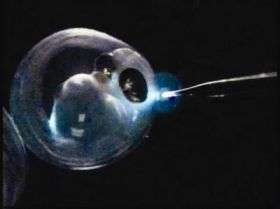
Researchers have harnessed the sensitivity of days-old fish embryos to create a tool capable of detecting a range of harmful chemicals.
By measuring rates of oxygen use in developing fish, which are sensitive to contaminants and stressful conditions, the technology could reveal the presence of minute levels of toxic substances before they cause more obvious and substantial harm. It could be used as an early warning system against environmental contamination or even biological weapons, said Purdue University researcher Marshall Porterfield, an associate professor of agricultural and biological engineering.
Respiration, the process wherein animals and other organisms burn oxygen to produce energy, is often the first of a fish's bodily functions affected by contaminants. The technology uses fiber optics to quickly monitor this activity and produce results within minutes, Porterfield said.
"Say you are exposed to the common cold virus," he said. "Before symptoms develop and you become aware of the bug's presence, it has already begun to attack your cells. Similarly, fish and other organisms are affected by contaminants before behavioral changes appear. Our technology detects heretofore undetectable changes to act as an early warning system."
In a study published online last week in the journal Environmental Science and Technology, the system detected the presence of several common pollutants such as the widely-used herbicide atrazine - even at levels near or below those that the U.S. Environmental Protection Agency deems acceptable for drinking water.
"This means the technology could not only help monitor environmental quality but may be used to enforce important water quality standards," said Marisol Sepulveda, lead author and assistant professor of forestry and natural resources at Purdue.
Testing also registered noticeable changes in the respiratory activity of fish embryos when the heavy metal cadmium was present at levels 60 times lower than the EPA limit, she said.
Throughout the study, contaminants did not destroy the eggs of laboratory-raised fathead minnows, a commonly studied fish species. This further demonstrates the tool's ability to discern subtle changes before they become fatal, Sepulveda said.
In the laboratory, researchers first manually positioned a tiny optical electrode, or optrode just outside individual embryos of two-day-old fathead minnows. At 1.5 millimeters in diameter, they were slightly smaller than the head of a pin, said primary author and Purdue doctoral student Brian Sanchez.
A fluorescent substance coated the electrode tip, its optical properties varying predictably with oxygen concentration. This allowed researchers to take quick measurements at locations only micrometers apart, moving the electrode via a computer-driven motor, Sanchez said. These readings then allowed researchers to calculate respiration rates within the eggs, he said.
Using a self-referencing technique Porterfield developed over the last decade, he and the team measured each egg with and without contaminants present. This allowed each embryo to serve as its own control, he said, providing more reliable results.
Porterfield said the technology could be used on other organisms. Study co-author and Purdue researcher Hugo Ochoa-Acuña has begun adjusting it to work with a type of crustacean.
A prototype could be ready to test in the field in four years if improvements continue, said Porterfield, a corresponding author. The technology currently tests immobilized eggs in a laboratory setting but there are plans to make the tool more versatile.
Porterfield also said he thinks the technology could have diverse uses. He imagines it could be conjugated with tumor cells to screen potential cancer drugs or help find new therapeutic targets.
During the study the technology detected four of five common pollutants tested, all known to act upon organisms in different ways: atrazine, cadmium, pentachlorophenol - an antifungal - and cyanide. It didn't register low levels of the insecticide malathion, possibly because fathead minnow embryos require more time to elapse for effects to become evident, Sanchez said.
Toxins can slow respiration by directly impeding it or they may stress the organism and cause it to burn more oxygen to provide energy for fighting the stressor, he said.
The most widely-used analogous technology monitors gill movements and other activities of bluegill fish with electrodes secured to the fish's bodies, Sepulveda said. The Purdue system could be advantageous as it records respiration in a sensitive life-stage and the optical equipment doesn't consume oxygen or require the same degree of calibration, Porterfield said.
The study, funded by Purdue's Center for the Environment and the U.S. Department of Education, was different from Sanchez's other research, which is primarily focused upon finding genes and proteins to serve as biomarkers for contaminant exposure in fish.
"This study was all the more exciting to be a part of due to its potential applications in protecting human health," he said.
Source: Purdue University


