Ancient sheep help pinpoint brain timing mechanisms linked to Seasonal Affective Disorder
August 13, 2008 Ancient sheep help pinpoint brain timing mechanisms linked to Seasonal Affective Disorder

Enlarge

(PhysOrg.com) -- New research by Aberdeen scientists suggests that Seasonal Affective Disorder (SAD) relates to an ancient timing mechanism in the brain dating back millions of years.

Discoveries by a University of Aberdeen-led team, involving collaborators in Edinburgh and Strasbourg, and published in the latest issue of Current Biology, shed new insights into the mechanisms by which seasonal rhythms are generated.

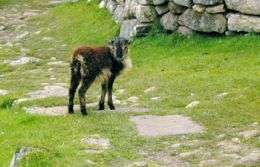
The researchers studied the primitive Soay breed of sheep, which relies on its strong seasonal biology to survive wild on the North Atlantic islands of St Kilda.

They identified a new role for a chemical known as thyroid stimulating hormone (TSH), which is secreted by cells in the pituitary gland and is already known to control the thyroid gland.

The new work reveals that a specialised group of pituitary TSH-secreting cells signal directly to the brain to control the sheep's seasonal behaviour.

This surprising discovery reverses the "master - slave" relationship between the brain and the pituitary, found in all vertebrates including humans, in which brain signals control pituitary hormone secretion.

Dr David Hazlerigg, Reader in Zoology at the University of Aberdeen said: "Our research points to an ancient seasonal timing mechanism that survives in modern vertebrates. Some humans may retain remnants of this ancient seasonal timing mechanism which would explain why they experience SAD.

It is now hoped that identifying this new role for TSH may lead to better understanding of seasonal or thyroid disorders in humans.

Dr Hazlerigg continues: "Our next target is to understand exactly what TSH does when it gets into the brain to cause changes in behaviour and hormone secretion. By defining these pathways we hope to increase our understanding not only of the control mechanisms in seasonal animals but also of SAD."

Provided by University of Aberdeen


print this article email this article download pdf blog this article bookmark this article     Stumble it Digg this share on Facebook retweet share on Reddit add to delicious
Rate this story - not rated yet


August 13, 2008 all stories

Comments: 0

not rated yet
  • Stumble this up

  • Digg this

  • share this

  • hide
  • Related Stories


Other News

Measuring and modeling blood flow in malaria

Biology / Cell & Microbiology

created 41 minutes ago | popularity not rated yet | comments 0

When people have malaria, they are infected with Plasmodium parasites, which enter the body from the saliva of a mosquito, infect cells in the liver, and then spread to red blood cells. Inside the blood cells, the parasites ...


Beyond sunlight: Explorers census 17,650 ocean species between edge of darkness and black abyss

Beyond sunlight: Explorers census 17,650 ocean species between edge of darkness and black abyss (w/ Video)

Biology / Plants & Animals

created 16 hours ago | popularity 4.9 / 5 (9) | comments 0

Census of Marine Life scientists have inventoried an astonishing abundance, diversity and distribution of deep sea species that have never known sunlight - creatures that somehow manage a living in a frigid ...


Rare Charles Darwin book found on toilet bookshelf (AP)

Rare Charles Darwin book found on toilet bookshelf

Biology / Other

created 15 hours ago | popularity 4.8 / 5 (4) | comments 1

(AP) -- An auction house says it is selling a rare first edition of Charles Darwin's "On the Origin of Species" found in a family's guest lavatory in southern England.


Bigger not necessarily better, when it comes to brains

Bigger not necessarily better, when it comes to brains

Biology / Plants & Animals

created Nov 17, 2009 | popularity 4.5 / 5 (19) | comments 11

(PhysOrg.com) -- Tiny insects could be as intelligent as much bigger animals, despite only having a brain the size of a pinhead, say scientists at Queen Mary, University of London.


Extinct goat Myotragus balearicus

Extinct goat was cold-blooded

Biology / Plants & Animals

created Nov 18, 2009 | popularity 4.9 / 5 (34) | comments 10

(PhysOrg.com) -- An extinct goat that lived on a barren Mediterranean island survived for millions of years by reducing in size and by becoming cold-blooded, which has never before been discovered in mammals.