First reported video of cell's recognition of danger through its protein response
August 13, 2008
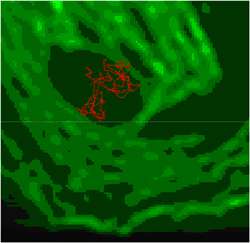
Total internal reflection fluorescence (TIRF) microscope time-lapse image of quantum-dot labeled proteins fluorescing on the surface of a cell membrane.
(PhysOrg.com) -- Cells are expected to respond defensively when an antigen lands on a cell membrane and prepares to cause mischief.
But to activate a response, a cell must become aware of the presence of the intruder on its membrane, just as a human first must become aware of a mosquito on a forearm in order to slap it.
In joint experimental work, physicists at Sandia National Laboratories and biologists at the University of New Mexico’s Cancer Research and Treatment Center have combined unusual techniques to make real-time movies that show exactly how a 50-nanometer-thick membrane notifies the cell it encloses that a hostile alien presence — an antigen — has made a landing.
And also why notification may not take place.
“We were able to characterize the motion of the receptor proteins in the membrane in real time as they respond to the antigen,” says lead Sandia researcher Alan Burns. “Perhaps more importantly, we learned the cell membrane is really complicated and highly structured, rather than fluid and unstructured, as is the prevailing notion.”
The membrane structures, which resemble holding corrals, says Burns, do move around in the membrane. But they restrict the motion of proteins. The response of the cell requires that the antigen receptor proteins cluster with other proteins to commence the cellular signaling network.
“The proteins are like Paul Revere giving a warning,” says Burns. “When proteins bind antigens, they begin to cluster. This causes other proteins to thrash around. That sends a message from the membrane to the cell nucleus that something’s wrong.
“But if there are places on the membrane that are walled off and an antigen lands there, the cell may not be notified there’s a problem. No protein, no warning.”
UNM researchers already knew that incoming antigens were detected by proteins present in the lipid matrix of the cell membrane. But how exactly to determine the process?
Burns, working with his former Sandia postdoctoral student Keith Lidke (now a UNM professor), modified a special microscope called a total internal reflection fluorescence (TIRF) microscope, whose laser-light output is completely contained within the microscope coverslip. This resembles the way optical fibers transport light, except that the TIRF does not ever release any light. But though the light is contained, making its use seem at first an exercise in futility because it penetrates nothing external, it generates a tiny electrical exploratory field that extends about 100 nm into the cell, which lies supported by the coverslip.
“When a cell settles on a piece of bare thin glass,” says Burns, “the membrane of the cell by definition is snuggled up against the glass and available to the radiation field.”
Enter the UNM biology team. Led by professor Diane Lidke, the team was able to attach quantum dots of 8 nm and 11 nm respectively to two different types of antigen receptor proteins in the membrane.
Quantum dots emit light when stimulated by an electrical field. The color fluoresced is determined by the size of the dot. So one protein, when stimulated by the laser’s electrical field, emitted orange light. The other emitted red. That way researchers could keep track of the motion of single, individual proteins and see how they interacted; moreover, it allowed them to observe barriers to the motion.
Sensitive CCD cameras picked up and videotaped the motion of the lit-up proteins as they reacted to the introduction of antigens to the membrane.
“It was like using cameras to watch individual bank robbers move around as a holdup progressed,” says Burns.
The work is of interest to Sandia, a national defense lab interested in determining the human response to bioinfectious diseases, and to UNM’s bioscience program.
Other authors on the paper were graduate student Nicholas Andrews and pathology professors Bridget Wilson and Janet Oliver, all with UNM’s Cancer Research and Treatment Center.
The Sandia work was funded by its Laboratory Directed Research and Development office. The National Institutes of Health funded the UNM portion.
The work was published online the week of July 20 in the journal Nature Cell Biology.
Provided by Sandia National Laboratories
-
When the isolated lung runs out of air
Feb 01, 2012 |
2 / 5 (1) |
0
-
Why the brain is more reluctant to function as we age
Feb 01, 2012 |
3.9 / 5 (7) |
0
-
A step closer to understanding, averting drug resistance
Jan 31, 2012 |
not rated yet |
0
-
The secret life of proteins: Researchers discover dual role of key player in immune system
Jan 28, 2012 |
4 / 5 (1) |
0
-
SUMO-snipping protein plays crucial role in T and B cell development
Jan 27, 2012 |
5 / 5 (3) |
0
-
Engineers build first sub-10-nm carbon nanotube transistor
Feb 01, 2012 |
4.9 / 5 (33) |
30
-
Something old, something new: Evolution and the structural divergence of duplicate genes
Jan 31, 2012 |
4.6 / 5 (7) |
1
-
The hidden nanoworld of ice crystals: Revealing the dynamic behavior of quasi-liquid layers
Jan 30, 2012 |
5 / 5 (4) |
1
-
Stock market network reveals investor clustering
Jan 27, 2012 |
3.9 / 5 (23) |
8
-
Of microchemistry and molecules: Electronic microfluidic device synthesizes biocompatible probes
Jan 26, 2012 |
5 / 5 (2) |
0
More news stories
A mitosis mystery solved: How chromosomes align perfectly in a dividing cell
Although the process of mitotic cell division has been studied intensely for more than 50 years, Whitehead Institute researchers have only now solved the mystery of how cells correctly align their chromosomes during symmetric ...
6 hours ago |
4.4 / 5 (10) |
0
|
Researchers find extensive RNA editing in human transcriptome
In a new study published online in Nature Biotechnology, researchers from BGI, the world's largest genomics organization, reported the evidence of extensive RNA editing in a human cell line by analysis of RNA-seq data, demons ...
6 hours ago |
5 / 5 (4) |
0
|
The proteins ensuring genome protection
Researchers from the University of Geneva (UNIGE), Switzerland, have discovered the crucial role of two proteins in developing a cell 'anti-enzyme shield'. This protection system, which operates at the level of molecular ...
6 hours ago |
5 / 5 (3) |
0
|
Entire genome of extinct human decoded from fossil
(PhysOrg.com) -- In 2010, Svante Pääbo and his colleagues presented a draft version of the genome from a small fragment of a human finger bone discovered in Denisova Cave in southern Siberia. The ...
Feb 07, 2012 |
4.7 / 5 (59) |
48
|
Why are there so few fish in the Earth's oceans?
(PhysOrg.com) -- A Stony Brook University researcher has found that, contrary to popular belief, there are not plenty of fish in the sea.
Feb 08, 2012 |
4.2 / 5 (18) |
27
|
Declining health-care productivity in England: Who says so?
Reports that the National Health Service in England has been declining in productivity in the last decade appear to have been accepted as fact. However, a Viewpoint published Online First by The Lancet disputes this. The Vi ...
Scientists discover molecular secrets of 2,000-year-old Chinese herbal remedy
For roughly two thousand years, Chinese herbalists have treated Malaria using a root extract, commonly known as Chang Shan, from a type of hydrangea that grows in Tibet and Nepal. More recent studies suggest that halofuginone, ...
New method to examine batteries -- MRI from the inside
There is an ever-increasing need for advanced batteries for portable electronics, such as phones, cameras, and music players, but also to power electric vehicles and to facilitate the distribution and storage of energy derived ...
Overeating may double risk of memory loss
New research suggests that consuming between 2,100 and 6,000 calories per day may double the risk of memory loss, or mild cognitive impairment (MCI), among people age 70 and older. The study was released today and will be ...
Lab study raises questions over nano-particle impact
Tests involving chickens have raised questions about the impact on health from engineered nano-particles, the ultra-fine grains commonly used in drugs and processed foods, scientists said on Sunday.
Google might launch Drive for cloud storage soon
(PhysOrg.com) -- Google's next big move, according to the Wall Street Journal, is a cloud storage service called Drive. Hardly first to the plate, Google is simply catching up to introducing its cloud reposi ...