Plastics suspect in lobster illness
August 14, 2008 Lobster Shell Disease

Enlarge

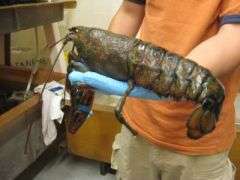
This drooping lobster is missing limbs and painted with dark spots, the tell-tale signs of shell disease. Credit: Joseph Caputo/MBL

The search for what causes a debilitating shell disease affecting lobsters from Long Island Sound to Maine has led one Marine Biological Laboratory (MBL) visiting scientist to suspect environmental alkyphenols, formed primarily by the breakdown of hard transparent plastics.

Preliminary evidence from the lab of Hans Laufer suggests that certain concentrations of alkyphenols may be interfering with the ability of lobsters to develop tough shells. Instead, the shells are weakened, leaving affected lobsters susceptible to the microbial invasions characteristic of the illness.

"Lobsters 'know' when their shell is damaged, and that's probably the reason when they have shell disease, why they molt more quickly," says Laufer, a visiting investigator at the MBL for over 20 years and professor emeritus of molecular and cell biology at the University of Connecticut. "But ultimately, they still come down with the disease. And we think the presence of alkyphenols contributes to that."

Like any crustacean, lobsters shed their shells multiple times in one lifetime. After molting, the outer skin of the soft and exposed lobster will begin to harden. It is here that Laufer thinks the alkyphenols are doing their damage. At this point, a derivative of the amino acid tyrosine, whose function is to harden the developing shell, is incorporated. It is known that alkyphenols and tyrosine are similarly shaped and Laufer suspects that the toxin may be blocking tyrosine from its normal functions. He is at MBL this summer to measure the amount of competition between the two molecules. Alkyphenols are also known to act as endocrine disruptors.

Laufer discovered the presence of alkyphenols in lobsters serendipitously while investigating a tremendous lobster die off at Long Island Sound in 1999, when shell disease, first observed in the mid-1990s, was noted to be on the rise. Although an unusually hot summer, it was also the first time New York City sprayed mosquito populations to prevent the spread of West Nile virus. Laufer, who began his career as an insect endocrinologist, suspected the toxins from the sprayings may have contributed to the lobster die off. In 2001, while searching for the mosquito toxins in lobsters, he instead found alkyphenols.

"It's a real problem," Laufer says. "Plastics last a long time, but breakdown products last even longer. Perhaps shell disease is only the tip of the iceberg of a more basic problem of endocrine disrupting chemicals in marine environments."

Source: Marine Biological Laboratory


print this article email this article download pdf blog this article bookmark this article     Stumble it Digg this share on Facebook retweet share on Reddit add to delicious
Rate this story - 4.6 /5 (18 votes)

Rank Filter

Move the slider to adjust rank threshold, so that you can hide some of the comments.


Display comments: newest first

  • jeffsaunders - Aug 14, 2008
    • Rank: not rated yet
    Plastic bags may have found another victim to add to their list.

    I am still waiting for results to come in from those people that are testing various "harmless" levels of a range of toxins when combined together.

    Not to mention that some chemicals that may be harmless to people will turn out to be lethal to other creatures.

August 14, 2008 all stories

Comments: 1

4.6 /5 (18 votes)
  • Stumble this up

  • Digg this

  • share this


Other News

New study describes connections between Circadian and metabolic systems

Biology / Other

created 47 minutes ago | popularity not rated yet | comments 0

A paper by University of Notre Dame biologist Giles Duffield and a team of researchers offers new insights into a gene that plays a key role in modulating the body's Circadian system and may also simultaneously modulate its ...


With Help from a Bacterium, Cockroaches Develop Way to Store Excess Uric Acid

With Help from a Bacterium, Cockroaches Develop Way to Store Excess Uric Acid

Biology / Plants & Animals

created 2 hours ago | popularity 5 / 5 (1) | comments 0

(PhysOrg.com) -- What life form can use materials as nutrients that we, and most other animals, would consider waste products?


New explanation for nature's hardiest life form

Biology / Cell & Microbiology

created 7 hours ago | popularity 4.3 / 5 (3) | comments 0

Got food poisoning? The cause might be bacterial spores, en extremely hardy survival form of bacteria, a nightmare for health care and the food industry and an enigma for scientists. Spore-forming bacteria, present almost ...


Longer toes eyed as sprinters' edge

Biology / Other

created 3 hours ago | popularity not rated yet | comments 0

(PhysOrg.com) -- Longer toes may give sprinters a leg up on other runners, according to a new study.


Hoping for a fluorescent basket case: How HIV is assembled and released from infected cells

Biology / Cell & Microbiology

created 5 hours ago | popularity not rated yet | comments 0

Although recent advances have raised hopes that a protective vaccine can be developed, acquired immunodeficiency syndrome (AIDS) remains a major public health problem. Much has been learned about HIV-1, the virus that causes ...