Vegetable Scales With A Mind Of Their Own
August 14, 2008 Vegetable Scales With A Mind Of Their Own

Enlarge

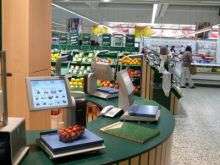
The intelligent self-service scales automatically recognize which type of fruit or vegetable has been placed on them. (c) Fraunhofer IITB

What was the number you were supposed to enter for the chili-pepper on the self-service scales? Was it 67 or 76? And the number for the bananas? The latest self-service scales automatically recognize what the customer has placed on them.

A quick stop at the supermarket: Balancing bananas, peppers and tomatoes in your arms, you rush from the vegetable counter to the self-service scales in order to print out the respective price label. But what was that number again, the one you had to enter for the tomatoes?

There will soon be an end to this constant running back and forth between the vegetable counter and the scales. Working on behalf of the industrial weighing company Mettler-Toledo, researchers at the Fraunhofer Institute for Information and Data Processing IITB in Karlsruhe have developed a webcam module for self-service scales.

"The scales automatically recognize which fruit or vegetables are to be weighed and ask the customer to choose between only those icons that are relevant – such as tomatoes, vine-ripened tomatoes and beefsteak tomatoes," states IITB scientist Sascha Voth. Customers can confirm the correct variety on a touch screen.

But how do the scales know whether the customer has placed a pepper, a tomato or a kiwi fruit on them? "The goods are registered by a camera integrated in the scales. An image evaluation algorithm compares the image with stored data and thus automatically recognizes which type of fruit this is," says Voth. Even the cloudy plastic bags in which the fruit may be packaged at the counter are no problem for the scales – the image evaluation system recognizes the various types of fruit and vegetable anyway.

However, though this initially sounds straightforward, it actually involves a number of challenges: Many types of fruit are a different color depending how ripe they are. Bananas, for instance, range from a uniform green to yellow or even spotted brown. Other types of fruit such as apples and pears come in numerous varieties that can likewise vary widely in color. "The new scales are very tolerant to fluctuations in color and brightness. The module can be employed under many different kinds of illumination and with different kinds of camera. Supermarket employees can of course extend the selection of fruit recognized by the scales to make it include new varieties," says Voth. The scales are currently being tested in about 300 supermarkets across Europe.

Source: Fraunhofer-Gesellschaft


print this article email this article download pdf blog this article bookmark this article     Stumble it Digg this share on Facebook retweet share on Reddit add to delicious
Rate this story - not rated yet


August 14, 2008 all stories

Comments: 0

not rated yet
  • Stumble this up

  • Digg this

  • share this

  • hide
  • Related Stories


  • hide
  • Relevant PhysicsForums posts

Other News

New 'finFETS' promising for smaller transistors, more powerful chips

New 'finFETs' promising for smaller transistors, more powerful chips

Technology / Semiconductors

created 11 hours ago | popularity 4.9 / 5 (8) | comments 2

(PhysOrg.com) -- Purdue University researchers are making progress in developing a new type of transistor that uses a finlike structure instead of the conventional flat design, possibly enabling engineers ...


Hydrogen milestone moves energy independence one step forward

Hydrogen milestone moves energy independence one step forward

Technology / Energy

created 9 hours ago | popularity 3.7 / 5 (6) | comments 1

(PhysOrg.com) -- Big things often come in small packages. That's certainly the case with the potential created by recent successes in hydrogen research at Idaho National Laboratory.


New search technique for images and videos has broad applications

New search technique for images and videos has broad applications

Technology / Computer Sciences

created 9 hours ago | popularity 5 / 5 (5) | comments 0

(PhysOrg.com) -- Engineers at the University of California, Santa Cruz, have developed a powerful new approach to a fundamental problem in computer vision: how to program a computer to recognize or categorize ...


The user-pays model is already in place at News Corp's Wall Street Journal

News Corp's Murdoch warns he may block Google

Technology / Internet

created 20 hours ago | popularity 2.3 / 5 (4) | comments 7

Global media mogul Rupert Murdoch has accused Google of stealing from his News Corp. empire, and warned he may block the search engine from accessing its content.


Improving security with face recognition technology

Improving security with face recognition technology

Technology / Computer Sciences

created 14 hours ago | popularity 3.3 / 5 (3) | comments 2

A number of U.S. states now use facial recognition technology when issuing drivers licenses. Similar methods are also used to grant access to buildings and to verify the identities of international travelers. ...