Phoenix Microscope Takes First Image of Martian Dust Particle
August 14, 2008 Martian Dust Particles

Enlarge

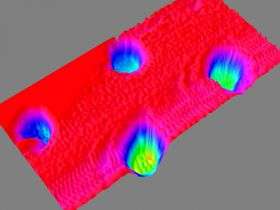
This color image is a three dimensional view of a digital elevation map of a sample collected by NASA's Phoenix Mars Lander's Atomic Force Microscope. A Martian particle -- only one micrometer, or one millionth of a meter, across -- is held in the left pit. Image credit: NASA/JPL-Caltech/University of Arizona/University of Neuchatel/Imperial College London

(PhysOrg.com) -- NASA's Phoenix Mars Lander has taken the first-ever image of a single particle of Mars' ubiquitous dust, using its atomic force microscope.

The particle -- shown at higher magnification than anything ever seen from another world -- is a rounded particle about one micrometer, or one millionth of a meter, across. It is a speck of the dust that cloaks Mars. Such dust particles color the Martian sky pink, feed storms that regularly envelop the planet and produce Mars' distinctive red soil.

"This is the first picture of a clay-sized particle on Mars, and the size agrees with predictions from the colors seen in sunsets on the Red Planet," said Phoenix co-investigator Urs Staufer of the University of Neuchatel, Switzerland, who leads a Swiss consortium that made the microscope.

"Taking this image required the highest resolution microscope operated off Earth and a specially designed substrate to hold the Martian dust," said Tom Pike, Phoenix science team member from Imperial College London. "We always knew it was going to be technically very challenging to image particles this small."

It took a very long time, roughly a dozen years, to develop the device that is operating in a polar region on a planet now about 350 million kilometers or 220 million miles away.

The atomic force microscope maps the shape of particles in three dimensions by scanning them with a sharp tip at the end of a spring. During the scan, invisibly fine particles are held by a series of pits etched into a substrate microfabricated from a silicon wafer. Pike's group at Imperial College produced these silicon microdiscs.

The atomic force microscope can detail the shapes of particles as small as about 100 nanometers, about one one-thousandth the width of a human hair. That is about 100 times greater magnification than seen with Phoenix's optical microscope, which made its first images of Martian soil about two months ago. Until now, Phoenix's optical microscope held the record for producing the most highly magnified images to come from another planet.

"I'm delighted that this microscope is producing images that will help us understand Mars at the highest detail ever," Staufer said. "This is proof of the microscope's potential. We are now ready to start doing scientific experiments that will add a new dimension to measurements being made by other Phoenix lander instruments."

"After this first success, we're now working on building up a portrait gallery of the dust on Mars," Pike added.

Mars' ultra-fine dust is the medium that actively links gases in the Martian atmosphere to processes in Martian soil, so it is critically important to understanding Mars' environment, the researchers said.

The particle seen in the atomic force microscope image was part of a sample scooped by the robotic arm from the "Snow White" trench and delivered to Phoenix's microscope station in early July. The microscope station includes the optical microscope, the atomic force microscope and the sample delivery wheel. It is part of a suite of tools called Phoenix's Microscopy, Electrochemistry and Conductivity Analyzer.

Provided by NASA


print this article email this article download pdf blog this article bookmark this article     Stumble it Digg this share on Facebook retweet share on Reddit add to delicious
Rate this story - 3.8 /5 (18 votes)

Rank Filter

Move the slider to adjust rank threshold, so that you can hide some of the comments.


Display comments: newest first

  • superhuman - Aug 14, 2008
    • Rank: 4 / 5 (1)
    Just sending a microscope to Mars is nothing to be exited about instead they should make some worthwhile pictures with it to justify the cost of putting it there.
    The one posted above doesn't cut it.
  • paulthebassguy - Aug 14, 2008
    • Rank: 5 / 5 (1)
    This mission would have been better if they had designed a probe to take some soil samples and then take them back to Earth for proper analysis.
  • DGBEACH - Aug 15, 2008
    • Rank: 4 / 5 (1)
    ...ok...and what about that "speck-of-dust"? What did you find???

August 14, 2008 all stories

Comments: 3

3.8 /5 (18 votes)
  • Stumble this up

  • Digg this

  • share this

  • hide
  • Related Stories

  • Phoenix Lander Winds Up Its Astonishing Summer On Mars
    created Nov 25, 2008 | popularity not rated yet | comments 0
  • Phoenix Mars Lander Confirms Martian Water
    created Jul 31, 2008 | popularity not rated yet | comments 0
  • Swiss nano-microscope delivers first images recorded on Mars
    created Jul 11, 2008 | popularity not rated yet | comments 0
  • Phoenix Returns Treasure Trove for Science
    created Jun 27, 2008 | popularity not rated yet | comments 0
  • Phoenix Mars Lander Inspects Delivered Soil Samples
    created Jun 14, 2008 | popularity not rated yet | comments 0


  • hide
  • Relevant PhysicsForums posts

  • Sideral question
    created 14 hours ago
  • Doppler shifted blackbody spectrum
    created 17 hours ago
  • Earth v. Moon
    created 19 hours ago
  • help me with coordinates and orbits
    created 19 hours ago
  • More from Physics Forums - General Astronomy

Other News

Astronauts finish another spacewalk, still no baby (AP)

Astronauts finish another spacewalk, still no baby

Space & Earth / Space Exploration

created 5 hours ago | popularity 3 / 5 (2) | comments 0

(AP) -- A spacewalking astronaut put aside the impending birth of his daughter and blazed through his first-ever venture outside the International Space Station on Saturday.


Unseasonably hot and dry weather combined with strong winds to fan scores of blazes in the country's southeastern states

Australia issues 'catastrophic' alerts as fires rage

Space & Earth / Environment

created 11 hours ago | popularity 4.5 / 5 (2) | comments 0

Australia has issued "catastrophic" alerts after record-breaking temperatures and wild lightning storms sparked more than 100 fires across the country, officials said Saturday.


Commuters wait on the platform shrouded by fog in London

Climate change not man-made, say majority of Britons: poll

Space & Earth / Environment

created Nov 15, 2009 | popularity 3.3 / 5 (15) | comments 45

Less than half of Britons believes that human activity is to blame for global warming, according to a poll carried out for The Times newspaper and published on Saturday.


Mysteriously warm times in Antarctica

Mysteriously warm times in Antarctica

Space & Earth / Earth Sciences

created Nov 18, 2009 | popularity 4.2 / 5 (21) | comments 28

(PhysOrg.com) -- A new study of Antarctica's past climate reveals that temperatures during the warm periods between ice ages (interglacials) may have been higher than previously thought. The latest analysis ...


UN: Fight climate change with free condoms (AP)

UN: Fight climate change with free condoms

Space & Earth / Environment

created Nov 18, 2009 | popularity 3.1 / 5 (11) | comments 22

(AP) -- The battle against global warming could be helped if the world slowed population growth by making free condoms and family planning advice more widely available, the U.N. Population Fund said Wednesday.