Scientists Discover New Bird Species
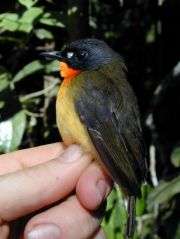
Scientists at the Smithsonian Institution have discovered a new species of bird in Gabon, Africa, that was, until now, unknown to the scientific community. Their findings were published in the international science journal Zootaxa today, Aug. 15.
The newly found olive-backed forest robin (Stiphrornis pyrrholaemus) was named by the scientists for its distinctive olive back and rump. Adult birds measure 4.5 inches in length and average 18 grams in weight. Males exhibit a fiery orange throat and breast, yellow belly, olive back and black feathers on the head. Females are similar, but less vibrant. Both sexes have a distinctive white dot on their face in front of each eye.
The bird was first observed by Smithsonian scientists in 2001 during a field expedition of the National Zoo's Monitoring and Assessment of Biodiversity Program in southwest Gabon. It was initially thought, however, to be an immature individual of an already-recognized species. Brian Schmidt, a research ornithologist at the Smithsonian's National Museum of Natural History and a member of the MAB program's team, returned to Washington, D.C., from Gabon in 2003 with several specimens to enter into the museum's bird collection. When he compared them with other forest robins of the genus Stiphrornis in the collection, Schmidt immediately noticed differences in color and plumage, and realized the newly collected birds might be unique.
"I suspected something when I found the first bird in Gabon since it didn't exactly match any of the species descriptions in the field guides," Schmidt said. "Once I was able to compare them side by side to other specimens in our collections it was clear that these birds were special. You, of course, have to be cautious, but I was still very excited at the prospect of possibly having found a new species of bird."
To ensure that the specimens Schmidt collected were a new species, geneticists at the Smithsonian's National Zoo compared the DNA of the new specimens to that of the four known forest robin species. The results clearly showed that these birds were in fact a separate and distinct species.
Discovering an unknown mammal or bird species is far from a common event. Before the 20th century, the rate of discoveries was great—several hundred new species were being described each decade. Since then, however, the pace has slowed and new species of vertebrates are generally only found in isolated areas.
Now officially recognized, the olive-backed forest robin brings Gabon's number of known bird species to 753. Other than its existence, however, little is known to science about this newcomer.
There is some knowledge about the species' habitat choice since all of the birds seen and heard in the wild were found in dense forest undergrowth. Other facts such as specific diet, mating and nesting habits, and the species' complete habitat range are all things that still need research.
"This discovery is very exciting for us," said Alfonso Alonso, who directs the Biodiversity Program in Gabon. The opportunity to study areas the tropics of Gabon allows scientists to learn about the organisms that live there and in turn develop plans to protect them in the future. "Finding the olive-backed forest robin strongly underscores the importance of our research. This helps us show the conservation importance of the area."
The MAB program is part of the Center for Conservation Education and Sustainability at the National Zoo. This particular study in the program is being conducted in the Gamba Complex of Protected Areas, a coastal region in southwestern Gabon containing the Loango and Moukalaba-Doudou National Parks with a restricted-access industrial corridor between them.
Scientists in the program are assessing the species diversity of the region, conducting applied research on the impact of management and development and providing biodiversity education programs locally to guide the regional conservation strategy. The program has partnered with the Gabonese government and Shell Gabon to integrate biodiversity conservation into energy development. The partnership has produced the first in-depth study of rainforest biodiversity in this area of Central Africa, provided relevant scientific advancements on the effects of development on biodiversity and identified conservation strategies for the long-term management of the area.
"Although finding an unknown species like the olive-backed forest robin was not the goal of the MAB project," Schmidt said, "it is definitely a reminder that the world still holds surprises for us."
Source: Smithsonian


