Study finds way to prevent protein clumping characteristic of Parkinson's disease
August 15, 2008
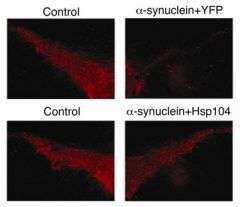
Hsp104 from yeast protects against alpha-synuclein toxicity in the rat brain. Red staining shows the levels of an enzyme involved in dopamine synthesis in the region of the rat brain most affected in Parkinson's disease (controls, left top and bottom). Rats were injected with viruses expressing alpha-synuclein & YFP (right top) or alpha-synuclein and Hsp104 (right bottom). Note the increased survival of dopamine-producing neurons in the rat brain injected with Hsp104 (right bottom) compared to rat brain without Hsp104 (right top). Credit: James Shorter, PhD, University of Pennsylvania School of Medicine, Journal of Clinical Investigation
Researchers at the University of Pennsylvania School of Medicine have identified a protein from a most unlikely source -- baker's yeast -- that might protect against Parkinson's disease. More than a million Americans suffer from Parkinson's disease, and no treatments are available that fundamentally alter the course of the condition. By introducing the yeast protein Hsp104 into animal models of Parkinson's disease, researchers prevented protein clumping that leads to nerve cell death characteristic of the disorder.
"Yeast express a protein called Hsp104, which is able to reverse protein aggregation," says James Shorter, PhD, Assistant Professor of Biochemistry and Biophysics. "However, for reasons that are unclear, Hsp104 is not found in mammals. We wondered if introducing Hsp104 into mammals could help with diseases connected with protein aggregation."
These findings will be published in the September 2008 issue of The Journal of Clinical Investigation and appeared online August 14, 2008
Clinicians do not fully understand the process and cause of Parkinson's disease. However, researchers believe that a protein called alpha-synuclein misfolds and clumps in many forms of the disease, and that this process is intimately tied to the selective death of dopamine-producing neurons that results in Parkinson's disease.
In this study, researchers found that Hsp104 could partially reverse alpha-synuclein aggregation in test-tube experiments. Remarkably, rats expressing Hsp104 showed lower levels of alpha-synuclein aggregation and alpha-synuclein-induced toxicity of neurons. This result is significant because the rat model used recreates the selective loss of dopamine-producing nerve cells in the region of the brain affected in Parkinson's disease, say the investigators.
"This study represents an important preliminary step," says Shorter. "One thing we'd like to do next is to treat an animal model which already has considerable quantities of alpha-synuclein aggregates to see if Hsp104 can actually reverse the process in the rat brain."
Co-authors in addition to Shorter are Christophe Lo Bianco of the Wallenberg Neurosciences Center in Lund, Sweden and the Brain Mind Institute in Lausanne, Switzerland; Etienne Regulier, Hilal Lasheul, and Patrick Aebischer, also of the Brain Mind Institute; Takeshi Iwatsubo at the University of Tokyo; and Susan Lindquist of the Whitehead Institute for Biomedical Research, Cambridge, MA. The Michael J. Fox Foundation, European Molecular Biology Organization, Swedish Parkinson's Foundation, Swiss National Science Foundation, American Heart Association, University of Pennsylvania Institute on Aging, and the National Institute of Health Director's New Innovator Award provided funding for this research.
Source: University of Pennsylvania School of Medicine
-
Lessons from yeast: A possible cure for Parkinson's disease?
Aug 14, 2008 |
5 / 5 (6) |
0
-
Cell's 'battery' found to play central role in neurodegenerative disease
Jan 17, 2012 |
5 / 5 (1) |
0
-
Researchers identify path to treat Parkinson's disease at its inception
Jan 16, 2012 |
4.5 / 5 (6) |
0
-
Molecular motor struts like drunken sailor
Jan 10, 2012 |
not rated yet |
0
-
'Rare' brain disorder may be more common than thought: study
Dec 25, 2011 |
4.7 / 5 (7) |
0
-
Engineers build first sub-10-nm carbon nanotube transistor
Feb 01, 2012 |
4.9 / 5 (31) |
30
-
Something old, something new: Evolution and the structural divergence of duplicate genes
Jan 31, 2012 |
4.6 / 5 (7) |
1
-
The hidden nanoworld of ice crystals: Revealing the dynamic behavior of quasi-liquid layers
Jan 30, 2012 |
5 / 5 (3) |
1
-
Stock market network reveals investor clustering
Jan 27, 2012 |
3.9 / 5 (23) |
8
-
Of microchemistry and molecules: Electronic microfluidic device synthesizes biocompatible probes
Jan 26, 2012 |
5 / 5 (1) |
0
-
Is Everyday Technology Killing Us?
Feb 08, 2012
-
Exercise and weight loss
Feb 08, 2012
-
Why do we have head aches? Our brains can't feel anything.
Feb 07, 2012
-
"The end of diseases" by David Agus, interview from Daily Show with Jon Stewart
Feb 04, 2012
-
Oncolytic adenovirus
Feb 04, 2012
-
Nutrition label stuffs and diets
Feb 02, 2012
- More from Physics Forums - Medical Sciences
More news stories
Complex wiring of the nervous system may rely on a just a handful of genes and proteins
Researchers at the Salk Institute have discovered a startling feature of early brain development that helps to explain how complex neuron wiring patterns are programmed using just a handful of critical genes. ...
2 hours ago |
5 / 5 (4) |
0
|
Human cognitive performance suffers following natural disasters, researchers find
Not surprisingly, victims of a natural disaster can experience stress and anxiety, but a new study indicates that it might also cause them to make more errors - some serious - in their daily lives. In their upcoming Human Fa ...
Medicine & Health / Psychology & Psychiatry
4 hours ago |
4 / 5 (1) |
0
Both maternal and paternal age linked to autism
Older maternal and paternal age are jointly associated with having a child with autism, according to a recently published study led by researchers at The University of Texas Health Science Center at Houston (UTHealth).
Medicine & Health / Psychology & Psychiatry
7 hours ago |
5 / 5 (1) |
0
|
New understanding of DNA repair could eventually lead to cancer therapy
A research group in the Faculty of Medicine & Dentistry at the University of Alberta is hoping its latest discovery could one day be used to develop new therapies that target certain types of cancers.
6 hours ago |
4.8 / 5 (4) |
0
|
Curry spice component may help slow prostate tumor growth
Curcumin, an active component of the Indian curry spice turmeric, may help slow down tumor growth in castration-resistant prostate cancer patients on androgen deprivation therapy (ADT), a study from researchers ...
8 hours ago |
4.6 / 5 (5) |
0
|
Google users warned of threat to smartphone wallets
Users of Google smartphone wallets were being warned on Friday that there is a way to crack pass codes intended to thwart thieves from going on illicit shopping sprees.
Anonymous knocks CIA website offline (Update)
The website of the Central Intelligence Agency was inaccessible on Friday after the hacker group Anonymous claimed to have knocked it offline.
NASA sees wide-eyed cyclone Jasmine
Cyclone Jasmine's eye has opened wider on NASA satellite imagery, as it moves through the Southern Pacific Ocean.
NASA sees Giovanna reach cyclone strength, threaten Madagascar
Tropical Storm 12S built up steam and became a cyclone on February 10, 2012 as NASA's Terra satellite passed overhead. Residents of east-central Madagascar should prepare for this cyclone to make landfall ...
Putting the squeeze on planets outside our solar system
(PhysOrg.com) -- Using high-powered lasers, scientists at Lawrence Livermore National Laboratory and collaborators discovered that molten magnesium silicate undergoes a phase change in the liquid state, abruptly ...
The power of estrogen -- male snakes attract other males
A new study has shown that boosting the estrogen levels of male garter snakes causes them to secrete the same pheromones that females use to attract suitors, and turned the males into just about the sexiest ...