Ariane 5 - Fifth launch of 2008
August 15, 2008 Ariane 5 - Fifth launch of 2008

Enlarge

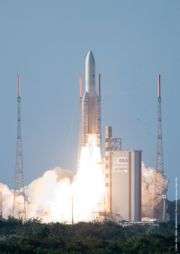
Ariane 5 makes an on-time liftoff from Europe’s Spaceport ELA-3 launch zone as it begins the successful mission to orbit Superbird-7 and AMC-21. This wide-angle view also shows a portion of the assembly and integration area for Ariane 5, which is partly visible in the foreground at right. Credits: ©2008 - ESA/CNES/ARIANESPACE/Activité Photo Optique Video CSG

Yesterday evening, an Ariane 5 ECA launcher lifted off from Europe’s Spaceport at Kourou, in French Guiana, on its mission to place two telecommunications satellites into geostationary transfer orbits.

Lift-off of flight V185 took place at 22:44 CEST/Paris on 14 August (20:44 UTC/GMT; 17:44 UTC-3/Kourou).The satellites were accurately injected into the correct transfer orbits about 30 minutes later.

The payload comprised AMC-21, which will provide will provide 24 Ku-band channels of television and enterprise data distribution services over the USA, the Gulf of Mexico, Central America and the Caribbean, and Superbird 7, which will provide 28 Ku-band channels of broadcast services and mobile terminal links over Japan, eastern Asia and the Pacific Ocean. The payload mass was 8068 kg; the satellite masses totalled 7229 kg, with payload adapters and dispensers making up the additional 839 kg.

This fifth launch of the year keeps Arianespace and Europe’s Spaceport on target for the seven missions planned for 2008 – the busiest year ever for Ariane 5.

Flight timeline

The Ariane 5’s cryogenic, liquid fuelled main engine was ignited first. Seven seconds later, the solid fuel rocket boosters were also fired, and a fraction of a second after that, the launch vehicle lifted off.

The solid boosters were jettisoned 2 min 20 sec after main engine ignition, and the fairing protecting the payload during the climb through the Earth’s atmosphere was discarded at 3 min 12 sec. The launcher’s main engine was shut down at 8 min 54 sec; 5 seconds later the main cryogenic stage separated from the upper stage and its payload.

4 seconds after main stage separation, the engine of the launcher’s cryogenic upper stage was ignited to continue the journey. The upper stage engine was shut down at 24 min: 44 sec into the flight, at which point the launch vehicle was travelling at 9438 metres per second (34 000 km/h) at an altitude of 547 kilometres and the conditions for geostationary transfer orbit injection had been achieved.

At 25 min 42 sec after main engine ignition, Superbird-7 separated from the launcher’s upper stage, followed by AMC-21 at 29 min 56 sec.

Ariane 5 ECA is the latest version of the Ariane 5 launcher. It is designed to place payloads weighing up to 9.6 tonnes into geostationary transfer orbit. With its increased capacity, Ariane 5 ECA can handle dual launches of very large satellites.

Provided by ESA


print this article email this article download pdf blog this article bookmark this article     Stumble it Digg this share on Facebook retweet share on Reddit add to delicious
Rate this story - 4.3 /5 (3 votes)


August 15, 2008 all stories

Comments: 0

4.3 /5 (3 votes)
  • Stumble this up

  • Digg this

  • share this

  • hide
  • Related Stories

  • Ariane 5 rocket places two satellites into orbit (w/ Video)
    created Oct 30, 2009 | popularity not rated yet | comments 0
  • European rocket hoists biggest-ever telecoms satellite (w/ Video)
    created Jul 02, 2009 | popularity not rated yet | comments 0
  • Ariane 5 - First launch of 2009
    created Feb 13, 2009 | popularity not rated yet | comments 0
  • Ariane rocket puts telecom satellites into orbit
    created Dec 21, 2008 | popularity not rated yet | comments 0
  • Ariane 5 - second launch of 2008
    created Apr 21, 2008 | popularity not rated yet | comments 0


  • hide
  • Relevant PhysicsForums posts

  • The shape of our solar system's orbits.
    created Nov 07, 2009
  • Above or Below the Line of Nodes
    created Nov 07, 2009
  • Supernova vs. Nova?
    created Nov 07, 2009
  • Supernova's Gamma Rays and Comets
    created Nov 06, 2009
  • More from Physics Forums - General Astronomy

Other News

Deep creep means milder, more frequent earthquakes along Southern California's San Jacinto fault

Deep creep means milder, more frequent earthquakes along Southern California's San Jacinto fault

Space & Earth / Earth Sciences

created 17 hours ago | popularity 4.5 / 5 (4) | comments 0

With an average of four mini-earthquakes per day, Southern California's San Jacinto fault constantly adjusts to make it a less likely candidate for a major earthquake than its quiet neighbor to the east, the ...


Success in 'space elevator' competition (AP)

Success in 'space elevator' competition (Update 3)

Space & Earth / Space Exploration

created Nov 05, 2009 | popularity 4.3 / 5 (33) | comments 50

(AP) -- A robot powered by a ground-based laser beam climbed a long cable dangling from a helicopter on Wednesday to qualify for prize money in a $2 million competition to test the potential reality of the ...


In a Galaxy Far, Far Away...

In a Galaxy Far, Far Away...

Space & Earth / Astronomy

created Nov 06, 2009 | popularity 4.8 / 5 (5) | comments 17

(PhysOrg.com) -- Astronomers have published the discovery of the farthest known object in the cosmos: a star that exploded when the universe was only 630 million years old -- only 4.6% of its current age. ...


'Dropouts' pinpoint earliest galaxies

'Dropouts' pinpoint earliest galaxies

Space & Earth / Astronomy

created Nov 06, 2009 | popularity 4.2 / 5 (10) | comments 13

Astronomers, conducting the broadest survey to date of galaxies from about 800 million years after the Big Bang, have found 22 early galaxies and confirmed the age of one by its characteristic hydrogen signature ...


Space hotel taking bookings for 2012 opening

Space hotel taking bookings for 2012 opening

Space & Earth / Space Exploration

created Nov 05, 2009 | popularity 4.4 / 5 (21) | comments 11

(PhysOrg.com) -- The first orbiting space hotel is on track to open for its first customers in 2012, but hurry, as bookings are filling fast.