Back to School Reminder: Kids Should Go for Safety, Not Style
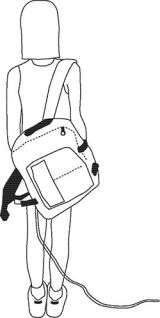
(PhysOrg.com) -- School children across the world may speak different languages but there is one experience an estimated 90 percent of all students share: wearing a backpack. Researchers from the University of San Diego, California School of Medicine say those students also share a common problem: low back pain due to overloaded backpacks.
The results of their research, published in the July/August edition of the Journal of Pediatric Orthopaedics, correlated pain associated with using a backpack with two main factors: the magnitude of the backpack load and the manner by which children distribute the load over their shoulders and back.
“The optimal position for wearing a backpack is high on the upper-back, with straps over both shoulders,” said Alan Hargens, Ph.D., professor, Department of Orthopedic Surgery, University of California, San Diego School of Medicine. “Kids who wear their backpacks in the more ‘stylish’ lower back position, or only use one strap, may suffer shoulder pain and posture problems.”
Hargens’ research team included: Henry Chambers, M.D., Department of Orthopedics, Rady Children’s Hospital San Diego; Brandon Macias, B.A. (Lead Author), Department of Orthopedic Surgery, UC San Diego School of Medicine and Gita Murthy, Ph.D., RORE, Inc.
Previous research by Hargens’ team (Archives of Pediatric & Adolescent Medicine, December 2005) shows that even in the high back position, pressure build-up under the straps could occlude blood flow and that pressures were higher on the right shoulder than left shoulder.
This most recent study quantified the pressure under backpack straps while children carried a typical range of loads under varying conditions.
“What’s interesting here is that, contrary to popular belief, it’s not just the weight of the backpack, but how it’s carried,” said Chambers. “And, the pain generated is not just on the back. It includes the pressure on the skin, which causes nerve pain similar to that tingling sensation caused when a leg or arm falls asleep.”
Ten healthy children (5 boys, 5 girls), ages 12 to 14 years, wore a backpack loaded at 10, 20, and 30 percent body weight (BW). The children carried the backpacks in two positions: low on the back or high the on back and pressure sensors measured strap pressure on the shoulders.
When walking with the backpack straps over both shoulders, contact pressures were significantly greater in the low-back position than in the high-back position. And regardless of carrying position, contact pressures on the right shoulder were always higher than those on the left shoulder.
On average, children load their backpacks with a weight equal to between 10 and 22 percent bodyweight. When the children put on a loaded backpack, they attributed 46 percent of the loading pain to the lower back and approximately 15 percent to the shoulders.
“It’s possible that our subjects alter their posture by elevating the right shoulder, thus increasing the contact pressure on that shoulder,” pointed out Hargens. “If those postures are practiced over a long period of time, with more weight and pressure on one shoulder, it may alter posture and produce prolonged pain. We need to study this further.”
Advice from researchers to parents and kids is simple: when it is necessary to carry heavy backpacks, carry them in a high-back position, using broad straps, to spread the load, and to minimize point pressures. Wear backpacks above the hips and maximize contact between the backpack straps and upper body. If the backpack has a waist-strap, use it.
“Following these recommendations may require conscious effort from the kids, encouragement from parents, peers, and school staff, until it becomes habitual,” said Murthy. “Although professionals and parents cannot often dictate what children should carry, it is important for us to educate them so they carry the packs correctly.”
Researchers agree this study supports the standard set by the American Academy of Orthopedics which suggests children carry a backpack weighing no more than 15 percent of their body weight.
“Parents also need to check what their children are carrying. We found that quite often it’s not just books and school work that’s weighing them down… but iPods and laptop computers and other things they may not need to carry to school everyday,” said Chambers.
Provided by University of California, San Diego


