Ames lab physicist develops 'electrifying' theory on superconducting fault-current limiters
August 16, 2008
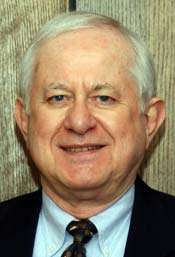
John R. Clem
(PhysOrg.com) -- John R. Clem, a physicist at the U.S. Department of Energy's Ames Laboratory, has developed a theory that will help build future superconducting alternating-current fault-current limiters for electricity transmission and distribution systems. Clem's work identifies design strategies that can reduce costs and improve efficiency in a bifilar fault-current limiter, a new and promising type of superconducting fault-current limiter.
"I was able to theoretically confirm that planned design changes to the current bifilar fault-current limiter being developed by Siemens and American Superconductor would decrease AC losses in the system," said Clem. "My calculations are good news for the future of the device."
Fault-current limiters protect power grids from sudden spikes in power, much like household surge protectors are used to save televisions and computers from damage during a lightning strike. Limiting fault currents is becoming an increasingly critical issue for large urban utilities, since these currents grow along with growing electric power loads.
Superconductors enable a novel and very promising type of fault current limiter — or "firewall" — that rapidly switches to a resistive state when current exceeds the superconductors critical current. At the same time, in normal operation, the superconductors' near-zero AC resistance minimizes power loss and makes the fault current limiter effectively "invisible" in the electric grid.
Clem analyzed a type of fault-current limiter, called a bifilar fault-current limiter, developed by Siemens and American Superconductor Corporation, who are now under contract with the DOE to demonstrate the technology at transmission voltages in the power grid of Southern California Edison. The team also includes Nexans, which is developing the terminations for the transmission fault-current limiter, and Air Liquide, which is providing the cryogenic cooling system.
Bifilar fault-current limiters are made from many turns of insulated superconducting tape wound into a coil shaped like a disk or a pancake. The tape consists of a thin, flat strip of superconducting material sandwiched between two strips of stainless steel. In the bifilar fault-current limiter design, adjacent tapes in the pancake coil carry current in opposite directions to effectively cancel out each tape's magnetic fields, thereby limiting electrical losses.
Siemens and American Superconductor were seeking to optimize the performance of their bifilar design. They asked Clem to predict how AC losses would change as the width of the tape is increased. Clem reported his findings in a recent issue of Physical Review B.
"I modeled the bifilar design as an infinite stack of superconducting tapes, in which adjacent tapes carry current in opposite directions," said Clem. "I was able to find an exact solution for the magnetic fields and currents that are generated in such a stack of tapes. Once I calculated how the magnetic flux penetrates into the tape, I then could calculate how much energy is lost in each current cycle for different tape widths and spacings between adjacent tapes."
"Clem's result was not obvious since there are competing mechanisms for AC loss in the bifilar configuration. It turns out that for typical parameters, when the spacing between adjacent tapes is small enough, the result is very simple: AC losses decrease as the tape width increases and the spacing decreases," said Alex Malozemoff, chief technical officer of American Superconductor. "This result is helping to guide us and our partner Siemens in an optimized design for a fault- current limiter in a major DOE-sponsored program, and it is expected to open a path to a commercial product in the future."
Article: http://link.aps.or … /v77/e134506
Provided by Ames Laboratory
-
Fast photon control brings quantum photonic technologies closer
1 minute ago |
not rated yet |
0
-
Engineers build first sub-10-nm carbon nanotube transistor
Feb 01, 2012 |
4.9 / 5 (33) |
30
-
Something old, something new: Evolution and the structural divergence of duplicate genes
Jan 31, 2012 |
4.6 / 5 (7) |
1
-
The hidden nanoworld of ice crystals: Revealing the dynamic behavior of quasi-liquid layers
Jan 30, 2012 |
5 / 5 (5) |
1
-
Stock market network reveals investor clustering
Jan 27, 2012 |
3.9 / 5 (23) |
8
-
What are the chemical reaction happen indise lamp in tungsten
4 hours ago
-
What is the number of significant digits in a integer with trailing 0's ?
5 hours ago
-
Forces of Magnets Attraction>Repulsion?
6 hours ago
-
Underwater projectile affected by Coriolis Effect
6 hours ago
-
Thermodynamics q
10 hours ago
-
what is electricity???
13 hours ago
- More from Physics Forums - General Physics
More news stories
Fast photon control brings quantum photonic technologies closer
(PhysOrg.com) -- Using photons instead of electrons to transmit information could lead to faster and more secure ways to communicate, among other advantages. Now a team of physicists has taken another step toward realizing ...
Rapunzel, Leonardo and the physics of the ponytail
(PhysOrg.com) -- New research provides the first mathematical understanding of the shape of a ponytail and could have implications for the textile industry, computer animation and personal care products.
4 hours ago |
4.7 / 5 (3) |
0
|
Researchers make better heat sensor based on butterfly wings
(PhysOrg.com) -- Scientists have long known that butterfly wings produce their iridescent colors by bouncing light around and between tiny ridges in structures made of chitin. More recently they’ve discovered ...
Explained: Sigma
It's a question that arises with virtually every major new finding in science or medicine: What makes a result reliable enough to be taken seriously? The answer has to do with statistical significance -- but ...
Feb 09, 2012 |
5 / 5 (21) |
87
Quantum physicist explains $100K offer for proof scaled-up quantum computing is impossible
(PhysOrg.com) -- MIT researcher Scott Aaronson has certainly riled the physics community with his offer this past Friday, of $100,000 to anyone who can prove that scaled-up quantum computing is impossible. ...
Transforming galaxies
(PhysOrg.com) -- Many of the Universe's galaxies are like our own, displaying beautiful spiral arms wrapping around a bright nucleus. Examples in this stunning image, taken with the Wide Field Camera 3 on ...
'Smart' microcapsules in a single step
(PhysOrg.com) -- A new, single-step method of fabricating microcapsules, which have potential commercial applications in industries including medicine, agriculture and diagnostics, has been developed by researchers ...
New ability to regrow blood vessels holds promise for treatment of heart disease
(Medical Xpress) -- University of Texas at Austin researchers have demonstrated a new and more effective method for regrowing blood vessels in the heart and limbs a research advancement that could have ...
A continent ablaze in auroral and manmade light
The North American continent is literally set ablaze in a confluence of Auroral and Manmade light captured in spectacular new videos snapped by the astronauts serving aboard the International Space Station ...
Nanostructured electrodes for rechargeable sodium-Ion batteries
Highly efficient 3V cathodes for rechargeable sodium-ion batteries have been developed by users from Argonne National Laboratory's Materials Science, Chemical Sciences & Engineering, and X-ray Sciences Divisions, ...
New tumor suppressor gene identified
A recent study published in Clinical Cancer Research suggests that the protein hVps37A suppresses tumor growth in ovarian cancer. The work, which was funded by the Austrian Science Fund FWF, shows, for th ...
Aug 16, 2008
Rank: 3 / 5 (1)
http://www.ingent...art00003
Aug 16, 2008
Rank: 5 / 5 (2)
Lots of things are dangerous if mistreated and we've learned to live with them just fine; even the fairly low voltage AC current found in your wall sockets is plenty enough to kill you if you don't treat live wires with any respect.
Aug 16, 2008
Rank: 5 / 5 (1)
2 points
1)like a fuse explodes in a fuse box. I think that is the idea. Blow the fuse made from a superconductor instead blowing your power station and ones downstream.
2)in the abstract of the paper you link to they put `explosion' in quotes because they using it in technical manner having to do with the wave propagation velocity.
Aug 16, 2008
Rank: 1 / 5 (1)
Wont this energy cost more than any savings it produces thru superconducting?
Wont current limiting "clamping" the load heat by blowing like a fuse cost a great deal more than traditional fuses?