Heads-up study of hair dynamics may lead to better hair-care products
August 17, 2008
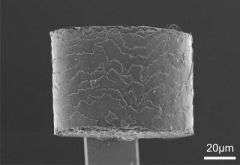
Submicroscopic view of segment of an individual hair fiber that reveals its extensive scaling. Image: Eva Max, University of Bayreuth, Germany
From frizzy perms to over-bleached waves, "bad hair days" could soon become a less frequent occurrence. Chemists report the first detailed microscopic analysis of what happens to individual hair fibers when they interact with each other, an advance in knowledge key to the development of improved shampoos, conditioners, and other products for repairing damaged hair, the researchers say. They presented the study here today at the American Chemical Society's 236th National Meeting.
Embracing that adage, "Personal care begins with hair," consumers now spend almost $60 billion annually on hair care products, one of the personal care industry's largest market segments. Despite the increasing availability of new hair care products within the past century, many products are inadequate for tackling today's rigorous hair treatments, the researchers say.
"Given all the new hair treatments out there, there's a growing need to make hair feel more natural, especially for women," says study co-author Eva Max, a doctoral student in chemistry at the University of Bayreuth in Germany. She notes, however, that researchers still are scrambling to put hair care on a firm scientific basis. The research involves "haptics," the science of touch — how the subjective perception of touch connects to objective surface properties of hair and other materials
"For the first time, we present an experimental setup that allows measuring the subtle forces, both physical and chemical, that arise when single hairs slide past each other or are pressed against each other," Max says. "The findings will help provide clearer strategies for optimizing hair care products."
Max points out that conventional methods for testing the effectiveness of hair care products involve measuring the forces required to comb hair under standardized laboratory conditions. Test volunteers are also asked to assess hair feel, but this approach is largely subjective. A more scientific way to study hair conditioning is needed, the researchers say.
In the new study, the researchers invented a unique technology for analyzing hair that involves mounting individual hair fibers on a cantilever tip of an atomic force microscope and measuring their interactions as they touch each other. "The system will allow scientists to explore how different hair care products affect hair-to-hair interactions so that these products can be optimized in a more systematic fashion," Max says.
The researchers used this new technique to analyze hair samples collected from volunteers. The samples, which were previously bleached, ranged from light blond to dark blonde in color.
The researchers found that hair feels rough and difficult to comb for two main reasons. On the one hand, mechanical damage to a hair's surface, or cuticle, creates scaly projections that jut out at perpendicular angles to other hair fibers. When hair fibers slide past each other, these scales create more friction than smooth hairs, causing a rough feel and making hair more difficult to comb. To soften hair, conditioners must contain active agents to smooth-out these scales so that they produce less friction, the researchers say.
On the other hand, chemical changes occur when hair fibers interact. Negative charges build up on the surface of hair that causes repulsion between single hairs. This repulsion causes friction and makes hair rough and difficult to comb. To solve the problem, positively-charged polymers that neutralize the negatively charged surfaces are included in conditioner formula to provide a silky feel to hair.
But finding the right formula for repairing damaged hair is no easy task, notes Claudia Wood, Ph.D., a senior scientist at BASF in Bayreuth, Germany. In addition to hair interactions, many other external factors, such as humidity, water content of hair, and hair stickiness, all affect hair quality, Wood says.
The key to repairing these processes is to find the right ratio of beneficial components in a conditioner or shampoo that optimize hair feel, Max and colleagues say. This new method will allow developers of hair care products to achieve this goal more easily, giving consumers a more reliable product, the researchers say. Their study was funded by BASF Care Chemicals Division.
Source: American Chemical Society
-
Counties with thriving small businesses have healthier residents, researchers find
Feb 07, 2012 |
5 / 5 (1) |
1
-
Sex-specific behaviors traced to hormone-controlled genes in the brain
Feb 02, 2012 |
5 / 5 (5) |
4
-
A mighty revealing mouse
Feb 01, 2012 |
5 / 5 (1) |
0
-
Blind moles use beauty for function, not fancy
Jan 27, 2012 |
4 / 5 (2) |
1
-
A genetic accelerator hits the gas on autoimmune diseases
Jan 16, 2012 |
not rated yet |
0
-
Engineers build first sub-10-nm carbon nanotube transistor
Feb 01, 2012 |
4.9 / 5 (33) |
30
-
Something old, something new: Evolution and the structural divergence of duplicate genes
Jan 31, 2012 |
4.6 / 5 (7) |
1
-
The hidden nanoworld of ice crystals: Revealing the dynamic behavior of quasi-liquid layers
Jan 30, 2012 |
5 / 5 (4) |
1
-
Stock market network reveals investor clustering
Jan 27, 2012 |
3.9 / 5 (23) |
8
-
Of microchemistry and molecules: Electronic microfluidic device synthesizes biocompatible probes
Jan 26, 2012 |
5 / 5 (2) |
0
More news stories
Scientists discover molecular secrets of 2,000-year-old Chinese herbal remedy
For roughly two thousand years, Chinese herbalists have treated Malaria using a root extract, commonly known as Chang Shan, from a type of hydrangea that grows in Tibet and Nepal. More recent studies suggest that halofuginone, ...
6 hours ago |
4.4 / 5 (15) |
5
|
New method to examine batteries -- MRI from the inside
There is an ever-increasing need for advanced batteries for portable electronics, such as phones, cameras, and music players, but also to power electric vehicles and to facilitate the distribution and storage of energy derived ...
Chemistry / Analytical Chemistry
6 hours ago |
5 / 5 (5) |
0
|
Hydrogen from acidic water: Researchers develop potential low cost alternative to platinum for splitting water
A technique for creating a new molecule that structurally and chemically replicates the active part of the widely used industrial catalyst molybdenite has been developed by researchers with the Lawrence Berkeley ...
Feb 09, 2012 |
4.8 / 5 (16) |
21
|
Fool's gold may prove an unlikely alternative to overexploited catalytic materials
Catalytic materials, which lower the energy barriers for chemical reactions, are used in everything from the commercial production of chemicals to catalytic converters in car engines. However, with current catalytic materials ...
Feb 10, 2012 |
4.4 / 5 (8) |
8
|
Research provides octagonal window of opportunity for carbon capture
(PhysOrg.com) -- Filtering carbon dioxide, a greenhouse gas, from factory smokestacks is a necessary, but expensive part of many manufacturing processes. However, a collaborative research team from the National ...
Feb 08, 2012 |
5 / 5 (2) |
5
|
Declining health-care productivity in England: Who says so?
Reports that the National Health Service in England has been declining in productivity in the last decade appear to have been accepted as fact. However, a Viewpoint published Online First by The Lancet disputes this. The Vi ...
Overeating may double risk of memory loss
New research suggests that consuming between 2,100 and 6,000 calories per day may double the risk of memory loss, or mild cognitive impairment (MCI), among people age 70 and older. The study was released today and will be ...
A mitosis mystery solved: How chromosomes align perfectly in a dividing cell
Although the process of mitotic cell division has been studied intensely for more than 50 years, Whitehead Institute researchers have only now solved the mystery of how cells correctly align their chromosomes during symmetric ...
Lab study raises questions over nano-particle impact
Tests involving chickens have raised questions about the impact on health from engineered nano-particles, the ultra-fine grains commonly used in drugs and processed foods, scientists said on Sunday.
Starve a virus, feed a cure? Findings show how some cells protect themselves against HIV
A protein that protects some of our immune cells from the most common and virulent form of HIV works by starving the virus of the molecular building blocks that it needs to replicate, according to research published online ...
Google might launch Drive for cloud storage soon
(PhysOrg.com) -- Google's next big move, according to the Wall Street Journal, is a cloud storage service called Drive. Hardly first to the plate, Google is simply catching up to introducing its cloud reposi ...