Cataloguing invisible life: Microbe genome emerges from lake sediment
August 17th, 2008 Methylotenera

Enlarge

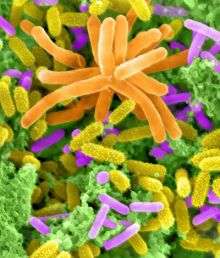
Microorganisms from a mud sample collected in Lake Washington. The purple and orange organisms are relatives of Methylotenera mobilis, whose complete DNA sequence is now published. Photo © Dennis Kunkel Microscopy, Inc. (Color by Ekaterina Latypova)

When entrepreneurial geneticist Craig Venter sailed around the world on his yacht sequencing samples of seawater, it was an ambitious project to use genetics to understand invisible ecological communities. But his scientific legacy was disappointing – a jumble of mystery DNA fragments belonging to thousands of unknown organisms.

Now a team led by a University of Washington scientist has studied lake mud, which contains microbial communities even more complex than those in seawater, and homed in on bacteria that perform the ecological task of eating methane. The study, published Sunday (Aug. 17) in the journal Nature Biotechnology, shows a way to sequence unidentified life.

"This work demonstrates that we can get a complete genome for a totally unknown organism," said lead author Ludmila Chistoserdova, a UW research scientist in chemical engineering. "We extracted a complete genome from a very complex community, and this is something novel."

Only 1 percent of microbes survive in the laboratory, Chistoserdova said, and the remaining 99 percent are undiscovered. Genetics can bypass the laboratory to help reveal microscopic communities, but most genetic tools use short stretches of known genetic code. Researchers look for these short stretches and copy, or amplify, them from the environment.

"You can only use amplification when you know what you're trying to get. And that's the problem," Chistoserdova said. "When you want to discover something unknown, amplification is a very deficient technique because you keep discovering the things you already know. So how can you discover the unknown?"

The researchers targeted a particular ecological function, in this case eating single-carbon compounds such as methane. First they collected samples of mud from the bottom of Lake Washington, a typical freshwater lake of moderate temperature and average levels of compounds such as methane, produced by decomposing organisms, in the sediment. Then they mixed the mud with five different samples of food labeled with carbon-13, a heavier isotope of carbon. Over time, organisms that ate the lab food incorporated the heavy carbon into their cells and their DNA. For five different single-carbon food sources, the scientists then separated the DNA by weight, knowing that the heavier pieces must belong to organisms that ate the lab-catered food.

Chistoserdova estimates the original mud sample contained about 5,000 different microbes, but the five batches of enriched DNA each contained only a dozen or so organisms. Researchers then were able to piece together carbon-13 DNA fragments to create one entire genome for Methylotenera mobilis, a microbe that eats methylamine, a form of ammonia. (This microbe was already known, though the team did not use that knowledge to create the sequence.) They also produced a partial genome for Methylobacter tundripaludum, a methane-eating microbe that so far resists cultivation in the lab.

The project was funded by the National Science Foundation and the Department of Energy.

Discovering an organism's entire genetic sequence has many uses. For example, the genetic code may produce clues for growing the microbe in the lab, which would allow scientists to study it and perhaps harness it for practical applications. Other research groups could look for the DNA in the environment as a telltale sign that the same microbe is present elsewhere. And knowing the identity of the most ecologically important organisms would help understand ecological cycles and monitor microbial population shifts, for instance due to climate change.

Chistoserdova's team was looking at methylotrophs, organisms that eat single-carbon compounds. Methane in the atmosphere, generated by decomposing plants and animals, is a greenhouse gas 25 times more potent than carbon dioxide. Unseen methylotrophs on land and in water keep the amount of methane reaching the atmosphere in check.

"These are the bacteria that maintain the Earth's health. Some of the methane escapes – in some parts of the lake you can see the bubbles. But whatever doesn't escape as bubbles, these bacteria do a very good job of eating it," Chistoserdova said.

Her group will continue to study the role of methane-eating freshwater bacteria.

For more information on the project, see http://depts.washington.edu/microobs .

Source: University of Washington


print this article email this article download pdf blog this article bookmark this article     Digg this Stumble it share on Facebook share on Reddit add to delicious save to Yahoo! bookmarks
4.5/5 after 8 votes


August 17th, 2008 all stories
Biology /

Comments: 0
Rank: 4.5/5 after 8 votes

  • Stumble this up

  • Digg this

  • Share it:
  • share on Facebook
  • share on MySpace
  • share on Slashdot
  • rss-newsfeed
  • share on Google
  • share on Reddit
  • add to delicious
  • save to Yahoo! bookmarks
  • share on Windows Live
  • Add to Mixx!
Rating: 4.5/5 after 8 votes

  • Related Stories

  • DNA of uncultured organisms sequenced using novel single-cell approach
    created Apr 22, 2009 | popularity not rated yet | comments 0
  • Women have more diverse hand bacteria than men
    created Nov 03, 2008 | popularity not rated yet | comments 0
  • Discovering a new life form in the hot springs of Yellowstone
    created Oct 13, 2008 | popularity not rated yet | comments 0
  • After the first decade of metagenomics -- adolescent growth spurt anticipated
    created Sep 25, 2008 | popularity not rated yet | comments 0
  • Microbes beneath sea floor genetically distinct
    created Jul 21, 2008 | popularity not rated yet | comments 0

Tags


  • Physicists Demonstrate Quantum Memory with Matter Qubits
    Physicists Demonstrate Quantum Memory with Matter Qubits
    Physics / General Physics
    created Jul 03, 2009 | popularity 4.4 / 5 (17) | comments 1
  • 'Holey' Nanosheets for Wastewater Dye Removal
    Nanotechnology / Nanomaterials
    created Jul 01, 2009 | popularity 5 / 5 (5) | comments 1
  • Jellyfish Robot Swims Like its Biological Counterpart
    Jellyfish Robot Swims Like its Biological Counterpart
    Electronics / Robotics
    created Jun 26, 2009 | popularity 4.4 / 5 (8) | comments 1
  • Could Maxwell's Demon Exist in Nanoscale Systems?
    Could Maxwell's Demon Exist in Nanoscale Systems?
    Physics / General Physics
    created Jun 24, 2009 | popularity 4.4 / 5 (18) | comments 29
  • Living Safely with Robots, Beyond Asimov's Laws
    Living Safely with Robots, Beyond Asimov's Laws
    Electronics / Robotics
    created Jun 22, 2009 | popularity 4.6 / 5 (52) | comments 40
  • Other News

    California water plan aims to save Puget Sound orcas

    Biology / Ecology

    created 9 hours ago | popularity not rated yet | comments 0

    A plan to restore salmon runs on California's Sacramento River also could help revive killer whale populations 700 miles to the north in Puget Sound, as federal scientists struggle to protect endangered species in a complex ...


    Scientists 'rebuild' giant moa using ancient DNA

    Biology / Plants & Animals

    created Jul 01, 2009 | popularity 5 / 5 (10) | comments 12

    (PhysOrg.com) -- Scientists have performed the first DNA-based reconstruction of the giant extinct moa bird, using prehistoric feathers recovered from caves and rock shelters in New Zealand.


    Pacific Giant Salamander (Dicamptodon tenebrosus)

    Salamanders, regenerative wonders, heal like mammals, people

    Biology / Microbiology

    created Jul 01, 2009 | popularity 5 / 5 (20) | comments 11

    The salamander is a superhero of regeneration, able to replace lost limbs, damaged lungs, sliced spinal cord -- even bits of lopped-off brain. But it turns out that remarkable ability isn't so mysterious after ...


    Genetically modified trees

    Anti-biotech groups obstruct forest biotechnology

    Biology / Biotechnology

    created Jun 30, 2009 | popularity 3.7 / 5 (7) | comments 5

    The potential of forest biotechnology to help address significant social and environmental issues is being "strangled at birth" by the rigid opposition of some groups and regulations that effectively preclude ...


    Super-sleepers could help super-sizers!

    Super-sleepers could help super-sizers!

    Biology / Plants & Animals

    created Jun 29, 2009 | popularity 5 / 5 (2) | comments 4

    Burrowing frogs can survive buried for several years without food or water. Scientists have discovered that the metabolism of their cells changes radically during the dormancy period allowing the frogs to ...