Newly detected air pollutant mimics damaging effects of cigarette smoke
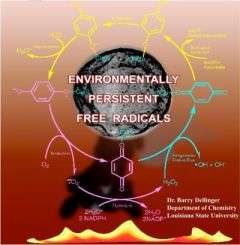
August 17th, 2008 Persistent Free Radicals

Enlarge

Persistent free radicals, a newly discovered air pollutant, could have effects similar to cigarette smoke, Louisiana researchers say. Credit: H. Barry Dellinger, Louisiana State University

A previously unrecognized group of air pollutants could have effects remarkably similar to harmful substances found in tobacco smoke, Louisiana scientists are reporting in a study scheduled for presentation today at the 236th National Meeting of the American Chemical Society. Inhaling those pollutants exposes the average person up to 300 times more free radicals daily than from smoking one cigarette, they added.

The discovery could help explain the long-standing medical mystery of why non-smokers develop tobacco-related diseases like lung cancer, said H. Barry Dellinger, Ph.D., the Patrick F. Taylor Chair of Environmental Chemistry at Louisiana State University in Baton Rouge.

"Free radicals from tobacco smoke have long been suspected of having extremely harmful effects on the body," Dellinger said. "Based on our work, we now know that free radicals similar to those in cigarettes are also found in airborne fine particles and potentially can cause many of the same life-threatening conditions. This is a staggering, but not unbelievable result, when one considers all of diseases in the world that cannot currently be attributed to a specific origin."

Scientists have long known that free radicals exist in the atmosphere. These atoms, molecules, and fragments of molecules are highly reactive and damage cells in the body. Free radicals form during the burning of fuels or in photochemical processes like those that form ozone. Most of these previously identified atmospheric free radicals form as gases, exist for less than one second, and disappear. In contrast, the newly detected molecules — which Dellinger terms persistent free radicals (PFRs) — form on airborne nanoparticles and other fine particle residues as gases cool in smokestacks, automotive exhaust pipes and household chimneys. Particles that contain metals, such as copper and iron, are the most likely to persist, he said. Unlike other atmospheric free radicals, PFRs can linger in the air and travel great distances.

"You basically have to be in certain places to inhale transient gas-phase radicals," Dellinger said. "You'd have to be right next to a road when a car passes, for example. Whereas we found that persistent radicals can last indefinitely on airborne fine particles. So you're never going to get away from them."

Once PFRs are inhaled, Dellinger suspects they are absorbed into the lungs and other tissues where they contribute to DNA and other cellular damage. Epidemiological studies suggest that more than 500,000 Americans die each year from cardiopulmonary disease linked to breathing fine particle air pollution, he says. About 10 to 15 percent of lung cancers are diagnosed in nonsmokers, according to the American Cancer Society. However, Dellinger stresses additional research is necessary before scientists can definitely link airborne PFRs to these diseases.

Smokers likely get a double dose of PFRs every time they light up, Dellinger said, since tobacco smoke also contains these molecules. In the five minutes it takes a typical smoker to finish a cigarette, he or she will breathe in an equal number of PFRs from the air and the smoke itself, likely compounding the damaging effects.

Source: American Chemical Society


print this article email this article download pdf blog this article bookmark this article     Digg this Stumble it share on Facebook share on Reddit add to delicious save to Yahoo! bookmarks
4.4/5 after 29 votes

Rank Filter

Move the slider to adjust rank threshold, so that you can hide some of the comments.


Display comments: newest first

  • JustinDoDrop - Aug 18, 2008
    • Rank: 1 / 5 (1)
    OMG that certainly cannot be a good thing.

    DR
    www.datools.net.tc
  • the_lovely_brenda - Aug 20, 2008
    • Rank: not rated yet
    do shampoo's, conditioners, body scubs, face wash, cleaning supplies release free radicals into the air??? whenever a roommate takes a shower i can smell the cleaning products in the air and it makes me wonder what ingredients the products contain.

August 17th, 2008 all stories
Chemistry /

Comments: 2
Rank: 4.4/5 after 29 votes

  • Stumble this up

  • Digg this

  • Share it:
  • share on Facebook
  • share on MySpace
  • share on Slashdot
  • rss-newsfeed
  • share on Google
  • share on Reddit
  • add to delicious
  • save to Yahoo! bookmarks
  • share on Windows Live
  • Add to Mixx!
Rating: 4.4/5 after 29 votes

  • Related Stories

  • Genetically engineered mice yield clues to 'knocking out' cancer
    created Jul 01, 2009 | popularity not rated yet | comments 0
  • Researchers identify enzyme that makes survival molecule for key vision cells
    created Jun 26, 2009 | popularity not rated yet | comments 0
  • Tiny levels of carbon monoxide damage fetal brain
    created Jun 25, 2009 | popularity not rated yet | comments 0
  • Research finds single gene controls growth of some cancers
    created Jun 12, 2009 | popularity not rated yet | comments 0
  • Cool plasma packs heat against biofilms
    created Jun 11, 2009 | popularity not rated yet | comments 0


  • Physicists Demonstrate Quantum Memory with Matter Qubits
    Physicists Demonstrate Quantum Memory with Matter Qubits
    Physics / General Physics
    created 14 hours ago | popularity 4.8 / 5 (8) | comments 1
  • 'Holey' Nanosheets for Wastewater Dye Removal
    Nanotechnology / Nanomaterials
    created Jul 01, 2009 | popularity 5 / 5 (5) | comments 1
  • Jellyfish Robot Swims Like its Biological Counterpart
    Jellyfish Robot Swims Like its Biological Counterpart
    Electronics / Robotics
    created Jun 26, 2009 | popularity 4.4 / 5 (7) | comments 1
  • Could Maxwell's Demon Exist in Nanoscale Systems?
    Could Maxwell's Demon Exist in Nanoscale Systems?
    Physics / General Physics
    created Jun 24, 2009 | popularity 4.4 / 5 (18) | comments 29
  • Living Safely with Robots, Beyond Asimov's Laws
    Living Safely with Robots, Beyond Asimov's Laws
    Electronics / Robotics
    created Jun 22, 2009 | popularity 4.6 / 5 (50) | comments 39
  • Other News

    urine

    Producing hydrogen from urine

    Chemistry / Analytical Chemistry

    created 14 hours ago | popularity 4.5 / 5 (19) | comments 13

    (PhysOrg.com) -- You do two things at motorway services: fill up one tank and empty another. US chemists have combined refuelling your car and relieving yourself by creating a new catalyst that can extract ...


    Oxygen key to 'cut and paste' of genes

    Oxygen key to 'cut and paste' of genes

    Chemistry / Biochemistry

    created 13 hours ago | popularity 4.3 / 5 (3) | comments 0

    (PhysOrg.com) -- An oxygen-sensitive enzyme has been found to play a key role in how genes create the many different proteins that make up our bodies.


    Scientists find a biological 'fountain of youth' in new world bat caves

    Chemistry / Biochemistry

    created Jun 30, 2009 | popularity 3.8 / 5 (24) | comments 26

    Scientists from Texas are batty over a new discovery which could lead to the single most important medical breakthrough in human history -- significantly longer lifespans. The discovery, featured on the cover of the July ...


    Stanford researchers find a quicker, cheaper way to sort isotopes

    Researchers find quicker, cheaper way to sort isotopes

    Chemistry / Analytical Chemistry

    created Jun 29, 2009 | popularity 5 / 5 (2) | comments 3

    (PhysOrg.com) -- Whether it's the summer grass that tickles your feet or the red Bordeaux smacking on your palette, nearly every part of the world around you carries special chemical markers. These markers, ...


    Researchers find new actions of neurochemicals (w/ Video)

    Researchers find new actions of neurochemicals (w/ Video)

    Chemistry / Biochemistry

    created Jul 02, 2009 | popularity 4.7 / 5 (7) | comments 0

    (PhysOrg.com) -- Although the tiny roundworm Caenorhabditis elegans has only 302 neurons in its entire nervous system, studies of this simple animal have significantly advanced our understanding of human ...