Genes and nutrition influence caste in unusual species of harvester ant
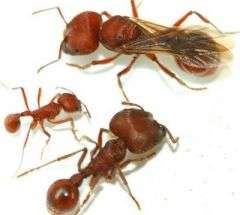
Researchers trying to determine whether nature or nurture determines an ant's status in the colony have found a surprising answer. Both.
Nature (that is, the ant's genetic makeup) and nurture (what it eats, for example) play a role in determining the fate of the Florida harvester ant, Pogonomyrmex badius, a resilient creature found in many parts of the southeastern United States.
The research team included scientists from the University of Illinois, the University of Arizona, Linfield College and Arizona State University. The findings appear this month in American Naturalist.
In the hierarchy of an ant colony, status is everything. If you are a "gyne" and thus destined to become a queen, you can expect the very best accommodations and generous portions at mealtimes. If you are a worker, you must be ready to sacrifice your health, welfare and reproductive capacity for the betterment of the colony.
The researchers were drawn to P. badius because its social structure is more complex than most. Its caste system includes two categories of workers: majors and minors. Major workers are nearly four times heavier than minors, but the minors outnumber them by 20 to 1. Gynes (pronounced jines) are about eight times heavier than minors.
The researchers wanted to know whether the ant's genetic endowment dictated its caste and size or whether nutrition also played a role.
"Basically what we found is that things are more complicated than previously thought," said Christopher R. Smith, a former graduate student in the School of Integrative Biology at Illinois and corresponding author on the study.
"Our study shows that there is a large genetic component to caste determination, but that there is also a very strong environmental component."
The researchers found that the genetic makeup of the colonies they studied was quite diverse. The average P. badius queen had mated with at least 20 males (the norm for ants is one to five). The genetic analysis also suggested that the offspring of most males could develop into any caste, but that some male lineages (patrilines) were more likely to become gynes while others were more likely to become major or minor workers.
A recent study of honey bees found that colonies with a lot of genetic diversity were better at nest building and finding and storing food than their less diverse counterparts.
It was long assumed that castes are environmentally determined, but recent studies on Pogonomyrmex harvester ants have found colonies in which becoming a worker or gyne is determined exclusively by genetic differences. Such rigidity constrains the colony's ability to adaptively adjust to environmental realities. For example, colonies that have few workers and yet produce a lot of larvae that are destined to become gynes fail to grow to maturity because they lack the resources to feed the voracious gynes.
On the other hand, colonies that can respond to environmental factors and alter the ratio of the castes they produce are often more successful in a changing environment. They can produce more workers when resources are scarce and more gynes when food is plentiful.
"Flexibility in caste determination is essential as it allows the colony to respond to changes in need or environmental fluctuations," said principal investigator Andrew Suarez, an Illinois professor of animal biology and of entomology and an affiliate of the Institute for Genomic Biology.
In the new study, the researchers analyzed what the P. badius ants were eating. Using stable isotope analysis, which looks for different versions of elements such as nitrogen and carbon in the diet, the researchers could tell whether individual ants were eating higher or lower on the food chain. Those at the top would have a more carnivorous diet, with a higher nitrogen content in their foods. They would also ingest more of a specific isotope of nitrogen in their foods than those eating seeds or plants.
The analysis showed that gynes were at the top of the dietary food chain and had the highest proportion of nitrogen in their diets. The minor workers had the lowest nitrogen content and were eating primarily from plant rather than animal sources. The majors were getting a better diet than the minors, but were not eating as well as the gynes.
"Differences in the nutrition that an individual assimilated during larval growth are strong predictors of caste," the authors wrote.
The researchers also found that genetic differences predict size in major workers and gynes, but not minor workers. Minor workers increase in size only as the colony grows, probably because larger colonies have more resources available to them.
The exact mechanisms by which genetics or diet influence caste are not yet known, Smith said, but in P. badius both play an important role. There may be a hormonal response, for example, that is driven in part by genetics and in part by nutrition that determines the trajectory of an individual ant's development, he said. Smith, currently a postdoctoral researcher at Arizona State University, continues to explore how genetic differences interact with variation in diet to generate diversity in the form and function of all ants.
The fact that nutrition can alter the genetic destiny of some ants in the colony probably allows it to adjust the ratio of workers to gynes to survive in tough times, he said.
"But there are still 'haves' and 'have nots' in the colony: those genetic variants who have a reproductive advantage and those that don't," Smith said.
Source: University of Illinois at Urbana-Champaign


