Perfect sight: Rosetta cameras track asteroid target
August 18th, 2008 Perfect sight: Rosetta cameras track asteroid target

Enlarge

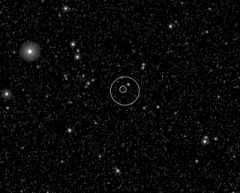
Asteroid Steins is the tiny white dot in the centre of the two concentric circles, as seen by Rosetta's Navigation Camera "A" in the morning of 4 August, when the spacecraft was approximately 24 mn kms from Steins; this was only the first in a series of steadily better images as Rosetta closed the range. On this day, the asteroid was still fainter than the nominal detection limit of the camera. The larger surrounding white spots are stars; almost all other small white spots are artefacts from the camera's CCD sensor (known as 'pixel dark current'), which considerably degrades the quality of the image. The asteroid was found within 3 arcseconds of its predicted position. Credits: ESA

(PhysOrg.com) -- On 14 August, Rosetta conducted a successful trajectory correction manoeuvre using data obtained from the Agency's first-ever optical tracking of an asteroid target, (2867) Steins. Images from the spacecraft's cameras were used to calculate the asteroid's location and optimise its trajectory for fly-by next month.

Rosetta's first major correction manoeuvre in the approach phase took place while the spacecraft was just less than 17 million km from Steins. The spacecraft’s thrusters burned continuously for approximately 2 minutes, starting at 13:42 CEST (Central European Summer Time). This achieved a change in Rosetta’s speed with respect to Steins of 12.8 cm/sec.

This tiny change in speed, though, will be enough to correct the spacecraft's 5 September Steins fly-by distance by 250 km. Prior to this manoeuvre, the spacecraft’s trajectory would have led it too close to the asteroid at the time of closest approach; to be compatible with spacecraft performance, Rosetta must be no closer than 800 km from Steins.

Daily imaging

Rosetta's OSIRIS (Optical, Spectroscopic, and Infrared Remote Imaging System) scientific camera and the on-board star-tracker navigational cameras began twice-weekly imaging periods on 4 August, recording 52 images of Steins. Flight dynamics specialists at ESA's European Space Operations Centre (ESOC) used these to calculate the 14 August thruster burn. Optical tracking of Steins will continue twice per week until 22 August, and will intensify with imaging slots daily between 25 August and 4 September - when the asteroid will be much closer.

"The closer we get to Steins, the more accurate our knowledge of the asteroid's position relative to Rosetta will be," said Trevor Morley, leading the Rosetta Flight Dynamics Orbit team at ESOC, Darmstadt, Germany. "Thanks to Rosetta's cameras, we will obtain increasingly precise measurements that will allow us to adjust again, if necessary, Rosetta's orbit for an optimal asteroid encounter."

Slots for possible future trajectory manoeuvres prior to the rendezvous with Steins are set for 28 August and 2, 4 and 5 September.
Exceptional results

According to Andrea Accomazzo, Rosetta Spacecraft Operations Manager at ESOC, the optical navigation campaign is providing exceptional results, far exceeding expectations.

"Both of Rosetta's navigation cameras could already see the asteroid from the very beginning of the tracking campaign - despite the long distance from Steins, and contrary to what we expected," Accomazzo said.

"The exceptional quality of the OSIRIS scientific camera – namely its angular resolution – provided data as accurate as expected, and made our current trajectory calculations very precise."

Rosetta's optical tracking campaign marks history for ESA's spacecraft operations. "It is the first time ever that we have used optical instrumentation on board a scientific spacecraft for navigation, as opposed to the usual techniques based on analysing radio signals," said Morley. "The exceptional results are really encouraging and we look forward to using this technique again in the future, if and when it is possible."

The Steins optical tracking campaign will continue right up to Rosetta's closest approach, now expected at 20:58 CEST, 5 September 2008.

Provided by ESA


print this article email this article download pdf blog this article bookmark this article     Digg this Stumble it share on Facebook share on Reddit add to delicious save to Yahoo! bookmarks
4.6/5 after 8 votes


August 18th, 2008 all stories
Space & Earth / Space Exploration

Comments: 0
Rank: 4.6/5 after 8 votes

  • Stumble this up

  • Digg this

  • Share it:
  • share on Facebook
  • share on MySpace
  • share on Slashdot
  • rss-newsfeed
  • share on Google
  • share on Reddit
  • add to delicious
  • save to Yahoo! bookmarks
  • share on Windows Live
  • Add to Mixx!
Rating: 4.6/5 after 8 votes

  • Related Stories

  • Rosetta starts tracking asteroid Steins
    created Aug 04, 2008 | popularity not rated yet | comments 0
  • Rosetta obtains 'light curve' of asteroid Steins
    created Mar 20, 2007 | popularity not rated yet | comments 0
  • Lutetia asteroid in Rosetta's spotlight
    created Jan 26, 2007 | popularity not rated yet | comments 0
  • Steins: A diamond in the sky
    created Sep 08, 2008 | popularity not rated yet | comments 0
  • Rosetta spacecraft meets asteroid Steins
    created Aug 25, 2008 | popularity not rated yet | comments 0


  • Physicists Demonstrate Quantum Memory with Matter Qubits
    Physicists Demonstrate Quantum Memory with Matter Qubits
    Physics / General Physics
    created Jul 03, 2009 | popularity 4.4 / 5 (17) | comments 1
  • 'Holey' Nanosheets for Wastewater Dye Removal
    Nanotechnology / Nanomaterials
    created Jul 01, 2009 | popularity 5 / 5 (5) | comments 1
  • Jellyfish Robot Swims Like its Biological Counterpart
    Jellyfish Robot Swims Like its Biological Counterpart
    Electronics / Robotics
    created Jun 26, 2009 | popularity 4.4 / 5 (8) | comments 1
  • Could Maxwell's Demon Exist in Nanoscale Systems?
    Could Maxwell's Demon Exist in Nanoscale Systems?
    Physics / General Physics
    created Jun 24, 2009 | popularity 4.4 / 5 (18) | comments 29
  • Living Safely with Robots, Beyond Asimov's Laws
    Living Safely with Robots, Beyond Asimov's Laws
    Electronics / Robotics
    created Jun 22, 2009 | popularity 4.6 / 5 (52) | comments 40
  • Other News

    Steam billows from the cooling towers at a nuclear power generating station in Byron

    Tropical zone expanding due to climate change: study

    Space & Earth / Earth Sciences

    created 1hour ago | popularity 5 / 5 (2) | comments 0

    Climate change is rapidly expanding the size of the world's tropical zone, threatening to bring disease and drought to heavily populated areas, an Australian study has found.


    US ambitions to send astronauts back to the moon as a prelude to missions to Mars have been put in doubt

    Forty years ago man first walked on the moon

    Space & Earth / Space Exploration

    created 23 hours ago | popularity 4.3 / 5 (4) | comments 2

    Forty years ago on July 20, 1969, American astronaut Neil Armstrong realized the oldest dream of human civilizations when he became the first man to walk on the moon.


    The least sea ice in 800 years

    The least sea ice in 800 years

    Space & Earth / Earth Sciences

    created Jul 01, 2009 | popularity 4.1 / 5 (65) | comments 60

    New research, which reconstructs the extent of ice in the sea between Greenland and Svalbard from the 13th century to the present indicates that there has never been so little sea ice as there is now. The ...


    Gas around young galaxy

    Intense heat killed the Universe's would-be galaxies, researchers say

    Space & Earth / Astronomy

    created Jul 01, 2009 | popularity 3.4 / 5 (21) | comments 27

    (PhysOrg.com) -- Our Milky Way galaxy only survived because it was already immersed in a large clump of dark matter which trapped gases inside it, scientists led by Durham University's Institute for Computational ...


    Scientists' Drill Hits Magma: Only Third Time on Record

    Scientists' Drill Hits Magma: Only Third Time on Record

    Space & Earth / Earth Sciences

    created Jun 29, 2009 | popularity 4.7 / 5 (22) | comments 21

    (PhysOrg.com) -- Scientists drilling a borehole deep into Iceland’s rocky crust to explore new methods of using geothermal energy hit a major roadblock on Thursday: Their drill ran into molten rock at a depth ...