Taking the bite out of shark DNA
August 18, 2008 Taking the bite out of shark DNA

Enlarge

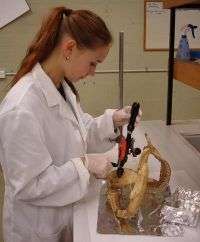
Macquarie University marine scientist Heidi Ahonen.

(PhysOrg.com) -- Extracting shark DNA has been somewhat of a challenge in the past, with scientists having to overcome the obvious hurdles associated with carrying out biopsies on live and rather uncooperative specimens.

Now, two Macquarie University marine scientists, Heidi Ahonen and Dr Adam Stow, have come up with a way of extracting the DNA without disturbing sharks in the wild - by taking samples from their old teeth.

Extracting DNA from sharks is not as simple as with other animals, given that they do not have the bony skeleton that is essential in order for the traditional extraction method to work.

Thanks to the unique ability sharks have to replace their teeth throughout their lifetime, however, old teeth may be collected from the sea floor in areas where sharks are known to aggregate.

Other DNA sources could include trophy jaws and teeth found in museums and private collections.

"Sadly, trophy jaws and teeth from sharks are relatively commonplace, whereas living sharks are becoming increasingly rare," Ahonen said, when interviewed by Nature News.

"This method allows information locked away within the teeth and jaws to be exploited to assist with conservation management."

Ahonen and Stow use a hand drill to extract a small amount of material from a shark's tooth or jaw. They then combine the material with a mixture of detergents and enzymes in order to release the DNA.

The new extraction technique will assist the marine science team at Macquarie in their study of grey nurse sharks and variations in shark genetics over time.

Ahonen and Stow's research has been published in the Journal of Fish Biology.

Provided by Macquarie University


print this article email this article download pdf blog this article bookmark this article     Stumble it Digg this share on Facebook retweet share on Reddit add to delicious
Rate this story - 4 /5 (1 vote)


August 18, 2008 all stories

Comments: 0

4 /5 (1 vote)
  • Stumble this up

  • Digg this

  • share this

  • hide
  • Related Stories

  • Plesiosaur a victim of shark attack
    created Oct 06, 2009 | popularity not rated yet | comments 0
  • A misplaced dinosaur tooth may have been cannibalism
    created Oct 05, 2009 | popularity not rated yet | comments 0
  • Could stressed out sharks save more fish? (w/ Video)
    created Oct 02, 2009 | popularity not rated yet | comments 0
  • New species of ghostshark from California and Baja California
    created Sep 22, 2009 | popularity not rated yet | comments 0
  • Greenland shark may become new source of biofuel
    created Jul 20, 2009 | popularity not rated yet | comments 0


Other News

Wasp

Well-traveled wasps provide hope for vanishing species

Biology / Plants & Animals

created 32 minutes ago | popularity not rated yet | comments 0

They may only be 1.5mm in size, but the tiny wasps that pollinate fig trees can travel over 160km in less than 48 hours, according to research from scientists at the University of Leeds. The fig wasps are transporting ...


Scientists successfully reprogram blood cells

Biology / Cell & Microbiology

created 1hour ago | popularity 5 / 5 (1) | comments 0

Researchers have transplanted genetically modified hematopoietic stem cells into mice so that their developing red blood cells produce a critical lysosomal enzyme -preventing or reducing organ and central nervous system damage ...


What is the meaning of 'one'? Evolutionary biologists argue for new meaning of 'organismality'

Biology / Evolution

created 5 hours ago | popularity 5 / 5 (1) | comments 1

Rice University evolutionary biologists David Queller and Joan Strassmann argue in a new paper that high cooperation and low conflict between components, from the genetic level on up, give a living thing its "organismality," ...


Study shows that some malignant tumors can be shut down after all

Biology / Cell & Microbiology

created 4 hours ago | popularity 5 / 5 (1) | comments 1

Oncologists have had their hands tied because more than half of all human cancers have mutations that disable a protein called p53. As a critical anti-cancer watchdog, p53 masterminds several cancer-fighting operations within ...


Researchers show how to divide and conquer 'social network' of cells

Researchers show how to divide and conquer 'social network' of cells

Biology / Biotechnology

created 6 hours ago | popularity not rated yet | comments 0

On Noah's Ark animals came in twos: male and female. In human bodies trillions of cells are coupled, too, and so are the molecules from which they are composed. Yet these don't come in twos, they are regrouped ...