Phoenix Camera Sees Morning Frost at the Landing Site
August 18, 2008 Phoenix Camera Sees Morning Frost at the Landing Site

Enlarge

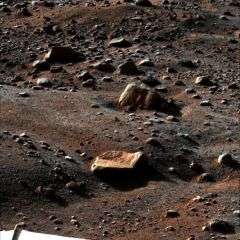
Water frost appears in this image the Phoenix Mars Lander's Surface Stereo Imager took on Aug. 14, 2008, at 6 a.m. local Mars time on Sol 79, the 79th Martian day after landing. The frost begins to disappear shortly after 6 a.m. as the sun rises on the landing site. The sun was about 22 degrees above the horizon when SSI took the image. Light at that oblique angle enhanced the detail of the polygons, troughs and rocks in the surrounding terrain. The image is false-color, enhanced to bring out details in the terrain. (NASA/JPL-Calech/University of Arizona/Texas A&M University)

(PhysOrg.com) -- The Surface Stereo Imager, or SSI, on NASA's Phoenix Mars Lander has seen water frost on the ground around the spacecraft's landing site.

Water frost appears in an image the SSI took on Aug. 14, 2008, at 6 a.m. local Mars time on Sol 79, the 79th Martian day after landing. The frost begins to disappear shortly after 6 a.m. as the sun rises on the landing site.

The sun was about 22 degrees above the horizon when SSI took the image. Light at that oblique angle enhanced the detail of the polygons, troughs and rocks in the surrounding terrain.

The SSI view was looking east-southeast, so the lander's eastern solar panel is visible in the bottom lefthand corner of the image. A rock informally named "Qaudlings" appears in the foreground, and another rock, called "Winkies," is located near the center of the image.

The science team enhanced the false-color image to show color variations. A larger view of the image is featured on the UA Phoenix Mars Mission gallery (http://phoenix.lpl.arizona.edu/gallery.php).

The SSI camera has taken thousands of images from atop its mast on the lander deck since landing day, May 25, 2008. The science team has relied on the camera's stereo vision to guide them in choosing where to dig and in operating the robotic arm.

A team led by Chris Shinohara of the UA Lunar and Planetary Laboratory built the SSI. Mark Lemmon of Texas A & M University, an alumnus of UA, is lead scientist for the camera.

Provided by University of Arizona


print this article email this article download pdf blog this article bookmark this article     Stumble it Digg this share on Facebook retweet share on Reddit add to delicious
Rate this story - 4.4 /5 (13 votes)


August 18, 2008 all stories

Comments: 0

4.4 /5 (13 votes)
  • Stumble this up

  • Digg this

  • share this

  • hide
  • Related Stories

  • Phoenix Sees the Colors of Mars
    created May 28, 2008 | popularity not rated yet | comments 0
  • Phoenix probe lands on Mars (Update 4)
    created May 25, 2008 | popularity not rated yet | comments 0
  • 'Perspectives on Energy Policy' report now available
    created Oct 22, 2009 | popularity not rated yet | comments 0
  • Half-million low-income elderly affected by sweeping cuts to state safety net
    created Oct 01, 2009 | popularity not rated yet | comments 0
  • 3-D Views Posted From NASA's Phoenix Mars Lander
    created Jul 18, 2008 | popularity not rated yet | comments 0


  • hide
  • Relevant PhysicsForums posts

  • Black hole confusion
    created Nov 14, 2009
  • Moon tied to Earth
    created Nov 13, 2009
  • Water on the Moon!
    created Nov 13, 2009
  • Is it possible for a single super-massive black hole...
    created Nov 13, 2009
  • More from Physics Forums - General Astronomy

Other News

MIT scientists pinpoint origin of dissolved arsenic in Bangladesh drinking water

Scientists pinpoint origin of dissolved arsenic in Bangladesh drinking water

Space & Earth / Environment

created 5 hours ago | popularity 5 / 5 (5) | comments 0

Researchers in MIT's Department of Civil and Environmental Engineering believe they have pinpointed a pathway by which arsenic may be contaminating the drinking water in Bangladesh, a phenomenon that has puzzled ...


Warmer means windier on world's biggest lake

Space & Earth / Earth Sciences

created 5 hours ago | popularity not rated yet | comments 0

Rising water temperatures are kicking up more powerful winds on Lake Superior, with consequences for currents, biological cycles, pollution and more on the world's largest lake and its smaller brethren.


Geeky 'tweeters' to report on space shuttle launch (AP)

Geeky 'tweeters' to report on space shuttle launch

Space & Earth / Space Exploration

created 4 hours ago | popularity not rated yet | comments 0

(AP) -- Fingers will be flying when space shuttle Atlantis blasts off Monday: About 100 of NASA's geekiest fans will be on hand, pecking away at iPhones, BlackBerrys, laptops and other Twittering gadgets.


Commuters wait on the platform shrouded by fog in London

Climate change not man-made, say majority of Britons: poll

Space & Earth / Environment

created 10 hours ago | popularity 2.9 / 5 (8) | comments 12

Less than half of Britons believes that human activity is to blame for global warming, according to a poll carried out for The Times newspaper and published on Saturday.


Hawaii's famed white sandy beaches are shrinking (AP)

Hawaii's famed white sandy beaches are shrinking

Space & Earth / Environment

created 10 hours ago | popularity 5 / 5 (1) | comments 1

(AP) -- Jenn Boneza remembers when the white sandy beach near the boat ramp in her hometown was wide enough for people to build sand castles.