2007 Hurricane Forecasts Took Blow from Winds and Saharan Dry, Dusty Air
August 18, 2008 By Kathryn Hansen 2007 Hurricane Forecasts Took Blow from Winds and Saharan Dry, Dusty Air

Enlarge

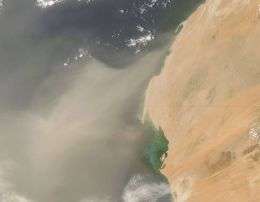
A dust plume from Northern Africa moves over the Atlantic on July 20, 2007. The westward extent of such dust could have contributed to the relatively quiet 2007 hurricane season. Credit: NASA

(PhysOrg.com) -- A new analysis of environmental conditions over the Atlantic Ocean shows that hot, dry air associated with dust outbreaks from the Sahara desert was a likely contributor to the quieter-than-expected 2007 hurricane season.

Factors known to influence the number and intensity of hurricanes in a season, including El Niño, sea surface temperatures, wind, and sea level pressure, led to NOAA forecasts [identify what agency made these forecasts; otherwise it might be assumed they are from NASA] for an above-average 2007 hurricane season. However, the season, which runs from June through November, turned up six hurricanes – a near normal number, but less than the 10 expected and far fewer than the record-breaking 15 hurricanes in 2005.

The difference between the 2007 and 2005 seasons could be due in part to the westward reach of Saharan dry air and dust over the North Atlantic, according to researchers, including Bill Lau of NASA's Goddard Spaceflight Center in Greenbelt, Md., and co-author of a study on this finding published Aug. 14 in the American Geophysical Union's Geophysical Research Letters. The study also confirms the possible role of Saharan dust in shattering predictions for the 2006 hurricane season, and has implications for more accurate predictions for future hurricane seasons.

Lau and colleagues previously reported that the presence of dust could have contributed to a weaker 2006 hurricane season than forecasters expected. Dust over the North Atlantic blocked some sunlight from reaching the ocean, accounting for 30 to 40 percent of the drop in sea surface temperatures measured between June 2005 and June 2006. The cooler sea surface increases atmospheric stability and also reduces the transfer of heat from ocean to atmosphere – a major source of fuel that drives hurricanes.

Now, the team found that hurricane formation in 2007 was also hampered by Saharan dry air. They go further, however, to describe the extent to which the dry air and associated dust spread across the tropical North Atlantic, as seen by instruments aboard NASA satellites such as the Moderate Resolution Imaging Spectroradiometer. They created a "wind-stretch index," based on the east-west difference in wind speed over the tropical Atlantic. The index is connected to relative humidity over the tropical western Atlantic, and is a perfect measure of how far west dry air and dust from Africa extends over the North Atlantic.

The team found that instances of Saharan dry air and dust extending far west over the Caribbean were in sync with conditions that contributed to fewer hurricanes in both 2007 and 2006, including lower sea surface temperatures. They also found that the far-reaching western extent of dust in 2006 and 2007 was associated with less-than-normal humidity over the western North Atlantic.

"This index hasn't been looked at before," said Lau. "We introduce a way to relate wind stretch to dry air and dust, which correlate very well with humidity in the western tropical Atlantic."

The link between dust and humidity, the researchers say, could aid future forecasts. As dust outbreaks occur most often in early summer prior to peak hurricane season, researchers could use a measure of humidity in the western tropical Atlantic to gauge the extent of dust transport, possibly providing an additional parameter to estimate the following month's hurricane activity.

"The index we proposed may provide practical implications for the prediction of Atlantic hurricane activities," says Donglian Sun of George Mason University in Fairfax Va., and lead author of the study. "Further studies are needed to discern the general prediction capability of our results."

If the index is on target, the team believes it could also describe dust's role in past hurricane seasons. Records of historical wind data from ground stations could be applied to the index to infer the westward extent of dry air and dust long before satellites existed to "see" dust from above.

Provided by Goddard Space Flight Center


print this article email this article download pdf blog this article bookmark this article     Stumble it Digg this share on Facebook retweet share on Reddit add to delicious
Rate this story - 3.8 /5 (10 votes)

Rank Filter

Move the slider to adjust rank threshold, so that you can hide some of the comments.


Display comments: newest first

  • mysticfree - Aug 19, 2008
    • Rank: not rated yet
    So what are the winds doing NOW?
  • Velanarris - Aug 19, 2008
    • Rank: not rated yet
    How about now?
  • p1ll - Aug 19, 2008
    • Rank: not rated yet
    and now? (lol)
  • jaggspb - Aug 19, 2008
    • Rank: not rated yet
    Now. You're looking at now sir. Everything that happens now, is happening now.

    What happened to then?
    We passed then.

    When?
    Just now. We're at now, now.

    Go back to then!
    When?

    Now.
    Now?

    Now!
    I can't.

    Why?
    We missed it.

    When?
    Just now.

    When will then be now?
    Soon.
  • agg - Aug 19, 2008
    • Rank: 5 / 5 (1)
    I'm not sure how americans caused this with their global warming but I think I'll
    decide first, then look for evidence to support my claim. Then I'll cash in. Also I know the Sahara has been dry for hundreds of years but
    I'm sure it's now hotter and drier than ever.
    The sky is falling now more than ever. Global warming!!! Run for the hills!!!

August 18, 2008 all stories

Comments: 5

3.8 /5 (10 votes)
  • Stumble this up

  • Digg this

  • share this

  • hide
  • Related Stories

  • Dusty Hurricanes
    created Apr 16, 2007 | popularity not rated yet | comments 0
  • NASA's advanced technology peers deep inside hurricanes
    created Mar 06, 2007 | popularity not rated yet | comments 0
  • The 2006 hurricane season was near normal
    created Jan 18, 2007 | popularity not rated yet | comments 0
  • Study: Dust may dampen hurricane fury
    created Oct 10, 2006 | popularity not rated yet | comments 0
  • A nursery for Hurricanes
    created Aug 08, 2006 | popularity not rated yet | comments 0


  • hide
  • Relevant PhysicsForums posts

  • The IPCC and the term "most"
    created Nov 23, 2009
  • Is global warming a fact?
    created Nov 23, 2009
  • Random variability of wind patterns
    created Nov 23, 2009
  • Record precipitation in the UK
    created Nov 22, 2009
  • More from Physics Forums - Earth

Other News

Past regional cold and warm periods linked to natural climate drivers

Space & Earth / Earth Sciences

created 5 hours ago | popularity 5 / 5 (4) | comments 6

Intervals of regional warmth and cold in the past are linked to the El Niño phenomenon and the so-called "North Atlantic Oscillation" in the Northern hemisphere's jet stream, according to a team of climate scientists. These ...


Russia: no space for space tourists (AP)

Russia: no space for space tourists

Space & Earth / Space Exploration

created 13 hours ago | popularity 2.7 / 5 (3) | comments 2

(AP) -- A top Russian space official says there is no space for tourists wishing to fly to the International Space Station.


Astronauts surprised by holiday turkey dinners (AP)

Astronauts surprised by holiday turkey dinners

Space & Earth / Space Exploration

created 9 hours ago | popularity not rated yet | comments 0

(AP) -- Space shuttle Atlantis' astronauts thought they were going to give thanks with pantry leftovers Thursday as their mission drew to a close, but found turkey dinners awaiting them.


Gullies and Flow Features on Crater Wall

Gullies and Flow Features on Crater Wall

Space & Earth / Space Exploration

created 9 hours ago | popularity 5 / 5 (1) | comments 0

(PhysOrg.com) -- This image from the High Resolution Imaging Science Experiment (HiRISE) camera on NASA's Mars Reconnaissance Orbiter shows a sample of the variety and complexity of processes that may occur ...


Burning coal worse for climate than clearing rain forests

Space & Earth / Environment

created 7 hours ago | popularity 3 / 5 (4) | comments 0

Deforestation has had a big influence on the increase of carbon dioxide (CO2) emissions in the past three centuries, but its impact is tapering off relatively. Nowadays, the burning of fossil fuels is a more crucial factor. ...