Molecular sleuths track evolution through the ribosome
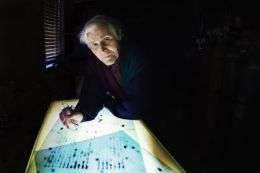
A new study of the ribosome, the cell's protein-building machinery, sheds light on the oldest branches of the evolutionary tree of life and suggests that differences in ribosomal structure between the three main branches of that tree are "molecular fossils" of the early evolution of protein synthesis.
The new analysis, from researchers at the University of Illinois, reveals that key regions of the ribosome differ between bacteria and archaea, microbes that the researchers say are genetically closer to eukarya, the domain of life that includes humans. The study appears this week in the Proceedings of the National Academy of Sciences.
The findings confirm and extend the early work of Illinois microbiology professor Carl Woese, an author on the study. Woese was the first to look for signs of evolution in the ribosome, where genetic information is translated into proteins. In the mid-1970s, he and his colleagues found consistent differences in the sequence of nucleotides that spell out the RNA of the ribosome in bacteria and archaea. These "molecular signatures" were so pronounced that Woese concluded that the archaea comprised a separate domain of life, distinct from bacteria and eukarya (animals, plants, fungi and protists). His classification system is now widely accepted.
"Carl Woese and his colleagues years ago established that protein translation had to be well developed when the evolution of modern cells started," said Illinois chemistry professor Zaida Luthey-Schulten, an author on the new study. "So the evolution of cells and the evolution of translation are really linked to one another."
The ribosome has two subunits, each made up of RNA and proteins. It interacts with a host of other molecules to guide the assembly of new proteins.
The researchers analyzed the sequence of nucleotides (the building blocks of RNA) and amino acids (the building blocks of proteins) that make up the ribosome.
They also looked at the three-dimensional structures of the ribosomal RNA and proteins and their proximity to each other.
Graduate student Elijah Roberts, lead author on the study, developed computer programs to analyze the ribosomal sequences of different organisms. Whenever he found a ribosomal RNA or protein sequence that differed between bacteria and archaea, he screened the database to determine whether a sequence was unique to a given domain.
"To be a molecular signature a sequence has to be common to all members of a single domain of life, but not another," Luthey-Schulten said.
Using the three-dimensional structures available for some bacterial and archaeal ribosomes, the researchers were also able to determine where in the ribosome these molecular signatures occurred.
"Until the 2000s, when these structures became available, you weren't able to correlate where these signatures were with what was touching them in 3-D space," Roberts said. "So nobody had ever done this sort of analysis before."
The researchers found that 50 percent of the signatures distinguishing the archaeal and bacterial ribosomes is located in five percent of the ribosomal RNA sequence. Most of these molecular signatures occur in regions that are critical to ribosomal function.
They also found correlations between some ribosomal protein and RNA signatures, which they say is evidence that the ribosomal RNA and proteins co-evolved.
"The ramifications of this work are it gives you a much better way to probe how this universal machinery changes from one organism to another," Luthey-Schulten said.
"In that the ribosome constitutes the core of the cellular translation mechanism, which is the sine qua non of gene expression, which is the essence of life as we know it, these findings constitute a major step in understanding the evolution of life, which is still a journey of a thousand miles," Woese said.
The new findings also have implications for human health, Luthey-Schulten said. Because the signatures that differentiate bacteria from other organisms often occur in regions that are essential to ribosomal functioning, they will likely be targets for the development of new antibiotic drugs, she said.
Source: University of Illinois at Urbana-Champaign


