Groundbreaking Research Shows DEET Not Sweet to Mosquitoes
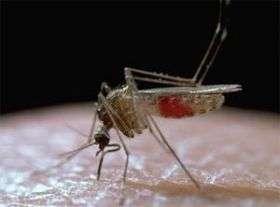
Spray yourself with a DEET-based insect repellent and the mosquitoes will leave you alone. But why? They flee because of their intense dislike for the smell of the chemical repellent and not because DEET jams their sense of smell, report researchers at the University of California, Davis.
Their groundbreaking findings will be published Monday, Aug. 18, in the Proceedings of the National Academy of Sciences (PNAS).
"We found that mosquitoes can smell DEET and they stay away from it," said noted chemical ecologist Walter Leal, professor of entomology at UC Davis. "DEET doesn't mask the smell of the host or jam the insect's senses. Mosquitoes don't like it because it smells bad to them."
DEET, the common name for N,N-diethyl-3-methylbenzamide, is the most common active ingredient in insect repellents. Developed by scientists at the U.S. Department of Agriculture and patented by the U.S. Army in 1946, DEET is considered the "gold standard" of insect repellents. Worldwide, more than 200 million people use DEET to ward off vectorborne diseases.
But DEET's mode of action or how it works has puzzled scientists for more than 50 years. Scientists long surmised that DEET masks the smell of the host, or jams or corrupts the insect's senses, interfering with its ability to locate a host. Mosquitoes and other blood-feeding insects find their hosts by body heat, skin odors, carbon dioxide (breath), or visual stimuli. Females need a blood meal to develop their eggs.
Leal said previous findings of other scientists showed a "false positive" resulting from the experimental design.
Entomologist Jim Miller of Michigan State University praised the UC Davis researchers' work as correcting "long-standing erroneous dogma."
"For decades we were told that DEET warded off mosquito bites because it blocked insect response to lactic acid from the host -- the key stimulus for blood-feeding," Miller said. "Dr. Leal and co-workers escaped the key stimulus over-simplification to show that mosquito responses -- like our own -- result from a balancing of various positive and negative factors, all impinging on a tiny brain more capable than most people think of sophisticated decision-making."
Miller added that the UC Davis research shows that recent work on DEET mode-of-action, published in the journal Science, apparently was "flat-out wrong."
"One of the great attributes of science is that, over time, it is self-correcting," he said.
Mosquitoes detect DEET and other smells with their antennae. Leal and researcher Zain Syed discovered the exact neurons on the antennae that detect DEET (N,N-diethyl-3-methylbenzamide). These neurons are located beside other neurons that sense a chemical, 1-octen-3-ol, known to attract mosquitoes.
"I was so delighted when I first encountered the neuron that detects DEET, a synthetic compound," said Syed. "I couldn't believe my eyes because it goes against conventional wisdom. So I repeated the experiment over and over until we discussed the findings in the lab."
The UC Davis investigators set up odorless sugar-feeding stations, including some that contained DEET, and found that DEET actively repelled Culex quinquefasciatus mosquitoes, also known as Southern house mosquitoes. The mosquito transmits West Nile virus, St. Louis encephalitis, and lymphatic filariasis, a disease caused by threadlike parasitic worms.
"Despite the fact that DEET is the industry standard mosquito repellent, relatively little is known about how it actually works," said UC Davis research entomologist William Reisen. "Previous studies have suggested a 'masking' or 'binding' with host emanations. Understanding the mode of action is especially important because DEET is used as the standard against which all other tentative replacement repellents are compared."
Major Dhillon, president of the American Mosquito Control Association and district manager of the Northwest Mosquito and Vector Control District, Riverside, praised the UC Davis work as "a breakthrough."
"In the future, this new knowledge can be incorporated into developing new repellents and may be in control strategies for Culex quinquefasciatus and other mosquitoes," he said.
Source: University of California - Davis


