Chemical liberated by leaky gut may allow HIV to infect the brain
In up to 20 percent of people infected with HIV, the virus manages to escape from the bloodstream and cross into the brain, resulting in HIV-associated dementia and other cognitive disorders. Now, scientists at the Albert Einstein College of Medicine of Yeshiva University have found strong evidence that a component of the cell walls of intestinal bacteria—a chemical present in high levels in the blood of HIV-infected people—helps HIV to penetrate the usually-impregnable blood brain barrier (BBB). The findings, published in the August issue of the Journal of Virology, could lead to strategies for preventing HIV from entering the brain and causing serious complications.
"Previous research has suggested that it's not individual HIV viruses that get into the brain but rather HIV-infected immune cells known as monocytes," says Dr. Harris Goldstein, director of the Einstein-Montefiore Medical Center for AIDS Research and senior author of the study. "Using an animal model, we wanted to find out first of all whether being infected with HIV enables monocytes to do what they don't usually do—escape from blood vessels and enter brain tissue."
Overcoming HIV's inability to infect mice, Dr. Goldstein and his colleagues had previously created a transgenic mouse line, HIV-TG mice, equipped with all the genes needed to make HIV—and that produces HIV in those cells, including monocytes and T cells, in which the virus multiplies in people. The HIV-TG mice were then bred with another transgenic mouse line, GFP-TG mice, containing the gene that codes for green fluorescent protein (GFP). The result: a double transgenic mouse line, HIV/GFP-TG mice, whose HIV-infected monocytes carried the GFP gene. This meant that the monocytes could be detected—either by looking for glowing green cells under the microscope or by using polymerase chain reaction, a sensitive genetic assay capable of detecting the DNA of the GFP gene.
Next, the researchers isolated millions of monocytes—HIV/GFP-producing monocytes from the HIV/GFP-TG mice, and monocytes from the GFP-TG mice producing GFP alone—and injected each type of monocyte into control mice.
Four days later, the researchers examined the brains of the injected mice to see whether monocytes from the bloodstream had crossed their BBB's. While there was no sign of monocytes in the brains of any of the mice injected with uninfected GFP monocytes, ultrasensitive DNA analysis showed that HIV/GFP monocytes were present at very low levels in the brains of nearly one third of the mice injected with the HIV-producing monocytes. "These results demonstrated very clearly that being infected with HIV somehow gives monocytes the capacity to cross an intact BBB," says Dr. Goldstein. "But we also suspected that something else was making it easier for HIV-infected monocytes to breach the defenses protecting the brain from infection."
In 2006, scientists at the National Institutes of Health had reported that HIV infection breaks down barriers in the intestine that normally prevent intestinal bacteria from entering the bloodstream. The blood of HIV-infected people was found to contain markedly elevated levels of lipopolysaccharide (LPS), a component of certain bacteria that are normally confined to the intestine but leak out due to HIV infection. In addition, previous animal studies had shown that exposure to elevated LPS levels compromised the integrity of the BBB. "So we hypothesized that the combination of HIV-infected monocytes and elevated LPS levels would amplify the ability of HIV to cross the BBB and get into the brain," says Dr. Goldstein.
To test this hypothesis, his team injected control mice with very low doses of LPS that were comparable to the levels in the bloodstream of HIV-infected individuals and would only minimally weaken their BBB's. Three hours later, half the mice were intravenously injected with HIV-and-GFP-producing monocytes, while the remaining mice were intravenously injected with GFP-producing monocytes that were otherwise normal.
Four days later, monocytes could not be detected in the brains of any of the 15 mice that were pre-treated with LPS and then injected with normal monocytes producing GFP alone. By contrast, monocytes were readily detected in the brains of about 25% of mice pre-treated with LPS and then injected with HIV-and-GFP-producing monocytes.
"Clearly, HIV-infected monocytes uniquely benefit from the LPS that is present in high amounts in the blood of HIV-infected people," says Dr. Goldstein. "So when HIV-infected monocytes are 'knocking on the door' of the BBB and starting to crack it open, the LPS facilitates their entry by making the BBB more permeable, apparently by weakening blood vessel structure."
If HIV-infected monocytes and LPS in the bloodstream can be considered a one-two punch for entry into the brain, a third punch—simply having a systemic HIV infection—also seems to help soften up the BBB. In making this discovery, Dr. Goldstein used his HIV-TG mouse strain, in which HIV is known to replicate inside brain cells associated with the BBB. These HIV-TG mice, along with control mice, were injected with LPS and, three hours later, intravenously injected with HIV-and-GFP-producing monocytes from the HIV/GFP-TG mouse strain.
Four days later, HIV-producing monocytes could be detected in the brains of about 25 percent of the control mice, as in the preceding experiment. By contrast, more than twice as many (70 percent) of the brains of HIV-TG mice that support systemic HIV infection contained HIV-producing monocytes. Even more impressive: When present, HIV-producing monocytes were three times more numerous in the brains of HIV-TG mice than in the brains of control mice.
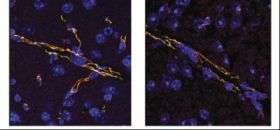
"These results demonstrate very dramatically that HIV infection of cells associated with the BBB, in conjunction with LPS exposure, contributes to BBB breakdown," says Dr. Goldstein. (See slides below). "So when HIV infection occurs, we seem to have a 1-2-3 combination of punches working in concert to facilitate entry of HIV-infected monocytes into the BBB-protected brain: HIV infection of monocytes increases their capacity to cross even an intact BBB; HIV infection in the gut releases LPS into the bloodstream allowing it to erode the BBB; and HIV infection of the cells of the BBB makes them more sensitive to the deleterious effects of LPS."
These findings could lead to preventive or therapeutic strategies. To help maintain the integrity of the BBB in HIV-infected people, says Dr. Goldstein, one approach might be to monitor the LPS level in their bloodstream and then reduce elevated levels. "We may be able to use antibiotics that kill intestinal bacteria that make LPS, and drugs are already available that can bind to LPS and clear it from the bloodstream," says Dr. Goldstein. "Ideally, we would promptly start newly diagnosed HIV-infected patients on a treatment to reinforce their BBB's so that HIV can't penetrate it—and perhaps we could even strengthen the BBB's of people who've been infected for quite a while. But before we can prevent the tragedy of HIV-associated dementia, we need to better understand the mechanism by which these molecular and cellular 'punches' interact to undermine the BBB."
Source: Albert Einstein College of Medicine


