New climate record shows century-long droughts in eastern North America
August 19, 2008
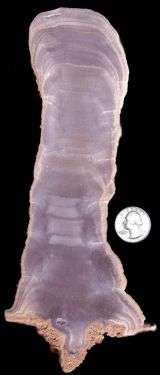
The stalagmite, which is 7.9 inches long, was collected from a site in Buckeye Creek Cave, West Virginia. It is 7,000-years-old. Image: Gregory Springer, Ohio University
A stalagmite in a West Virginia cave has yielded the most detailed geological record to date on climate cycles in eastern North America over the past 7,000 years. The new study confirms that during periods when Earth received less solar radiation, the Atlantic Ocean cooled, icebergs increased and precipitation fell, creating a series of century-long droughts.
A research team led by Ohio University geologist Gregory Springer examined the trace metal strontium and carbon and oxygen isotopes in the stalagmite, which preserved climate conditions averaged over periods as brief as a few years. The scientists found evidence of at least seven major drought periods during the Holocene era, according to an article published online in the journal Geophysical Research Letters.
"This really nails down the idea of solar influence on continental drought," said Springer, an assistant professor of geological sciences.
Geologist Gerald Bond suggested that every 1,500 years, weak solar activity caused by fluctuations in the sun's magnetic fields cools the North Atlantic Ocean and creates more icebergs and ice rafting, or the movement of sediment to ocean floors. Other scientists have sought more evidence of these so-called "Bond events" and have studied their possible impact on droughts and precipitation. But studies to date have been hampered by incomplete, less detailed records, Springer said.
The stalagmites from the Buckeye Creek Cave provide an excellent record of climate cycles, he said, because West Virginia is affected by the jet streams and moisture from the Gulf of Mexico and the Pacific Ocean.
Other studies have gleaned climate cycle data from lakes, but fish and other critters tend to churn the sediment, muddying the geological record there, said study co-author Harold Rowe, an assistant professor of geological sciences at the University of Texas at Arlington.
"(The caves) haven't been disturbed by anything. We can see what happened on the scale of a few decades. In lakes of the Appalachian region, you're looking more at the scale of a millennium," Rowe said.
Strontium occurs naturally in the soil, and rain washes the element through the limestone. During dry periods, it is concentrated in stalagmites, making them good markers of drought, Rowe explained. Carbon isotopes also record drought, Springer added, because drier soils slow biological activity. This causes the soil to "breathe less, changing the mix of light and heavy carbon atoms in it," he said.
In the recent study, the scientists cut and polished the stalagmite, examined the growth layers and then used a drill to take 200 samples along the growth axis. They weighed and analyzed the metals and isotopes to determine their concentrations over time.
The data are consistent with the Bond events, which showed the connection between weak solar activity and ice rafting, the researchers said. But the study also confirmed that this climate cycle triggers droughts, including some that were particularly pronounced during the mid-Holocene period, about 6,300 to 4,200 years ago. These droughts lasted for decades or even entire centuries.
Though modern records show that a cooling North Atlantic Ocean actually increases moisture and precipitation, the historic climate events were different, Springer said. In the past, the tropical regions of the Atlantic Ocean also grew colder, creating a drier climate and prompting the series of droughts, he explained.
The climate record suggests that North America could face a major drought event again in 500 to 1,000 years, though Springer said that manmade global warming could offset the cycle.
"Global warming will leave things like this in the dust. The natural oscillations here are nothing like what we would expect to see with global warming," he said.
Though some climate and drought records exist for the Western and Midwest areas of North America, the eastern Appalachian region hasn't been studied much to date, Rowe said. The research team plans to examine additional stalagmite records from West Virginia and Tennessee to paint a better picture of North American climate cycles.
Source: Ohio University
-
Climate-driven heat peaks may shrink wheat crops
Jan 29, 2012 |
3.9 / 5 (14) |
20
-
NASA sees repeating La Nina hitting its peak
Jan 19, 2012 |
4.8 / 5 (4) |
0
-
Ecologists call for screening imported plants to prevent a new wave of invasive species
Jan 04, 2012 |
5 / 5 (2) |
0
-
The case of the dying aspens
Dec 12, 2011 |
5 / 5 (5) |
4
-
Durban climate deal leaves difficult road ahead
Dec 11, 2011 |
5 / 5 (3) |
18
-
Engineers build first sub-10-nm carbon nanotube transistor
Feb 01, 2012 |
4.9 / 5 (31) |
30
-
Something old, something new: Evolution and the structural divergence of duplicate genes
Jan 31, 2012 |
4.6 / 5 (7) |
1
-
The hidden nanoworld of ice crystals: Revealing the dynamic behavior of quasi-liquid layers
Jan 30, 2012 |
5 / 5 (3) |
1
-
Stock market network reveals investor clustering
Jan 27, 2012 |
3.9 / 5 (23) |
8
-
Of microchemistry and molecules: Electronic microfluidic device synthesizes biocompatible probes
Jan 26, 2012 |
5 / 5 (1) |
0
-
Do some geologists actually act a lot like Randy Marsh?
23 hours ago
-
Discrepancy between oxygen and carbon-dioxide levels
Feb 09, 2012
-
where gems are found in the world
Feb 09, 2012
-
Wind Waves in Reservoir ~ Wind run-up and Wind set-up
Feb 08, 2012
-
Balance of oxygen in the atmosphere
Feb 01, 2012
-
The case for a methanol-based economy
Jan 30, 2012
- More from Physics Forums - Earth
More news stories
Latin America mining boom clashes with conservation
Latin America is experiencing a mining boom as prices rise fuelled by a hike in global demand, but the region is also being hit by a wave of violent protests, strikes and rallies by environmentalists.
1 hour ago |
not rated yet |
0
Europe stakes billion-dollar bet on new rocket
A pencil-slim rocket is scheduled to lift into space from South America on Monday, carrying a billion-dollar bet that Europe can grab a juicy slice of the market to place satellites in low orbit.
Space & Earth / Space Exploration
21 hours ago |
4 / 5 (3) |
0
Political leaders play key role in how worried Americans are by climate change: study
More than extreme weather events and the work of scientists, it is national political leaders who influence how much Americans worry about the threat of climate change, new research finds.
Feb 06, 2012 |
5 / 5 (6) |
72
NASA budget will axe Mars deal with Europe: scientists
US President Barack Obama's budget proposal to be submitted next week for 2013 will cut NASA's budget by 20 percent and eliminate a major partnership with Europe on Mars exploration, scientists said Thursday.
Space & Earth / Space Exploration
Feb 10, 2012 |
5 / 5 (3) |
55
Humans may have helped the decline of African rainforests 3000 years ago
(PhysOrg.com) -- Large areas of rainforests in Central Africa mysteriously disappeared over three thousand years ago, to be replaced by savannas. The prevailing theory has been that the cause was a change ...
Google might launch Drive for cloud storage soon
(PhysOrg.com) -- Google's next big move, according to the Wall Street Journal, is a cloud storage service called Drive. Hardly first to the plate, Google is simply catching up to introducing its cloud reposi ...
Love a click away in Indonesia's Twitter Republic
He was a geeky kid from Yogyakarta, she a glamorous city girl in Jakarta. In a country with one of the world's most vibrant social networking scenes they fell in love on Twitter.
Walney offshore wind farm is world's biggest (for now)
(PhysOrg.com) -- The Walney wind farm on the Irish Sea--characterized by high tides, waves and windy weather--officially opened this week. The farm is treated in the press as a very big deal as the Walney ...
GPS court ruling leaves US phone tracking unclear
A US Supreme Court decision requiring a warrant to place a GPS device on the car of a criminal suspect leaves unresolved the bigger issue of police tracking using mobile phones, legal experts say.
Europeans protest controversial Internet pact
Tens of thousands of people marched in protests in more than a dozen European cities Saturday against a controversial anti-online piracy pact that critics say could curtail Internet freedom.
Study finds that anti-diabetic medication can prevent the long-term effects of maternal obesity
In a study to be presented today at the Society for Maternal-Fetal Medicine's annual meeting, The Pregnancy Meeting, in Dallas, Texas, researchers will report findings that show that short therapy with the anti-diabetic medication ...
Aug 19, 2008
Rank: 3.5 / 5 (8)
"Global warming will leave things like this in the dust. The natural oscillations here are nothing like what we would expect to see with global warming," he said.
First we decide what we expect to see. Then we look for so called facts that support our bias.
Then we write more bullshit grants.
Aug 19, 2008
Rank: 3.7 / 5 (6)
So much for objectivity.
Aug 20, 2008
Rank: not rated yet
Graymouser is correct in saying that to draw any conclusion based on this evidence in simply not objective.
Aug 21, 2008
Rank: not rated yet
Aug 22, 2008
Rank: not rated yet
Oct 14, 2008
Rank: not rated yet
We have so many comments in the media saying that the warming will lead to droughts and famine, when so does the cooling; it seems that a change in temperature brings a change in precipitation that can result in droughts here and floods there - no surprise that when things are different - things are different.
I hope you have based you research results on drills from more than one individual cave, as water percolation levels may be affected by other changes besides levels of precipitation. e.g. land form coverage and stream relocation could alter the amount of water and the age of water acting as the source of the water that creates the stalagmites.
P.S next time I go Caving will I find that all the stalagmites have holes in them?