Key advance toward 'micro-spacecraft'
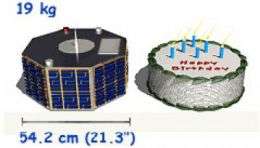
Fleets of inexpensive, pint-sized spacecraft are one giant leap closer to lift off. Researchers here at the 236th National Meeting of the American Chemical Society describe a new, razor thin temperature-regulating film that brings this sci-fi vision of "micro-spacecraft" weighing barely 50 pounds and 10-pound "nano-spacecraft" closer to reality.
"We don't have the processes in space to remove excess heat or keep the spacecraft warm in excess cold," says Prasanna Chandrasekhar, Ph.D. "It may sound very trivial, but controlling the temperature of a spacecraft is absolutely crucial. Currently, there is no way to do it for very small spacecraft."
With the cost of orbiting one pound of payload hovering around $5,000, micro-spacecraft are expected to be the thrust of future aerospace development. With these miniature craft, NASA, military and private firms will be able to launch more probes and satellites at lower cost, opening the doors to profound new applications for communications and defense. But before the first micro-spacecraft can blast off, scientists need to shrink the titanic thermal regulation systems used to help prevent today's ships from frying in the harsh sunlight of space – or freezing in the pitch black absence of it.
Space is an unforgiving environment. Outside of the cozy confines of Earth's atmosphere, every shuttle and satellite needs to contend with extreme heat and cold, blasts of charged particles from constant solar wind and periodic solar flares, corrosive atomic oxygen and punishing UV rays. Finally, there are micrometeoroids, bits of space debris traveling at over 20,000 miles per hour – approximately ten times faster than any bullet on earth.
Chandrasekhar and his team had to construct a thermo-regulating technology that could contend with all of these hazards – and still be light enough for use on micro-spacecraft.
In large spacecraft, mechanical "louvers" – Chandrasekhar calls them "glorified window blinds" – and loops of refrigeration pipes handle thermal control. Besides having weight and cost disadvantages, these technologies are difficult or impossible to adapt to micro- and nano-spacecraft.
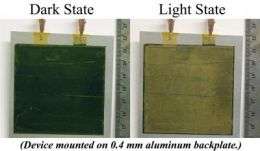
Chandrasekhar began tackling the problem in 2003 as an offshoot of a military technology. His solution was to design a so-called "thin-film variable emittance electrochromic device," a slender, flexible "sandwich" that feels like plastic and can change color when given an electrical charge. The thin-film could be applied to micro-spacecraft like a skin, switching color from light to dark based on its exposure to harsh sunlight or extreme darkness. Chandrasekhar added that the "color change" is in the infrared as well as in the visible color spectrum.
The film moves from a high "emittance" state — or one that emits lots of heat — in hot temperatures and a low emittance, or insulating, state in freezing temperatures. The thermo-film also has a protective layer consisting of germanium silicon oxides to protect it from atomic oxygen, which can corrode ships and shorten their lifespan – a serious problem for space stations and vital communications satellites.
The silicon oxide topcoat also imparts a lower "solar absorptance" to the skin. Even in its light-color state, the skin is still highly absorptive of solar radiation and can get very hot as a result. The topcoat ensures that the solar absorptance stays below a value that prevents heating of the skin under direct solar radiation.
Although the film is under one hundredth of an inch thick, it is tough enough to withstand the micrometeoroids hurtling through space. "The test for micrometeoroids was very simple — we just fired a gun loaded with small particles and tiny, harpoon-like needles at it," says Chandrasekhar, a researcher with the Ashwin-Ushas Corporation who carried out the research with NASA.
Other extreme experiments confirmed the film's resilience. To simulate the succession of intense heat and cold of space, the device was placed in a vacuum and exposed to temperatures that cycled continuously between -58 and 212 degrees F over several months. The film successfully endured these and other durability tests – Chandrasekhar says their device has yielded "very good results" all around.
"This work represents a radical improvement over prior work presented by this firm in incorporating a protective layer that drastically lowers the solar absorptance to an acceptable value," says Chandrasekhar. "The variable emittance electrochromic technology is an entirely new technology pioneered by this firm. To the best of our knowledge, no other group has done any work in this area."
NASA aims to get the first micro-spacecraft prototypes operational by 2013, so Chandrasekhar says his team is working to get their thermo-film tested in space as soon as possible.
Once deployed, micro-spacecraft would fly in constellation, making them nearly impossible to detect or blast out of the sky. With cheaper launch costs and a larger number of tiny satellites in orbit, micro-spacecraft could broaden the scope of satellite communications by opening it up to industries now unable to afford them. Improved hurricane detection as well as faster, more reliable and universally accessible telecommunications would be just the beginning.
Earthbound uses also exist for the thermo-film. Chandrasekhar says that countries with hot or cold climates could build homes with this color- and emittance-changing film to better control temperature cheaply. He has already received inquiries from overseas to create cinderblocks skinned with the temperature regulating film.
Chandrasekhar says that interest is building for the thermo-film. "A lot of spacecraft engineers have come to us saying 'If we had this technology, it would give us much greater design freedom for future micro-spacecraft.'"
Credit: American Chemical Society


