Biomarkers reveal our biological age
(PhysOrg.com) -- Not a day passes when we don’t get a little bit older. However, the exact processes involved in human aging are still puzzling. Scientists working with Lenhard Rudolph and Hong Jiang from the Max Planck Research Group for Stem Cell Aging in Ulm have now identified a group of proteins that reveal the biological age of a person. These biomarkers could be used in medicine to adapt therapies for older people to their individual biological age (PNAS, August 12, 2008).
Experience, wisdom and a certain inner serenity - according to popular belief, these are all characteristics that only come to us at a certain age. A growing percentage of our population can enjoy these positive aspects of aging, because medical progress and improvements in hygiene, the supply of food and living conditions have resulted in more and more people in industrial countries becoming increasingly older.
However, there is another side to this positive development: many older patients suffer from age-related illnesses and it is often difficult for doctors to decide which therapies an older person can cope with. This is due to the fact that chronological age does not necessarily correspond to biological age. "Many older people have a very good ability to regenerate, even better than some younger people," says Lenhard Rudolph, who headed the study. Together with his doctoral student, Hong Jiang, he searched for biomarkers that would provide him with some information about a person’s biological age. The two Max Planck researchers were supported in their search by Harald Mischak from the company Mosaiques Diagnostics.
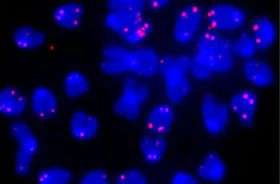
The scientists took a very close look at the end pieces of human chromosomes, called telomeres. These are needed to keep the chromosome stable and, at the same time, to safeguard it. However, they are shortened by 50 to 200 base pairs every time the cell divides - in the course of aging, they become so short that they lose their protective function. As a result, the chromosomes become unstable and the cell irreversibly loses its ability to divide. Scientists have now been able to show that this is one cause of cell aging.
Rudolph and Jiang discovered that the shortening of the telomeres and DNA damage, which they brought about through radiation in their study, led to an overlapping reaction in the human cells. In both cases the affected cells release marker proteins. "One interesting observation was that the same proteins can be measured in human blood and that a significant increase can be shown to be associated with aging and age-related diseases," Rudolph sums up.
The results of their work not only provide meaningful markers for biological aging, but also corroborate the DNA damage hypothesis for human aging. The Max Planck researchers are hoping that their biomarkers will be of use in medical applications, which will make it possible to adapt therapies individually to patients’ biological age and thus achieve better results. There is, however, even more to the biomarkers, as Rudolph explains: "They could also be used to test behavioural intervention, food supplements and pharmacological therapies to delay the aging processes."
Citatoin: Hong Jiang, Eric Schiffer, Zhangfa Song, Jianwei Wang, Petra Zürbig, Kathrin Thedieck, Suzette Moes, Heike Bantel, Nadja Saal, Justyna Jantos, Meiken Brecht, Paul Jenö, Michael N. Hall, Klaus Hager, Michael P. Manns, Hartmut Hecker, Arnold Ganser, Konstanze Döhner, Andrzej Bartke, Christoph Meissner, Harald Mischak, Zhenyu Ju, and K. Lenhard Rudolph, Proteins induced by telomere dysfunction and DNA damage represent biomarkers of human aging and disease, PNAS August 12, 2008 vol. 105 no. 32 11299-11304
Provided by Max-Planck-Research Group on Stem Cell Aging


