Efficient technique enables thinking
August 19, 2008 Efficient technique enables thinking

Enlarge

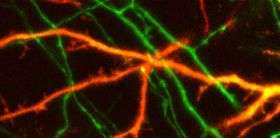
Constantly-changing contact between cells makes thought possible. Scientists at the Max Planck Institute for Neurobiology have now explained why this process does not take hours. Image: Max Planck Institute for Neurobiology/Lohmann

(PhysOrg.com) -- Nerve cells constantly create new contact points to their neighbouring cells. This is how the basic structure of our brain develops. In adults, new contact makes learning and memory possible. However, not all contact between cells is useful - most of it is dismantled again very quickly. Scientists at the Max Planck Institute for Neurobiology in Martinsried near Munich have now described a completely new technique with which nerve cells can evaluate the quality of the cells they contact in a very time- and energy-saving way. (Neuron, July 31, 2008)

The brain consists of a hundred billion nerve cells. What’s more, each of these cells is linked to its neighbours by many thousands of contact points. During brain development, young nerve cells must come into contact with the correct partner cells so that the brain can carry out its complex functions. However, contact between nerve cells is also constantly being set up and dismantled in adults. It is this continuous restructuring of the brain that allows us to learn and to forget.

Complex brain restructuring

Building and rebuilding the brain uses up a great deal of energy - it is not for nothing that the brain is the organ with the highest energy consumption. In reality, it should actually be consuming much more energy. This is because both young and adult nerve cells allow many hundreds of cell extensions to grow towards their neighbours. If the cells make contact, they need to exchange information about the quality of the connection: if the cells do not fit optimally together, the extension is broken down again after a short time, ranging from just a few seconds to a few minutes.

Up to now, it had been assumed that nerve cells can only exchange information via the synapses which are special contact points. However, synapses require up to two days to become fully functional - a waste of time and energy if the contact is to be broken down again. The brain could take almost 1000 years to develop if a synapse had to mature at each cell contact.

Calcium: the key to efficiency

It appears that nerve cells can also obtain information about their neighbours even without a synapse. Neurobiologists Christian Lohmann and Tobias Bonhoeffer from the Max Planck Institute for Neurobiology have now explained how they do that. The scientists marked a number of nerve cells with fluorescent dyes, observed them under a special microscope and discovered the secret to how the information is exchanged: local calcium signals very quickly transmit all the necessary information to the cell. A synapse only actually develops when the cell and the contact point prove to be suitable candidates for long-term contact.

How does this work in concrete terms? When a lengthening extension encounters a neighbouring cell, a release of calcium is triggered at its base. This calcium signal then acts like a stop sign: the extension immediately ceases to grow. At the same time, this signal already contains all the important information about the quality of the new contact: the contact only remains intact if the calcium signal is significantly higher than the surrounding calcium level of the cell. Otherwise, the extension withdraws and the nerve cell searches for a suitable partner cell at another point.

Suitable for both young and old

"We were astounded by the efficiency of this technique," says Tobias Bonhoeffer. "It saves the brain time and energy, and at the same time collects important information - in passing, so to speak." The scientists assume that nerve cells in adult brains use the same method to weigh up their partner cells. This allows the correct partner cell to be found quickly and a thought to be completed.

Citation: Christian Lohmann and Tobias Bonhoeffer, A role for local calcium signaling in rapid synaptic partner selection by dendritic filopodia, Neuron, July 31, 2008

Provided by Max Planck Institute of Neurobiology


print this article email this article download pdf blog this article bookmark this article     Stumble it Digg this share on Facebook retweet share on Reddit add to delicious
Rate this story - 4.8 /5 (37 votes)

Rank Filter

Move the slider to adjust rank threshold, so that you can hide some of the comments.


Display comments: newest first

  • gmurphy - Aug 20, 2008
    • Rank: not rated yet
    wow, this is so cool, i'm constantly implementing neural networks and this kind of dynamic behaviour is very difficult to implement elegantly.

August 19, 2008 all stories

Comments: 1

4.8 /5 (37 votes)
  • Stumble this up

  • Digg this

  • share this

  • hide
  • Related Stories

  • Crossing the line: how aggressive cells invade the brain (w/ Video)
    created Nov 05, 2009 | popularity not rated yet | comments 0
  • This is your brain on fatty acids
    created Oct 30, 2009 | popularity not rated yet | comments 0
  • Now hear this: Scientists show how tiny cells deliver big sound
    created Oct 22, 2009 | popularity not rated yet | comments 0
  • Nanowire biocompatibility in the brain: So far so good
    created Oct 22, 2009 | popularity not rated yet | comments 0
  • Discovery of enzyme structure points way to creating less toxic anti-HIV drugs
    created Oct 15, 2009 | popularity not rated yet | comments 0


  • hide
  • Relevant PhysicsForums posts

  • Improving the brain through chemistry
    created Nov 07, 2009
  • Sleep / REM Sleep and homeostasis
    created Nov 07, 2009
  • The Biceps Reflex
    created Nov 05, 2009
  • Consequenses of striking a Vein and an artery?
    created Nov 05, 2009
  • More from Physics Forums - Medical Sciences

Other News

The upside of feeling down

The upside of feeling down

Medicine & Health / Psychology & Psychiatry

created 1hour ago | popularity not rated yet | comments 1

A chill wind chases you into the door of your local newsagent. Rain is drumming down outside. As you pay for your newspaper, you briefly notice a number of strange items on the checkout counter - a matchbox ...


Diet switching can activate brain's stress system, lead to 'withdrawal' symptoms

Medicine & Health / Research

created 2 hours ago | popularity not rated yet | comments 0

In research that sheds light on the perils of yo-yo dieting and repeated bouts of sugar-bingeing, researchers from The Scripps Research Institute have shown in animal models that cycling between periods of eating sweet and ...


Words, gestures are translated by same brain regions, says new research

Medicine & Health / Neuroscience

created 5 hours ago | popularity 5 / 5 (1) | comments 0

Your ability to make sense of Groucho's words and Harpo's pantomimes in an old Marx Brothers movie takes place in the same regions of your brain, says new research funded by the National Institute on Deafness and Other Communication ...


Implantable Glucose Sensor Could Spell Relief for Millions of Diabetics (w/ Video)

Implantable Glucose Sensor Could Spell Relief for Millions of Diabetics (w/ Video)

Medicine & Health / Research

created 2 hours ago | popularity not rated yet | comments 0

(PhysOrg.com) -- UConn researchers have developed a tiny wireless device that can be inserted under a patient?s skin to monitor blood glucose levels over a period of several months.


Advance growing animal penile erectile tissue in lab may benefit patients

Medicine & Health / Research

created 4 hours ago | popularity 5 / 5 (4) | comments 0

In an advance that could one day enable surgeons to reconstruct and restore function to damaged or diseased penile tissue in humans, researchers at Wake Forest University Baptist Medical Center's Institute for Regenerative ...