Rifamycin antibiotics attack tuberculosis bacteria with walls, not signals
(PhysOrg.com) -- Amid concerns about the rising number of new tuberculosis cases worldwide, researchers led by Rockefeller University’s Seth A. Darst have reexamined and disproved a theory that describes how a potent class of antibiotics kills a deadly form of bacteria. The findings, which will appear in this week’s online issue of the Proceedings of the National Academy of Sciences, not only bring scientists closer to understanding how these antibiotics work but also how the bacteria become resistant to their effects.
The class of antibiotics, called rifamycins, was developed in the 1950s to combat tuberculosis-causing bacteria. The problem, however, was that the bacteria fought back, quickly developing resistance. And the rate of decline for new tuberculosis cases has begun to slow during the past decade, with more than nine million people across the globe currently afflicted.
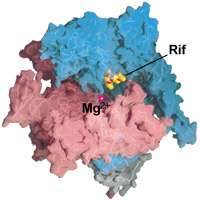
Rifamycins kill their prey by binding to RNA polymerase, the enzyme that kicks off gene expression by transcribing DNA to messenger RNA. However, the exact mechanism by which rifamycins interfere with the process had long remained unknown. A breakthrough came in 2001, when Elizabeth Campbell, a research associate in Darst’s Laboratory of Molecular Biophysics, and her colleagues showed that rifamycins bind next to RNA polymerase’s active center such that the rifamycin acts like a wall, physically blocking RNA from elongating. These results supported a steric-occlusion model for rifamycin action that explained — and continues to explain — past findings.
But the newer model, proposed three years ago, describes a very different mechanism. Called the allosteric model, it proposes that rifamycins do, indeed, bind to the enzyme next to the enzyme’s active center, but instead of blocking the elongating RNA molecule, rifamycins transmit a signal to the enzyme’s active center, decreasing a magnesium ion’s ability to bind. Without the magnesium ion, Mg2+, RNA cannot be transcribed.
“It was a beautiful model, but there were parts of it that didn’t add up and those parts directly conflicted with the model published in 2001,” says lead researcher Andrey Feklistov, a postdoc in the Darst lab who conducted the research along with several colleagues at Rockefeller, the Waksman Institute of Microbiology at Rutger’s University and The Public Health Research Institute of New Jersey Medical School.
The steric-occlusion model suggested that the stronger the rifamycin binds — that is, the sturdier the wall — the better it would work to halt transcription. But according to the allosteric model proposed by a team from The Ohio State University, that wasn’t necessarily the case. Even if rifamycins bind strongly, the enzyme could still be rifamycin-resistant due to a blip along the long signaling pathway. “So we did what scientists do,” says Feklistov. “We took another look.”
By testing the same two mutant strains of RNA polymerase that the Ohio team used, ones that had mutations along the proposed signaling pathway, the Darst team found that the mutants were resistant to rifamycin precisely because the antibiotic could not bind tightly to the enzyme. “This suggests that the steric-occlusion model best explains the available biochemical and structural evidence that has been published,” says Feklistov. Moreover, the Darst team found that rifamycins have no effect on metal ion binding to the active center, in direct contradiction to the allosteric model.
Understanding the mechanism by which rifamycins kill bacteria allows scientists to better understand how the tuberculosis-causing bacteria develop resistance to the antibiotics — and develop drugs to combat this effect. “At this stage,” says Feklistov, “any evidence, positive or negative, will help focus our attention toward this goal.”
Provided by Rockefeller University


