CU to show off its 100-mpg car-in-progress at state fair
August 19, 2008 By Krishna Ramanujan CU to show off its 100-mpg car-in-progress at state fair

Enlarge

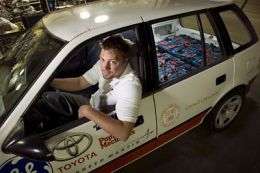
Cornell graduate student Trey Riddle sits in a modified Geo Metro his team is using to test battery packs, generators and braking methods in preparation for competing for the Progressive Automobile X Prize. Jason Koski/University Photography

(PhysOrg.com) -- A car that gets 100 miles a gallon may sound far-fetched, but the biggest challenge in designing a high-mileage hybrid vehicle for the $10 million Progressive Automobile X Prize (AXP) competition in 2010 is not know-how, says Cornell's AXP team. The biggest challenges are space to work in, time and money.

"Our goal is to bring awareness of the technology to the public," said team leader Trey Riddle, a graduate student in Cornell's Department of Mechanical and Aerospace Engineering. "With some creativity and innovation, we have the technology now. This isn't some far-off pie-in-the-sky."

At the 2008 New York State Fair in Syracuse, the Cornell AXP Team will display a pilot car -- a modified 1993 Geo Metro -- though that vehicle's main function is to test drive such technologies as battery packs, electrical generators and regenerative braking schemes. It will look nothing like the sleek final design. The car is part of the Visions New York exhibit at the Americraft Center of Progress Building.

"We should be able to begin building the final car early next year," said Riddle, who leads a team of more than 70 students from various Cornell disciplines, including engineering, ergonomics, and applied economics and management. The biggest design challenges for the team, which is mentored by Al George and John Callister, both Cornell professors of mechanical engineering, are maximizing drive-train efficiency, aerodynamics and keeping the car's weight low while meeting safety standards.

The team's final submission will be a commercially viable plug-in hybrid vehicle that can run on electricity for 40 to 50 miles on a full battery charge. The car's battery will be able to recharge while in motion, using a small diesel-powered onboard generator and regenerative braking. The battery also will charge in six hours when plugged into a standard electrical outlet. The final car must meet tailpipe and wells-to-wheels greenhouse gas emissions standards, seat four people, have 10 cubic feet of cargo space, accelerate to 60 mph in 12 seconds and be able to drive at least 200 miles with an efficiency equivalent to getting 100 miles per gallon. Contest rules also require a business plan that identifies a target market, suggests prices and creates a system for producing, distributing and servicing the vehicle with the goal of bringing to market at least 10,000 vehicles per year.

The AXP's qualifying races will be held in New York City in September 2009 for the 2010 final competition. Races will include urban, highway and racetrack courses.

Cornell and Western Washington University are the only universities in the mainstream auto class of the competition, which has 61 entries. Though a number of smaller automobile makers are competing for the prize, none of the three biggest automakers are involved.

The AXP is offered by the X Prize Foundation, best known for awarding the $10 million Ansari X Prize to Mojave Aerospace Ventures in 2004 for the flight of SpaceShipOne, the first private spacecraft capable of carrying three people to 100 kilometers (62 miles) above the Earth twice within two weeks. The goal of X Prizes is to encourage innovation through competition.

The Cornell team is sponsored by General Electric, Cornell's College of Engineering, National Instruments, Tektronix Inc., Toyota Motor Corp., Autodesk Inc., Cornell Systems Engineering Program, Popular Mechanics, Lockheed Martin, First Manhattan, the Triad Foundation and Exide Technologies.

Provided by Cornell University


print this article email this article download pdf blog this article bookmark this article     Stumble it Digg this share on Facebook retweet share on Reddit add to delicious
Rate this story - 3.9 /5 (8 votes)

Rank Filter

Move the slider to adjust rank threshold, so that you can hide some of the comments.


Display comments: newest first

  • Lord_jag - Aug 21, 2008
    • Rank: not rated yet
    "Though a number of smaller automobile makers are competing for the prize, none of the three biggest automakers are involved."

    10 million is nothing to them. I'm sure when the design is finished they will be sure to buy it up to make their oil fiends good and happy.
  • lengould100 - Sep 24, 2008
    • Rank: not rated yet
    "none of the three biggest automakers are involved." -- and people wonder why they're going down the drain.

August 19, 2008 all stories

Comments: 2

3.9 /5 (8 votes)
  • Stumble this up

  • Digg this

  • share this

  • hide
  • Related Stories

  • Self-driving car will get smarter
    created Oct 06, 2009 | popularity not rated yet | comments 0
  • Martian weather satellite's first report
    created Oct 13, 2008 | popularity not rated yet | comments 0
  • Cassini Pinpoints Source of Jets on Saturn's Moon Enceladus
    created Aug 15, 2008 | popularity not rated yet | comments 0
  • Microrobots dance on something smaller than a pin's head
    created Jun 02, 2008 | popularity not rated yet | comments 0
  • Fuel cells: distant dream, but burning with promise
    created May 15, 2008 | popularity not rated yet | comments 0


  • hide
  • Relevant PhysicsForums posts

Other News

Framed for child porn -- by a PC virus

Framed for child porn -- by a PC virus

Technology / Internet

created 16 hours ago | popularity 5 / 5 (5) | comments 3

(AP) -- Of all the sinister things that Internet viruses do, this might be the worst: They can make you an unsuspecting collector of child pornography.


A system of space solar power system (SSPS)

Japan eyes solar station in space as new energy source

Technology / Energy

created Nov 08, 2009 | popularity 4.7 / 5 (14) | comments 20

It may sound like a sci-fi vision, but Japan's space agency is dead serious: by 2030 it wants to collect solar power in space and zap it down to Earth, using laser beams or microwaves.


Dartmouth professor finds that iconic Oswald photo was not faked

Professor finds that iconic Oswald photo was not faked (w/ Video)

Technology / Computer Sciences

created Nov 05, 2009 | popularity 3.8 / 5 (9) | comments 38

(PhysOrg.com) -- Dartmouth Computer Scientist Hany Farid has new evidence regarding a photograph of accused John F. Kennedy assassin Lee Harvey Oswald. Farid, a pioneer in the field of digital forensics, digitally ...


airpod

Car That Runs on Compressed Air Questioned by Critics (w/ Video)

Technology / Energy

created Nov 03, 2009 | popularity 3.8 / 5 (21) | comments 34

(PhysOrg.com) -- As electric cars begin breaking into the short-distance vehicle market, one French company thinks that it has an alternative to the electric vehicle: a car that runs on compressed air. Motor ...


Sahara

Will Europe Be Powered by the Sahara

Technology / Energy

created Nov 04, 2009 | popularity 4 / 5 (22) | comments 25

(PhysOrg.com) -- Europe has long been interested in developing alternative energy sources. And, one of the more interesting places that some Europeans are looking for solar power is the Sahara. With the vast ...