Large Hadron Collider set to unveil a new world of particle physics
August 19, 2008
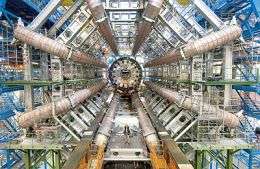
The massive ATLAS detector dwarfs a worker standing in front of it during installation at the Large Hadron Collider. UCSC physicists have been working on the ATLAS project since 1994. Image courtesy of CERN.
(PhysOrg.com) -- The field of particle physics is poised to enter unknown territory with the startup of a massive new accelerator--the Large Hadron Collider (LHC)--in Europe this summer. On September 10, LHC scientists will attempt to send the first beam of protons speeding around the accelerator.
The LHC will put hotly debated theories to the test as it generates a bonanza of new experimental data in the coming years. Potential breakthroughs include an explanation of what gives mass to fundamental particles and identification of the mysterious dark matter that makes up most of the mass in the universe. More exotic possibilities include evidence for new forces of nature or hidden extra dimensions of space and time.
"The LHC is a discovery machine. We don't know what we'll find," said Abraham Seiden, professor of physics and director of the Santa Cruz Institute for Particle Physics (SCIPP) at the University of California, Santa Cruz.
SCIPP was among the initial group of institutions that spearheaded U.S. participation in the LHC. About half of the entire U.S. experimental particle-physics community has focused its energy on the ATLAS and CMS detectors, the largest of four detectors where experiments will be performed at the LHC. SCIPP researchers have been working on the ATLAS project since 1994. It is one of many international physics and astrophysics projects that have drawn on SCIPP's 20 years of experience developing sophisticated technology for tracking high-energy subatomic particles.
The scale of the LHC is gigantic in every respect--its physical size, the energies attained, the amount of data it will generate, and the size of the international collaboration involved in its planning, construction, and operation. In September, high-energy beams of protons will begin circulating around the LHC's 27-kilometer (16.8-mile) accelerator ring located 100 meters (328 feet) underground at CERN, the European particle physics lab based in Geneva, Switzerland. After a period of testing, the beams will cross paths inside the detectors and the first collisions will take place.
Even before the machine is ramped up to its maximum energy early next year, it will smash protons together with more energy than any previous collider. The debris from those collisions--showers of subatomic particles that the detectors will track and record--will yield results that could radically change our understanding of the physical world.
In a talk at the American Physical Society meeting earlier this year, Seiden gave an overview of the LHC research program, including a rough timeline for reaching certain milestones. One of the most highly anticipated milestones, for example, is detection of the Higgs boson, a hypothetical particle that would fill a major gap in the standard model of particle physics by endowing fundamental particles with mass. Detection of the Higgs boson is most likely to occur in 2010, Seiden said.
But there's no guarantee that the particle actually exists; nature may have found another way to create mass. "I'm actually hoping we find something unexpected that does the job of the Higgs," Seiden said.
Technically, the Higgs boson was postulated to explain a feature of particle interactions known as the breaking of electroweak symmetry, and the LHC is virtually guaranteed to explain that phenomenon, according to theoretical physicist Howard Haber.
"We've been debating this for 30 years, and one way or another, the LHC will definitively tell us how electroweak symmetry breaking occurs. That's a fundamental advance," said Haber, a professor of physics at UCSC.
Haber and other theorists have spent years imagining possible versions of nature, studying their consequences, and describing in detail what the evidence would look like in the experimental data from a particle accelerator such as the LHC. The Higgs boson won't be easy to find, he said. The LHC should produce the particles in abundance (if they exist), but most of them will not result in a very distinctive signal in the detectors.
"It's a tough game. You can only do it by statistical analysis, since there are other known processes that produce events that can mimic a Higgs boson signal," Haber said.
Evidence to support another important theory--supersymmetry--could show up sooner. In many ways, supersymmetry is a more exciting possibility than the Higgs boson, according to theorist Michael Dine, also a professor of physics at UCSC.
"By itself, the Higgs is a very puzzling particle, so there have been a lot of conjectures about some kind of new physics beyond the standard model. Supersymmetry has the easiest time fitting in with what we know," Dine said.
Adding to its appeal, supersymmetry predicts the existence of particles that are good candidates to account for dark matter. Astronomers have detected dark matter through its gravitational effects on stars and galaxies, but they don't yet know what it is. Particles predicted by supersymmetry that could account for dark matter may be identified at the LHC as early as next year, Seiden said.
"Initially, we'll be looking for things that are known standards to make sure that everything is working properly. In 2009, we could start really looking for new things like supersymmetry," he said.
The massive ATLAS detector--45 meters (148 feet) long and 25 meters (82 feet) high--has involved more than 2,000 physicists at 166 institutions. Seiden's team at SCIPP has been responsible for developing the silicon sensors and electronics for the detector's inner tracker, which measures the trajectories of charged particles as they first emerge from the site of the collisions.
Seiden is now leading the U.S. effort to develop a major upgrade of ATLAS. The current detector is designed to last for 10 years, and the upgrade will coincide with a planned increase in the luminosity of the proton beams at the LHC (which will then become the "Super LHC").
"These large projects take such a long time, we have to start early," Seiden said.
Meanwhile, operation and testing of the current ATLAS detector is already under way at CERN, said Alexander Grillo, a SCIPP research physicist who has been working on the project from the start.
"We've been operating it and looking at cosmic ray particles," he said. "Nature gives us these cosmic rays for free, and they're the same kinds of particles we'll see when the machine turns on, so it enables us to check out certain aspects of the detector. But we're very excited to start seeing collisions from the machine."
ATLAS and the other LHC detectors are designed with "trigger" systems that ignore most of the signals and record only those events likely to yield interesting results. Out of the hundreds of millions of collisions happening every second inside the detector, only 100 of the most promising events will be selected and recorded in the LHC's central computer system.
"We'll be throwing away a lot of data, so we have to make sure the triggers are working correctly," Seiden said.
Grillo noted that the ATLAS project has been a great opportunity for UCSC students. Both graduate students and undergraduates have been involved in the development of the detector, along with postdoctoral researchers, research physicists, and senior faculty.
"The graduate students and postdocs get to go to Geneva, but even the undergraduates get a chance to work in a real physics lab and be part of a major international experiment," Grillo said.
SCIPP's prominent role in the LHC is also a boon for theoretical physicists at UCSC who are not directly involved in the collaboration, such as Dine, Haber, Thomas Banks, and others.
"There is a high level of interaction and camaraderie between theorists and experimentalists at UCSC, which is not the case at other leading institutions," Dine said. "For me, it's valuable just in terms of being aware of what's happening on the experimental side."
According to Haber, the LHC is certain to generate a lot of excitement in the world of physics.
"If nothing were found beyond what we know today, that would be so radical, because it would be in violation of a lot of extremely fundamental principles," he said.
Provided by University of California, Santa Cruz


That's so COOL and no more long waiting time to find .. whatever.
The LHC is not going to be the end of the world, if it were, we wouldn't be here because the earth would have been destroyed long ago.
Prominent quantum physicists also say that there is a chance that at any moment, you could suddenly tunnel through the matter that makes up your floor. But the chance is so tiny that it has never and in all likelyhood will never happen.
http://www.newsci...d=dn7145
http://news.bbc.c...7613.stm
http://unisci.com...1012.htm
The strangellets may be unstable enough to decay before they can hit the Earth, when formed at distance, but they were never formed so close near Earth. After all, the cold fusion was believed to be impossible by prominent quantum physicists and now we can observe it by video.
http://lenr-canr....akIR.wmv
The contemporary models of dense matter instabilities are neglecting the surface tension phenomena, which keeps the unstable phase more stable. For example, the neutron itself is unstable as such, but when exposed a large gravitational pressure at the core of neutron stars, it remains stable. But such stabilization requires a large amount of neutron matter, so its improbable in LHC scale. Is here some other mechanism, which can stabilize it?
My answer is YES! and it was completely ignored in contemporary models. As we know, the pressure inside of tiny water droplets of micrometer size is similar to hydrostatic pressure in 150 meter depth because of their surface tension. It seems, that observed evidence of stable tetra and pentaneutronium states is supporting this hypothesis. You can imagine the consequences at the case of more dense quark matter for yourself.
In addition, existing safety analysis considers generally low crossection of black hole interaction with terrestrial matter considering, every black hole will evaporate first, then it can swallow a sufficient amount of matter. Here we are neglecting the fact, the black hole or strangellet produced can exhibit a strong charge and or magnetic moment, i.e. it will attract and interact with surrounding matter a much faster, then every safety analysis has every considered (compare the Dr. Otto Rossler's web for further details. http://www.lhcfacts.org/ )
Of course, if we ignore an important phenomena, it makes no problem to consider them safe and to fool the publicity, after then.
Another point is, not just extreme states of matter, but even rather common & stable neutron fluid can become dangerous to Earth. A large cluster of neutrons could expell the electrons and protons from atom nuclei, thus replacing them under formation of another neutron clusters by avalanche like mechanism. It's possible, the more thorough analysis would render such mechanism impossible - but such mechanism was never analyzed thoroughly, it was even never considered!
It's a bit silly, if our destiny depends on such shortseeing way of thinking. Unfortunatelly, the informed publicity is the only force, which can force the scientists to reconsider these new connections, which were revealed recently. The scientists itself are sectarian group, which has lost its connection with reality already. The scientific community isn't able to intercept even the most trivial finding, like the AWT model or could fusion experiments. They're blind and deaf exactly like you.
Sounds like you're more of a philosopher that has read a lot of Wikipedia rather than someone who has actually been involved in the scientific community. Being open minded is great but at the same time when you are dealing with these theories you have to keep your sanity and see through all the BS. Anyone can come up with a "model" for anything but only time and nature will tell us if any of those models are correct. Besides no one in the scientific community is "deaf" to all these theories, in fact if you would have been an experimentalist I'm sure you would know that almost every analysis in current high energy particle physics deals with many of the outlandish theories today. Sometimes we have evidence that such theories can't exist and sometimes we can't conclude anything about their validity. So if you have a really good theory by which you think the universe is governed, talk to a physicist and understand why your theory might or might not work rather than being "blind and deaf" to what they are telling you.
Anyway, this is not problem of acceptation of some AWT, which can be delayed without problem, but the development of more thorough safety analysis, which reconsiders all possible LHC risks of catastrophic scenarios above presented. Until such safety analysis will not be presented, it has no meaning to discuss about LHC risks seriously.
I have personally sat down and talked to people that have done the calculations and have analyzed the risks posed by LHC. The problem is not that these analysis are not being carried out, it's that people such as your self don't listen to the arguments. Speculation on "this might happen...and that might happen" is easily gobbled up by the layman who wants to argue something. Show me your calculations and simulations prior to saying "this is an actual catastrophe scenario" then I will heed your warning. Have some merit to what you are saying and perhaps not so many people will turn a deaf ear to your arguments. Real arguments require evidence which is not of the philosophical nature but rather data which is acquired through long years of thought and hard work. So perhaps when you have devoted your life to something other than philosophical speculation and contribute to that devotion, you will see what these postdocs and professors are trying to tell you.
Well, all this can be missing under situation, when every experiment in common school lab must have it's person responsible for safety established first.... While the buildup of LHC experiments remains trully the masterpiece of management and logistic, it's safety provision is pathetic. Which person remains responsible for safety provision of these experiments?
Can the scientists use nuclear weaponry during experiments, for example? If not, what prohibits them in doing this? The true is, the scientists can do in LHC underground, what they want.
First of all I concur with xen_uno, they have done risk assessments. Second, lhcfacts.org has no legitimate calculations and is again chalk full of philosophical BS. If you consider the following as convincing arguments you are neither a philosopher (not a good one anyway) nor scientist.
I'm sorry, but ludicrous attempts to warn people don't generally work. So don't cry wolf because perhaps one day there will be a danger and no one will listen because people like would have taught people like me to disregard such warnings. I don't really wanna die either but my decision relies not on speculation brought up by people who love to "just argue" but rather the data that has been collected and reviewed. By the way, as a side note; Hawking was the one that purposed that these miniature black holes would be created in conditions comparable to the ones at LHC, so why do people say that Hawking was right about BHs begin created but not about them evaporating? Is the mechanism (laws of nature) by which they are created different than the ones from causing them to evaporate? Interesting how people don't think about these paradoxes. Well I can say one thing for sure, If you are right no one will ever know.
Just a numbers and links to these number, please. Or you're incompetent to discuss with me anymore.
In addition, here exists a theory of small primordial black holes, which should survive up to now, but it was never considered in connection with LHC experiments.
http://en.wikiped...ck_holes
How is it possible, by these theories such small BH can survive up to these days and the LHC BH not?
It looks like I had my share of BS for today.
It's time to move on.
That and microscopic black holes are formed constantly and evaporate within microseconds.
As for stragelets and other odd matter phenomina, you do realize that the Earth's atmosphere is bombarded with energies that make the LHC look like a pop gun in a field of artillery. If a strangelet could be created in the LHC then they have probably been created in the upper atmosphere multiple times and decayed just as all the mathematics concerning strange particles postulate.
The LHC is no more dangerous than the aurora borealis.
The large energies bombarding Earth atmosphere are always formed by single particle not by dense compact clusters of protons. And as such they're moving fast toward Earth. The aspect of critical matter is important here.
You realize the logic of that argument is so far off from observed and theoretical physics that your forum posting card should be removed.
In order for a strangelet to be moving too fast to interact with standard baryonic matter it would have to be tripling the speed of light.
The energy hitting the Earth is certainly not single particulate energy. The entire idea for large relatavistic colliders came from observations of large dense particle streams bombarding the Earth's magnetosphere at high energy.
Well lets see...
mass of our sun: 1.98892E30 kilograms
upper limit on quark size: 1E-18
the Schwarzschild radius is defined as approximatly
r=(mass of black hole/mass of our sun) * km
so given size of quark = radius of a black hole you get
(1E-21)(1.98892E30) = 1.98892E9 kg
so for the benefit of your argument say these black holes are created at rest, which maximizes the available mass from a collision. So you get
E = mc^2 = (1.98892E9 kg)(2.9979E8 m/s)^2 =
1.787523E29 J = 28.639 MeV
So wait! haven't we been making black holes since particle accelerators started out? Oh that's right we had the likes of you picketing about the end of the world back then too. Hmm? Were still here! So ok ok, how about a black hole the size of a proton or a nucleus?
for a black hole the size of:
a proton: .01432 TeV (We've been creating those)
a nucleus(uranium): .21477 TeV (and these too!)
We are creating black holes the size of atoms as we speak! Come on! Don't you think in the process of acquiring Trillions of events somewhere in there we would have created a black hole what would have gobbled up Earth? Granted these are only layman approximations, but the thing is if you carry out more precise ones then the odds of a devastating black hole being created are not in your favor.
...should I go on?
Oh and by the way, LHC collisions are not q q-bar! So you rely on the gluons to produce your q-bar in which case q q-bar interaction don't happen as often. These are simple little things that you and everyone who is arguing your point should understand. These approximations take 2 minutes to carry out so maybe you should sit down and do some, instead of relying on what the web tells you and then regurgitating bogus facts on posts. You wanna sound like a scientist? Do some science! You wanna be a concerned citizen? Then trust the people that know what they are doing to do their job instead of interjecting your erroneous concerns.
(my money is on yes he does, and a good laugh will be had by all.)
Nice to know we are basing MBH evaporation on fluff made real by CERN Public Relations and not observed science.
But dont worry biased CERN scientists say we are safe. LOL
...you should first learn how to read, then then try really really hard to get those synapses going, and then if anything useful happens you can try and put up a post. For example
...is self contradicting, oh and...
...means you don't really know what you are talking about.
Quote from their paper, p27:
"From the LHC-threatening perspective, the main point of the present article is that the LHC should really not be allowed to operate at full intensity or beam energy by these effects on the initial state due to SI."
SOURCE:
Holger B. Nielsen, Masao Ninomiya:
Test of Influence from Future in Large Hadron Collider; A Proposal
"We are creating black holes the size of atoms as we speak! Come on! Don't you think in the process of acquiring Trillions of events somewhere in there we would have created a black hole what would have gobbled up Earth?" - and no micro black holes in the universe do exist since nothing has been observed, its only theory, they only exist on paper. Take me to a website that demonstrates they are real as reality.
http://arxiv.org/.../0205106
A. LHC Creates black holes as CERN Predicted (1 per second) [1].
B. Micro Black holes do not evaporate as LSAG accepts is plausible. [2]
C. One or more micro black holes are captured by Earth's gravity as LSAG accepts as plausible. [3]
D. Micro Black holes grow exponentially as Dr. Otto E. Rossler's paper predicts and calculates. [4]
If the reasonable, plausible assumptions above prove correct, and only mother nature currently knows for certain, then there exists a 100% probability of destruction of the planet, in lay persons terms.
.."Though the final phases of the black hole's evaporation are still unknown, the formation of a black hole remnant is a theoretically well motivated expectation. We analyze the observables emerging from a black hole evaporation with a remnant instead of a final decay. We show that the formation of a black hole remnant yields a signature which differs substantially from a final decay. We find the total transverse momentum of the black hole event to be significantly dominated by the presence of a remnant mass providing a strong experimental signature for black hole remnant formation"....
http://arxiv.org/.../0507138
http://www.lhcdefense.org/
http://www.lhcfacts.org/
read
http://arxiv.org/...91v2.pdf
and show me you understand what that paper actually said rather than quoting phrases. By the way, Holger is part of CERN and is on leave, thus your "NOT related to the CERN group" comment is misguided. Another thing, you should really take the suggestion (not insult) on reading posts prior to randomly saying something (aimed at your "black holes only on paper" argument). About pointing you to the web, well not many credible sources reside on the web pertaining to this topic. So as a suggestion, do some of your own thinking and don't regurgitate what your web browser tells you. A few of the papers Alizee quoted are not bad explanations of current black hole theories, so take a read.
In response to Alizee:
BH theories are nowhere near perfect. There are many places where there is no modern framework for solutions thus by using "the next best thing" for a framework causes breakdowns and paradoxes when trying to get to the answer. As you should have read in your own citations current "best working models" say BHs exist for about 10^-40 s from which you get Standard Model results, thus no doomsday. The argument that a black hole is prohibited to fully evaporate is also flawed. It contains a paradox in addition to the evidence that "we are still here". If BHs didn't evaporate (aside from the fact that no one knows even if they are created) then we would currently be sitting in an event horizon seeing the end of the universe.
http://arxiv.org/...91v2.pdf
can you re-post the another link
Yeah, it's the paper you cited.
http://arxiv.org/...91v2.pdf
THREE CHEERS FOR LHC!!