Light touch: Controlling the behavior of quantum dots
August 19th, 2008 Light touch: Controlling the behavior of quantum dots

Enlarge

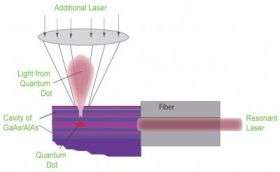
Schematic of NIST-JQI experimental set up. Orienting the resonant laser at a right angle to the quantum dot light minimizes scattering. Image: Solomon/NIST

Researchers from the National Institute of Standards and Technology and the Joint Quantum Institute (JQI), a collaborative center of the University of Maryland and NIST, have reported a new way to fine-tune the light coming from quantum dots by manipulating them with pairs of lasers. Their technique, published in Physical Review Letters, could significantly improve quantum dots as a source of pairs of “entangled” photons, a property with important applications in quantum information technologies.

The accomplishment could accelerate development of powerful advanced cryptography applications, projected to be a key 21st-century technology.

Entangled photons are a peculiar consequence of quantum mechanics. Tricky to generate, they remain interconnected even when separated by large distances. Merely observing one instantaneously affects the properties of the other. The entanglement can be used in quantum communication to pass an encryption key that is by its nature completely secure, as any attempt to eavesdrop or intercept the key would be instantly detected. One goal of the NIST-JQI team is to develop quantum dots as a convenient source of entangled photons.

Quantum dots are nanoscale regions of a semiconductor material similar to the material in computer processors but with special properties due to their tiny dimensions. Though they can be composed of tens of thousands of atoms, quantum dots in many ways behave almost as if they were single atoms. Unfortunately, almost is not good enough when it comes to the fragile world of quantum cryptography and next-generation information technologies. When energized, a quantum dot emits photons, or “particles” of light, just as a solitary atom does. But imperfections in the shape of a quantum dot cause what should be overlapping energy levels to separate. This ruins the delicate balance of the ideal state required to emit entangled photons.

To overcome this problem, the NIST-JQI team uses lasers to precisely control the energy levels of quantum dots, just as physicists have been doing with actual single atoms since the mid-1970s and, much more recently, with the artificial quantum dot variety. With their customized set-up, which includes two lasers—one shining from above the quantum dot and the other illuminating it from the side—the researchers were able to manipulate energy states in a quantum dot and directly measure its emissions.

By adjusting the intensity of the laser beams, they were able to correct for imperfection-caused variations and generate more ideal signals. In so doing, the team was the first to demonstrate that laser-tuned quantum dots can efficiently generate photons one at a time, as required for quantum cryptography and other applications.

While the device currently still requires quite cold temperatures and sits in a liquid helium bath, it is compact enough to fit in the palm of your hand—an elegant setup that could be eventually implemented in quantum cryptography applications.

Citation: A. Muller, W. Fang, J. Lawall and G.S. Solomon. Emission spectrum of a dressed exciton-biexciton complex in semiconductor quantum dot. Physical Review Letters, 101, 027401 (2008), posted online July 11, 2008.

Source: National Institute of Standards and Technology


print this article email this article download pdf blog this article bookmark this article     Digg this Stumble it share on Facebook share on Reddit add to delicious save to Yahoo! bookmarks
4.6/5 after 17 votes


August 19th, 2008 all stories
Nanotechnology / Nanophysics

Comments: 0
Rank: 4.6/5 after 17 votes

  • Stumble this up

  • Digg this

  • Share it:
  • share on Facebook
  • share on MySpace
  • share on Slashdot
  • rss-newsfeed
  • share on Google
  • share on Reddit
  • add to delicious
  • save to Yahoo! bookmarks
  • share on Windows Live
  • Add to Mixx!
Rating: 4.6/5 after 17 votes


  • Physicists Demonstrate Quantum Memory with Matter Qubits
    Physicists Demonstrate Quantum Memory with Matter Qubits
    Physics / General Physics
    created Jul 03, 2009 | popularity 4.4 / 5 (17) | comments 1
  • 'Holey' Nanosheets for Wastewater Dye Removal
    Nanotechnology / Nanomaterials
    created Jul 01, 2009 | popularity 5 / 5 (5) | comments 1
  • Jellyfish Robot Swims Like its Biological Counterpart
    Jellyfish Robot Swims Like its Biological Counterpart
    Electronics / Robotics
    created Jun 26, 2009 | popularity 4.4 / 5 (8) | comments 1
  • Could Maxwell's Demon Exist in Nanoscale Systems?
    Could Maxwell's Demon Exist in Nanoscale Systems?
    Physics / General Physics
    created Jun 24, 2009 | popularity 4.4 / 5 (18) | comments 29
  • Living Safely with Robots, Beyond Asimov's Laws
    Living Safely with Robots, Beyond Asimov's Laws
    Electronics / Robotics
    created Jun 22, 2009 | popularity 4.6 / 5 (52) | comments 40
  • Other News

    A 'quantum of sol' -- how nanotechnology could hold the key to a solar-powered future

    A 'quantum of sol' -- how nanotechnology could hold the key to a solar-powered future

    Nanotechnology / Nanomaterials

    created Jun 30, 2009 | popularity 3.9 / 5 (15) | comments 16

    (PhysOrg.com) -- A new generation of 'nano-structured' millimetre-sized solar cells that could convert the sun's energy to electricity more than twice as efficiently as current technology, is the subject of ...


    Australian researchers are set to begin human trials of a tiny nano-cell that acts as a "Trojan horse" against cancer

    Hi-tech 'Trojan horse' can kill cancer cells: researchers

    Nanotechnology / Bio & Medicine

    created Jun 29, 2009 | popularity 4.7 / 5 (12) | comments 7

    Australian researchers are set to begin human trials of a tiny nano-cell that acts as a "Trojan horse" against cancer cells, a breakthrough they say may curb the need for debilitating chemotherapy.


    'Holey' Nanosheets for Wastewater Dye Removal

    Nanotechnology / Nanomaterials

    created Jul 01, 2009 | popularity 5 / 5 (5) | comments 1

    (PhysOrg.com) -- Researchers have discovered that extremely thin sheets of nickel oxide with hexagonally shaped holes can absorb hazardous dyes from wastewater nearly as well as the best traditional methods, but are recyclable. ...


    Harnessing Nanoparticles To Track Cancer Cell Changes

    Nanotechnology / Bio & Medicine

    created Jul 03, 2009 | popularity not rated yet | comments 1

    The more dots there are, the more accurate a picture you get when you connect them. Cancer researchers adopting that philosophy have developed a new imaging technology that could give scientists the ability to simultaneously ...


    Computer-Guided Nanoparticle Therapy Destroys Tumors

    Nanotechnology / Bio & Medicine

    created Jun 29, 2009 | popularity 5 / 5 (11) | comments 0

    Gold nanoshells are among the most promising new nanoscale therapeutics being developed to kill tumors, acting as antennas that turn light energy into heat that cooks cancer to death. Now, a multi-institutional research team ...