MIT engineers work toward cell-sized batteries
August 20th, 2008 By Elizabeth Thomson MIT engineers work toward cell-sized batteries

Enlarge

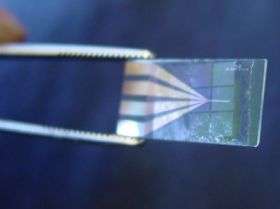
Tweezers hold the device used to test MIT's new components for microbatteries (batteries themselves are invisible in this image). Photo courtesy / Belcher Laboratory, MIT

(PhysOrg.com) -- Forget 9-volts, AAs, AAAs or D batteries: The energy for tomorrow’s miniature electronic devices could come from tiny microbatteries about half the size of a human cell and built with viruses.


MIT engineers have developed a way to at once create and install such microbatteries — which could one day power a range of miniature devices, from labs-on-a-chip to implantable medical sensors — by stamping them onto a variety of surfaces.
MIT engineers work toward cell-sized batteries
Enlarge

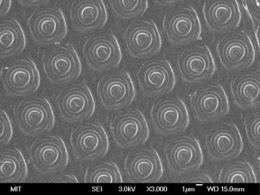
An array of microbattery electrodes, each only about four micrometers, or millionths of a meter, in diameter. Image courtesy / Belcher Laboratory, MIT

In the Proceedings of the National Academy of Sciences (PNAS) the week of Aug. 18, the team describes assembling and successfully testing two of the three key components of a battery. A complete battery is on its way.

“To our knowledge, this is the first instance in which microcontact printing has been used to fabricate and position microbattery electrodes and the first use of virus-based assembly in such a process,” wrote MIT professors Paula T. Hammond, Angela M. Belcher, Yet-Ming Chiang and colleagues.

Further, the technique itself “does not involve any expensive equipment, and is done at room temperature,” said Belcher, the Germeshausen Professor of Materials Science and Engineering and Biological Engineering.

Hammond is the Bayer Professor of Chemical Engineering and associate head of the Department of Chemical Engineering. Chiang is a professor of ceramics in the Department of Materials Science and Engineering. Belcher, Chiang and Hammond are also affiliated with the MIT Energy Initiative, which aims to help transform the global energy system to meet the needs of the future. Belcher and Hammond are also faculty members in the Koch Institute for Integrative Cancer Research at MIT.

Batteries consist of two opposite electrodes — an anode and cathode — separated by an electrolyte. In the current work, the MIT team created both the anode and the electrolyte.

First, on a clear, rubbery material the team used a common technique called soft lithography to create a pattern of tiny posts either four or eight millionths of a meter in diameter. On top of these posts, they then deposited several layers of two polymers that together act as the solid electrolyte and battery separator.

Next came viruses that preferentially self-assemble atop the polymer layers on the posts, ultimately forming the anode. In 2006, Hammond, Belcher, Chiang and colleagues reported in Science how to do this. Specifically, they altered the virus’s genes so it makes protein coats that collect molecules of cobalt oxide to form ultrathin wires — together, the anode.

The final result: a stamp of tiny posts, each covered with layers of electrolyte and the cobalt oxide anode. “Then we turn the stamp over and transfer the electrolyte and anode to a platinum structure” that, together with lithium foil, is used for testing, Hammond said.

The team concludes in their PNAS paper: “the resulting electrode arrays exhibit full electrochemical functionality.”

What’s next? In addition to developing the third part of a full battery — the cathode — via the viral assembly technique, the team is also exploring a stamp for use on curved surfaces, Belcher said. “We’re also interested in integrating [the batteries] with biological organisms.”

Additional coauthors of the PNAS paper are first author Ki Tae Nam, Ryan Wartena, Pil J. Yoo (now at Sungkyunkwan University, Korea), Forrest W. Liau, and Yun Jung Lee.

Provided by MIT


print this article email this article download pdf blog this article bookmark this article     Digg this Stumble it share on Facebook share on Reddit add to delicious save to Yahoo! bookmarks
4.5/5 after 36 votes


August 20th, 2008 all stories
Technology / Energy

Comments: 0
Rank: 4.5/5 after 36 votes

  • Stumble this up

  • Digg this

  • Share it:
  • share on Facebook
  • share on MySpace
  • share on Slashdot
  • rss-newsfeed
  • share on Google
  • share on Reddit
  • add to delicious
  • save to Yahoo! bookmarks
  • share on Windows Live
  • Add to Mixx!
Rating: 4.5/5 after 36 votes

  • Related Stories

  • Researchers build tiny batteries with viruses
    created Apr 06, 2006 | popularity not rated yet | comments 0
  • Virus battery could power cars, electronic devices
    created Apr 02, 2009 | popularity not rated yet | comments 0
  • MIT Creates New Material For Fuel Cells, Increases Power Output By 50 Percent
    created May 15, 2008 | popularity not rated yet | comments 0
  • Printable batteries
    created Jul 02, 2009 | popularity not rated yet | comments 0
  • Microbes turn electricity directly to methane
    created Mar 30, 2009 | popularity not rated yet | comments 0

Tags


  • Physicists Demonstrate Quantum Memory with Matter Qubits
    Physicists Demonstrate Quantum Memory with Matter Qubits
    Physics / General Physics
    created Jul 03, 2009 | popularity 4.4 / 5 (13) | comments 1
  • 'Holey' Nanosheets for Wastewater Dye Removal
    Nanotechnology / Nanomaterials
    created Jul 01, 2009 | popularity 5 / 5 (5) | comments 1
  • Jellyfish Robot Swims Like its Biological Counterpart
    Jellyfish Robot Swims Like its Biological Counterpart
    Electronics / Robotics
    created Jun 26, 2009 | popularity 4.4 / 5 (7) | comments 1
  • Could Maxwell's Demon Exist in Nanoscale Systems?
    Could Maxwell's Demon Exist in Nanoscale Systems?
    Physics / General Physics
    created Jun 24, 2009 | popularity 4.4 / 5 (18) | comments 29
  • Living Safely with Robots, Beyond Asimov's Laws
    Living Safely with Robots, Beyond Asimov's Laws
    Electronics / Robotics
    created Jun 22, 2009 | popularity 4.6 / 5 (51) | comments 39
  • Other News

    Homeland Security Secretary Janet Napolitano

    US government Internet traffic to be screened: report (Update)

    Technology / Internet

    created 23 hours ago | popularity 5 / 5 (1) | comments 2

    The Obama administration is planning to use the National Security Agency to screen Internet traffic between government agencies and the private sector, the Washington Post reported Friday.


    Volkswagen hopes to turn out its first all-electric car in 2013

    Volkswagen plans electric car in 2013: head

    Technology / Energy

    created 17 hours ago | popularity 3 / 5 (2) | comments 0

    German auto maker Volkswagen hopes to turn out its first all-electric car in 2013, VW head Martin Winterkorn said Friday.


    Japanese veterans in Imperial Army uniforms march in Tokyo

    Japanese imperial army maps to go online

    Technology / Internet

    created 15 hours ago | popularity 3 / 5 (2) | comments 0

    Old Asia-Pacific maps from Japanese Imperial Army archives are going online for modern use, such as studying changes in forest cover or the growth of cities, a Japanese researcher said Friday.


    Swiss scientist-adventurer and pilot Bertrand Piccard gestures as he unveils the 'Solar Impulse' airplane

    Swiss team unveil pioneering solar plane

    Technology / Energy

    created Jun 26, 2009 | popularity 4.7 / 5 (42) | comments 21

    Round-the-world balloooning pioneer Bertrand Piccard unveiled his solar-powered aircraft in Switzerland on Friday, ready for another trend-setting circumnavigation of the globe powered solely by the sun.


    Racing car powered by chocolate and steered by carrots takes to the track at Goodwood

    Technology / Engineering

    created 21 hours ago | popularity 1 / 5 (3) | comments 0

    A racing car created from potatoes and carrots and powered by chocolate will be put through its paces this weekend at the world’s largest celebration of motorsport.